
%201.svg)


Asbestos awareness is the basic knowledge that lets a worker, supervisor, or building owner recognise the risk of asbestos in their environment, understand the legal duties around it, and avoid the actions that would release fibres into the air. It's not the same as being qualified to remove or repair asbestos materials. It's the foundational level — designed to keep people from accidentally creating an exposure incident in a country where roughly 5,000 deaths a year are still attributed to past asbestos exposure.
This guide brings together the whole picture: what asbestos is, where you'll still find it in UK buildings, what the regulations require, who needs training, and what to do if something goes wrong. It links out to detailed pages on each subtopic for anyone who needs to go deeper.
What asbestos awareness actually means
The phrase "asbestos awareness" describes two related but distinct things, and the distinction matters.
The first is the concept — the general knowledge that asbestos exists, where it tends to be found, what makes it dangerous, and what you should and shouldn't do around it. This is what someone working in a pre-2000 building should have as part of their basic understanding of their work environment.
The second is Category A asbestos awareness training — a specific tier of formal training defined in the Approved Code of Practice (L143) that supports the Control of Asbestos Regulations 2012. Category A is the foundational training that employers are legally required to provide to workers whose work could foreseeably disturb asbestos. It's not the training that qualifies anyone to work on asbestos — that's Category B or Category C.
When someone says "I need asbestos awareness training," they usually mean Category A. This guide covers both — the concept that underpins the training, and the structure of the formal training itself.
Why asbestos awareness still matters in 2026
It's been more than a quarter of a century since the full UK asbestos ban came into force on 24 November 1999, and most of a lifetime since the 1985 prohibition of blue and brown asbestos. So the obvious question — does this still matter? — has a clear answer: yes, and it will continue to matter for decades.
.webp)
The reasons are structural. Asbestos was used in UK construction on an industrial scale from the 1930s through to the late 1990s. The UK was importing somewhere in the region of 170,000 tonnes a year at the peak of use in the 1960s and 70s. Almost all of that material was built into the country's housing, schools, hospitals, offices, factories, and infrastructure — and the 1999 ban didn't require any of it to be removed. The default approach under UK law is to manage asbestos in place where it's stable and only remove it where necessary. As a result, asbestos remains present in a substantial share of pre-2000 UK buildings, where it will stay until those buildings are demolished or substantially refurbished.
The disease burden reflects that history. The Health and Safety Executive's most recent statistics, published in 2025, record 2,218 mesothelioma deaths in 2023 — slightly down from the previous year but still part of an annual asbestos-related death toll of around 5,000 once asbestos-related lung cancer and asbestosis are included. Because asbestos diseases have latency periods of 20 to 50 years, the people dying today were typically exposed in the 1970s and 80s. The next decades' figures will reflect exposures that are happening now — including exposures that happen when an untrained worker drills into a textured ceiling, lifts a vinyl floor tile, or breaks an asbestos cement roof sheet without realising what they're disturbing.
Awareness is what prevents those exposures.
The UK legal backdrop
The framework that governs asbestos in the UK rests on a single piece of legislation: the Control of Asbestos Regulations 2012, in force from 6 April 2012 and replacing earlier versions from 1987, 2002, and 2006.
CAR 2012 covers four areas:
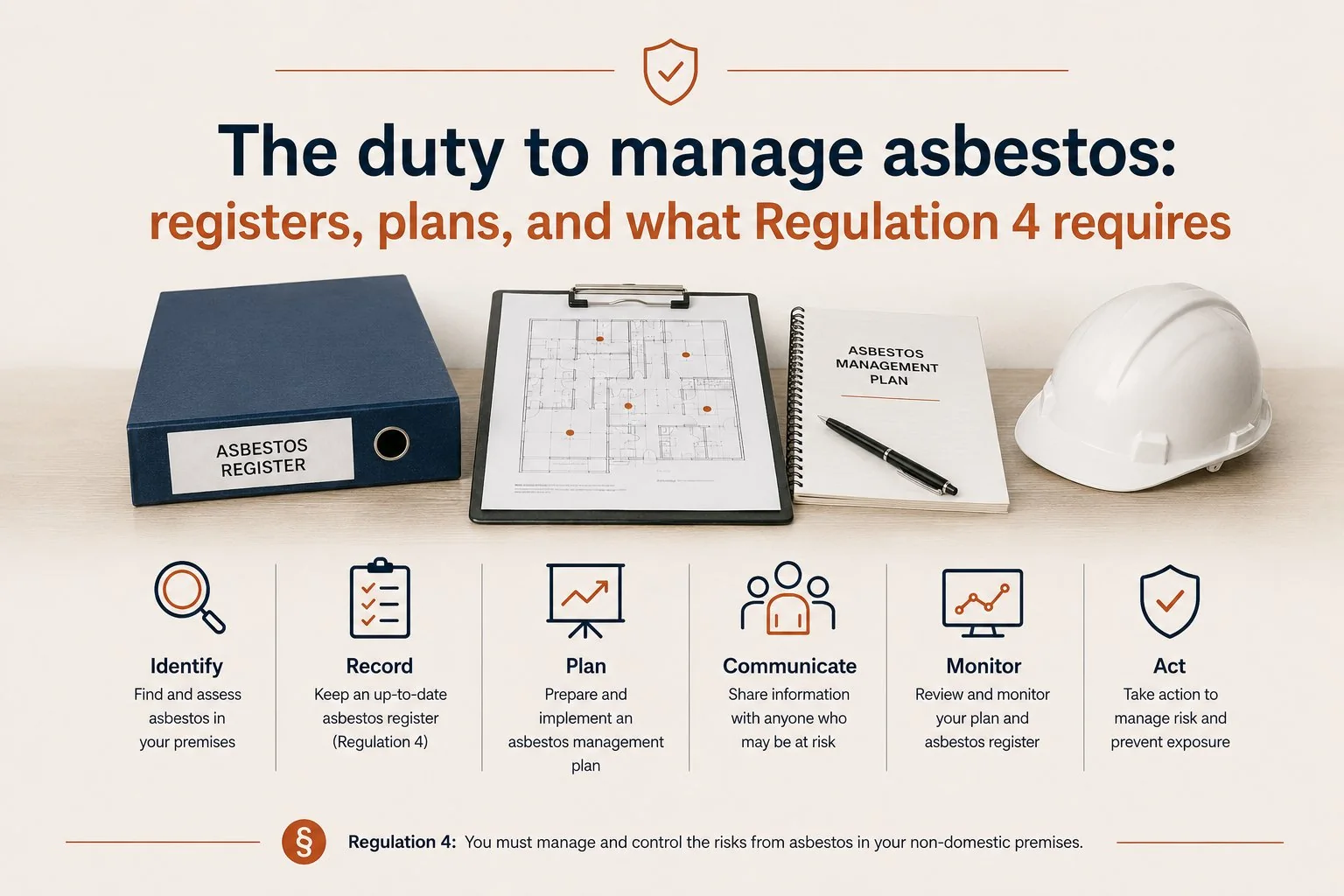
- The duty to manage asbestos in non-domestic premises (Regulation 4) — the ongoing responsibility on whoever has control of a building to identify what asbestos is present, record it, assess the risk, and manage it safely.
- The duty to identify asbestos before any work that might disturb it (Regulation 5) — the responsibility on the employer of the people doing the work to find out what's there before they start.
- The duty to train anyone who could foreseeably be exposed to asbestos in their work (Regulation 10) — which is where formal asbestos awareness training enters the picture.
- The duty to control exposure where asbestos work is going to happen (Regulations 6 through 22) — covering risk assessment, control measures, RPE, medical surveillance, and disposal.
Two further pieces of regulation sit alongside CAR 2012: the Construction (Design and Management) Regulations 2015 (CDM 2015), which apply to construction projects and feed into asbestos planning, and the Reporting of Injuries, Diseases and Dangerous Occurrences Regulations 2013 (RIDDOR), which require certain asbestos exposure incidents to be reported.
The 1985 and 1999 prohibition regulations are still in force — they're what makes new asbestos imports and supply illegal in the UK. CAR 2012 is what governs the management of the asbestos already in place.
Who needs to be aware
In broad terms, anyone who works in or on UK buildings constructed or substantially refurbished before 2000 should have some level of asbestos awareness. In legal terms, the question is whether the work "could foreseeably disturb the fabric of a building" or supervises work that could.
The standard list of trades the HSE identifies as needing Category A awareness training includes electricians, plumbers, gas engineers, joiners, painters and decorators, plasterers, roofers, demolition workers, heating engineers, telecoms installers, alarm installers, shopfitters, surveyors, facilities staff, caretakers, and site managers — alongside the supervisors of any of these. The test isn't job title; it's the nature of the work.
We have a separate page on who needs asbestos awareness training, with a fuller list of trades and the practical question of how to decide whether your role is in scope.
The three categories of training
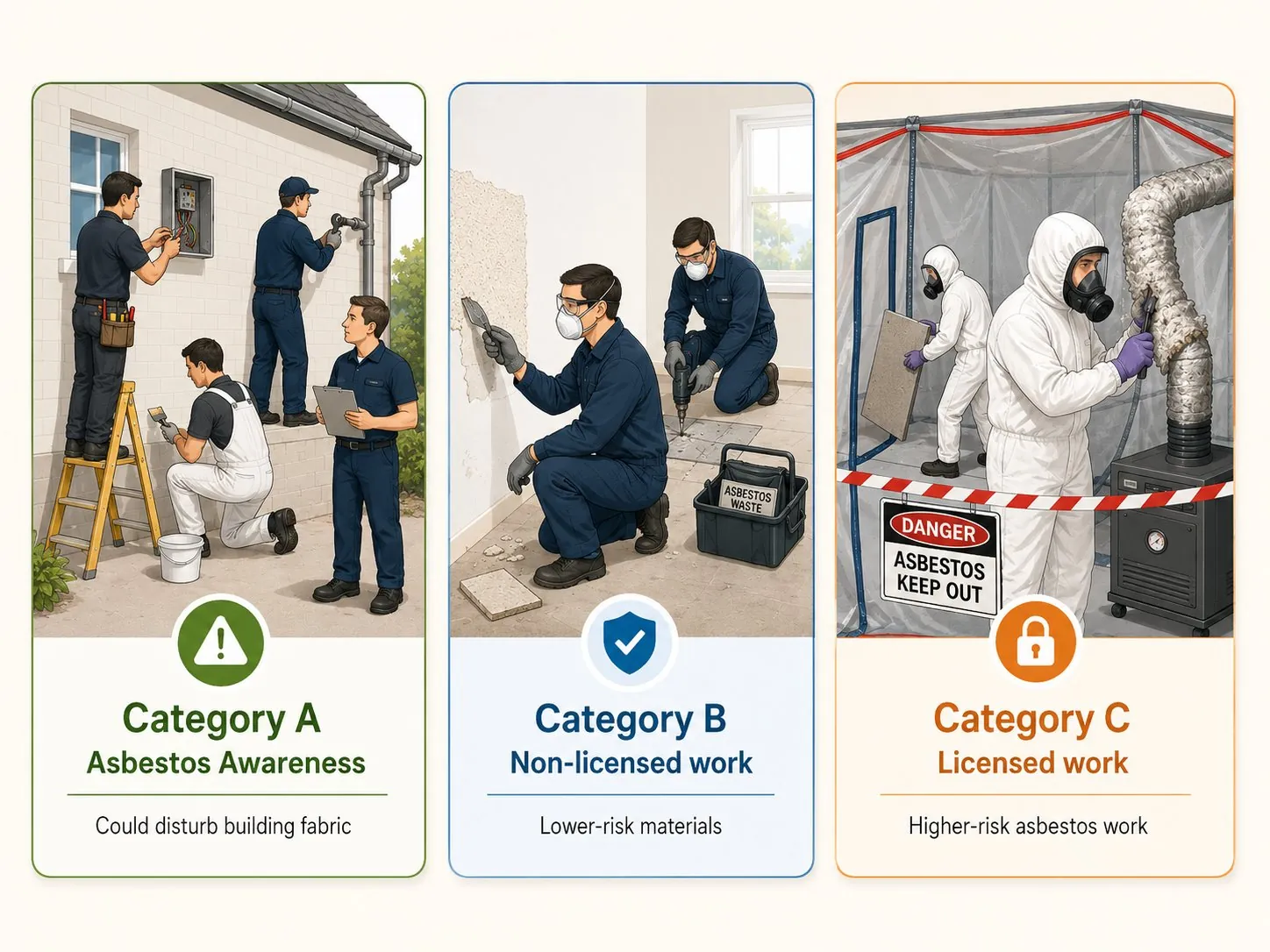
Asbestos training is structured as three tiers, set out in L143 and reflected in HSE guidance. Each tier corresponds to a different level of intended interaction with asbestos:
- Category A — Awareness. For workers who might encounter asbestos but won't deliberately disturb it. Covers recognition of ACMs, the risks, the regulations, and what to do if you find asbestos.
- Category B — Non-licensed work. For workers who will deliberately disturb lower-risk asbestos materials. Covers safe work practices, control measures, PPE, and waste handling for non-licensed and NNLW work.
- Category C — Licensed work. For workers carrying out higher-risk asbestos removal. The full syllabus for licensed asbestos work, including practical assessment.
The most important distinction is between A and B. Category A is awareness only — it doesn't qualify anyone to remove, repair, or otherwise work on asbestos. If the work involves deliberately disturbing asbestos — drilling, cutting, lifting, scraping, removing — Category B is the minimum, and Category C is required for the highest-risk materials.
A second distinction worth being clear about: Category A is the level most often delivered online, and the HSE recognises e-learning as a valid delivery method provided the course meets the L143 syllabus. Category B and C are typically delivered in-person with practical assessment.
What asbestos awareness training does NOT do
This is worth its own paragraph because it's the single most common misunderstanding in the topic.
Category A asbestos awareness training equips workers to recognise asbestos-containing materials, understand the risks, and avoid disturbing what they shouldn't. It does not qualify anyone to work with asbestos. A worker with Category A training who finds an asbestos cement sheet should leave it alone, report it, and let appropriately trained or licensed personnel deal with it — not drill through it because they now feel informed.
The framing the HSE uses for awareness training is "the information workers need to avoid work that may disturb asbestos." If avoidance isn't possible — because the work plan involves deliberately disturbing the material — the worker needs a higher tier of training.
Common asbestos materials worth being aware of
.webp)
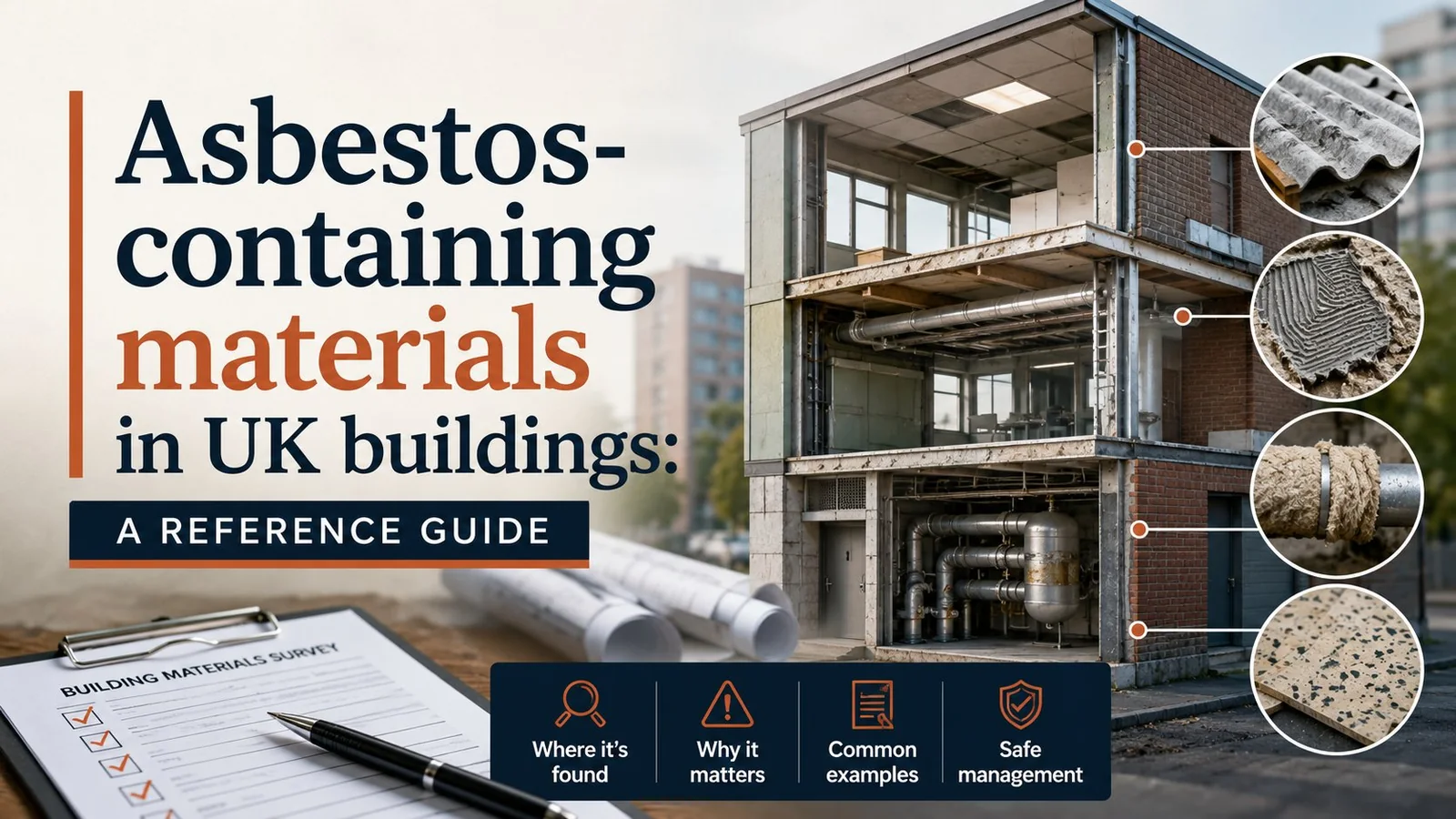
The asbestos you're most likely to encounter in a UK building isn't raw fibre or anything that screams "danger". It's ordinary-looking building materials made with chrysotile, amosite, or (less commonly) crocidolite mixed into the matrix. The main categories are:
- Asbestos cement — corrugated roof sheets, garage roofs, downpipes, gutters, soil pipes, cold water tanks, flues. Grey, sometimes painted, often weathered. Generally non-friable and low-risk while undisturbed.
- Asbestos insulating board (AIB) — ceiling tiles, wall panels, fire-door linings, soffit panels, service riser cupboards. Off-white or grey fibrous board, sometimes hard to distinguish from modern plasterboard or gypsum board. Moderately friable.
- Pipe lagging and thermal insulation — wrapped around heating and steam pipes, around boilers and calorifiers. White or grey crusty material, often painted. Highly friable; nearly always licensed work to disturb.
- Sprayed coatings — applied to structural steel and ceilings for fire protection. Textured, popcorn-like, fibrous. Highly friable; licensed work.
- Floor tiles and floor coverings — 9-inch vinyl and thermoplastic tiles, mastic adhesives, paper backings. Non-friable in good condition but with two separate hazard layers (tile and glue).
- Textured coatings (Artex and similar) — swirled or stippled ceiling and wall finishes from the 1960s through 1980s. Low fibre release when intact, higher when sanded or scraped.
- Rope seals, gaskets, and asbestos paper — in stoves, ovens, boilers, around pipes, behind electrical equipment. Mid-friability.
- Loose-fill insulation — in lofts and cavity walls, usually amosite. Highest fibre release potential of any asbestos material.
We've got a visual reference page for what each of these materials looks like, and a fuller encyclopaedic guide to all the asbestos-containing materials you'll find in UK buildings. For the specific case of floor tiles, which are the most-asked-about single material, see our guide to recognising asbestos floor tiles.
Recognising the limits of visual identification
Throughout this site, you'll see the same caveat repeated: visual inspection can raise suspicion but cannot confirm asbestos. There's a reason for that.
Asbestos fibres are microscopic — far smaller than the human eye can resolve. The materials that contain asbestos were designed to look like ordinary building products. A 1970s asbestos cement roof sheet looks identical to a non-asbestos fibre cement sheet from the same era. A chrysotile-containing Artex ceiling looks identical to one without. The only reliable identification method is laboratory analysis, typically polarised light microscopy on a physical sample at a UKAS-accredited laboratory.
This matters because it shapes the right behaviour. If you can't tell by looking, and you're working in a pre-2000 UK building, the safe default is to presume asbestos is present unless you have evidence it isn't. The HSE's working principle for duty holders is exactly that: presume, manage, test if you need to know for certain.
For the six different asbestos minerals — chrysotile, amosite, crocidolite, and the three rarer types — see our guide to the types of asbestos and how they differ.
What to do if you find or disturb asbestos
.webp)
The steps are the same whether you've identified suspect material or accidentally disturbed something:
- Stop work immediately. Don't try to clean up. Don't move material around.
- Leave the area. Take anyone else with you.
- Close doors and windows behind you to limit fibre spread.
- Don't brush off your clothes. Asbestos fibres on fabric should be removed by wet-wiping with a damp cloth, using a gentle patting action — never dry-brushed.
- Tell someone. The supervisor, the duty holder, the building owner — depending on the setting.
- Get the material tested before any further work near it.
- If you may have been exposed, see your GP and ask for the exposure to be recorded on your medical history.
Detailed step-by-step guidance is on our what to do if you've been exposed to asbestos page.
How often is refresher training actually required?
This deserves its own section because it's the single most-misunderstood part of the regulation.
The HSE position, set out clearly on the HSE training page, is that there is no legal requirement to repeat an entire formal asbestos awareness refresher training course every 12 months. The legal duty under Regulation 10 is that training is "given at regular intervals" and is "adapted to take account of significant changes" in the work — but Regulation 10 doesn't specify a 12-month or any other fixed interval.
Many training providers issue certificates that expire after 12 months. That's a provider convention, not a legal requirement. The expiry of a certificate doesn't trigger an automatic legal need for full retraining; it's a prompt to consider whether refresher input is needed.
In practice, a sensible approach for most employers is to:
- Provide full Category A training for every new starter
- Provide an annual refresher — which can be a short e-learning update, a toolbox talk, or an in-house briefing
- Repeat full training every two to three years, or sooner if there are significant changes in the work
This approach satisfies Regulation 10 comfortably without the unnecessary cost and disruption of annual full retraining for a workforce whose knowledge hasn't materially changed.
Frequently asked questions
What is the difference between asbestos awareness and an asbestos awareness course?
Asbestos awareness is the concept — the knowledge that workers and supervisors need to operate safely in environments where asbestos may be present. An asbestos awareness course is the formal training that delivers this knowledge, typically as a Category A course meeting the L143 syllabus.
Does asbestos awareness training qualify me to work with asbestos?
No. Category A training is for avoiding asbestos disturbance, not for working with asbestos. If your work will deliberately disturb asbestos materials, you need Category B (non-licensed work) or Category C (licensed work) training instead.
How long does asbestos awareness training take?
A typical Category A online course runs between 90 minutes and three hours. In-person delivery for Category A is usually half a day.
Is online asbestos awareness training accepted by employers?
Yes, where it's delivered by an accredited provider and meets the L143 syllabus. The HSE explicitly recognises e-learning as a valid delivery method for Category A.
Do I need annual refresher training?
There's no specific legal requirement for annual refresher training. The duty is for adequate training at regular intervals — which many employers reasonably interpret as annual refreshers, but isn't a fixed legal frequency.
Who pays for asbestos awareness training — the employer or the worker?
The employer. Regulation 10 places the duty on the employer to provide adequate training to employees. The worker shouldn't be expected to pay for legally-required training out of their own pocket. Self-employed workers, however, must arrange and pay for their own training.
Can I do the training in my own time, online?
Many workers do, particularly self-employed sole traders. The duty under Regulation 10 doesn't dictate when or where training happens, only that it's provided and is adequate.
What's covered in a Category A course?
The L143 syllabus covers: the properties of asbestos and its effects on health (including the increased lung-cancer risk for smokers); the types, uses, and likely occurrence of asbestos in buildings and plant; the general procedures to follow in an emergency such as accidental release of asbestos dust; and the basic legal framework.
Does asbestos awareness training need to be face-to-face?
No, not for Category A. Online delivery is accepted by the HSE. Higher categories (B and C) typically involve in-person elements.
Do small employers have to provide training too?
Yes. The duty under Regulation 10 doesn't have a size threshold. A two-person electrical firm has the same training duty for both workers as a larger business.
The core of asbestos awareness is straightforward: in any pre-2000 UK building, presume asbestos is present unless evidence shows otherwise, work in a way that doesn't disturb it, and call for the right help if you find or disturb something suspect. The regulations and the training requirements all come back to those principles.
For workers, supervisors, and employers who need to meet the Regulation 10 training duty, our UKATA-approved Asbestos Awareness Course delivers the L143 syllabus online, with certification on completion. The course is suitable for the trades listed above — and for anyone whose work could foreseeably bring them into contact with asbestos in a UK building.
The HSE provides comprehensive official guidance on asbestos including the survey guide HSG264, the licensed contractors' guide HSG247, and the Approved Code of Practice L143 referenced throughout this guide.