
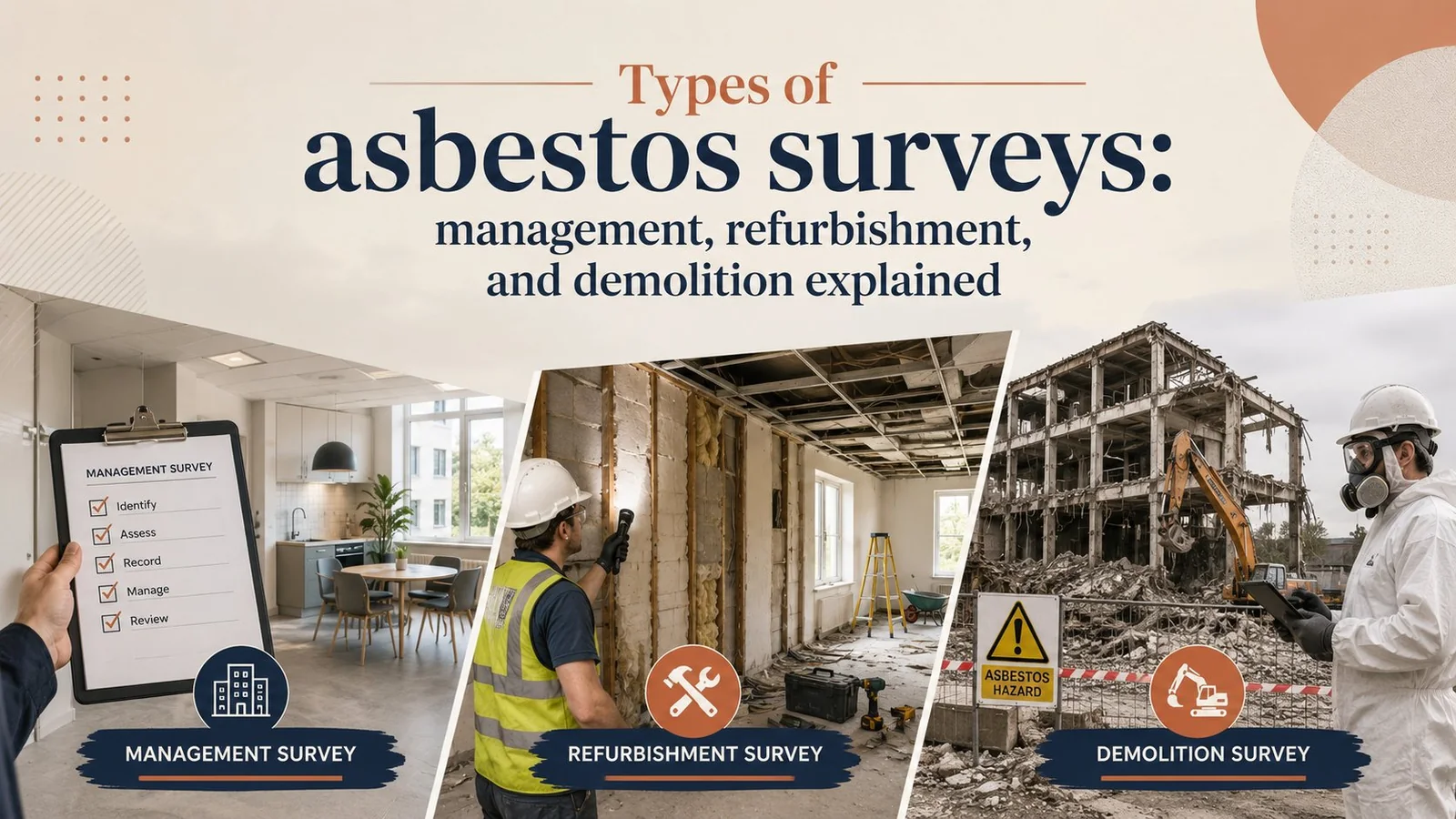
There are two types of asbestos survey recognised under current UK guidance. A management survey is the standard survey used to identify and record asbestos materials in a building that’s in normal occupation. A refurbishment and demolition survey is the more intrusive survey carried out before any building work that could disturb the fabric. Choosing the wrong type — or, more often, trying to start refurbishment work on the basis of a management survey alone — is one of the most common compliance failures in the UK asbestos system.
This page explains what each survey type involves, when the law actually requires each, who can carry them out, and what to look for in a good survey report. It’s informational rather than commercial; the site doesn’t sell surveys.
Why HSG264 retired the old Type 1/2/3 terminology
If you’ve worked with asbestos surveys before about 2010, you may remember the old “Type 1”, “Type 2”, and “Type 3” survey labels. These were the categories defined under the previous MDHS100 guidance: Type 1 was a non-intrusive presumption survey, Type 2 added sampling, Type 3 was a fully intrusive pre-demolition survey.
In January 2010, the HSE published HSG264 — “Asbestos: The survey guide” — which retired the numbered system. The replacement framework has just two survey types:
- Management survey (which subsumed the old Types 1 and 2)
- Refurbishment and demolition survey (which replaced Type 3)
This change matters because some training material, some consultant marketing, and some older survey reports still use the legacy Type 1/2/3 labels. They’re not wrong as descriptions, but they don’t reflect current guidance. A surveyor offering a “Type 2 survey” today is using terminology that hasn’t been current for over fifteen years — not necessarily a competence issue, but a signal worth noticing.
The management survey
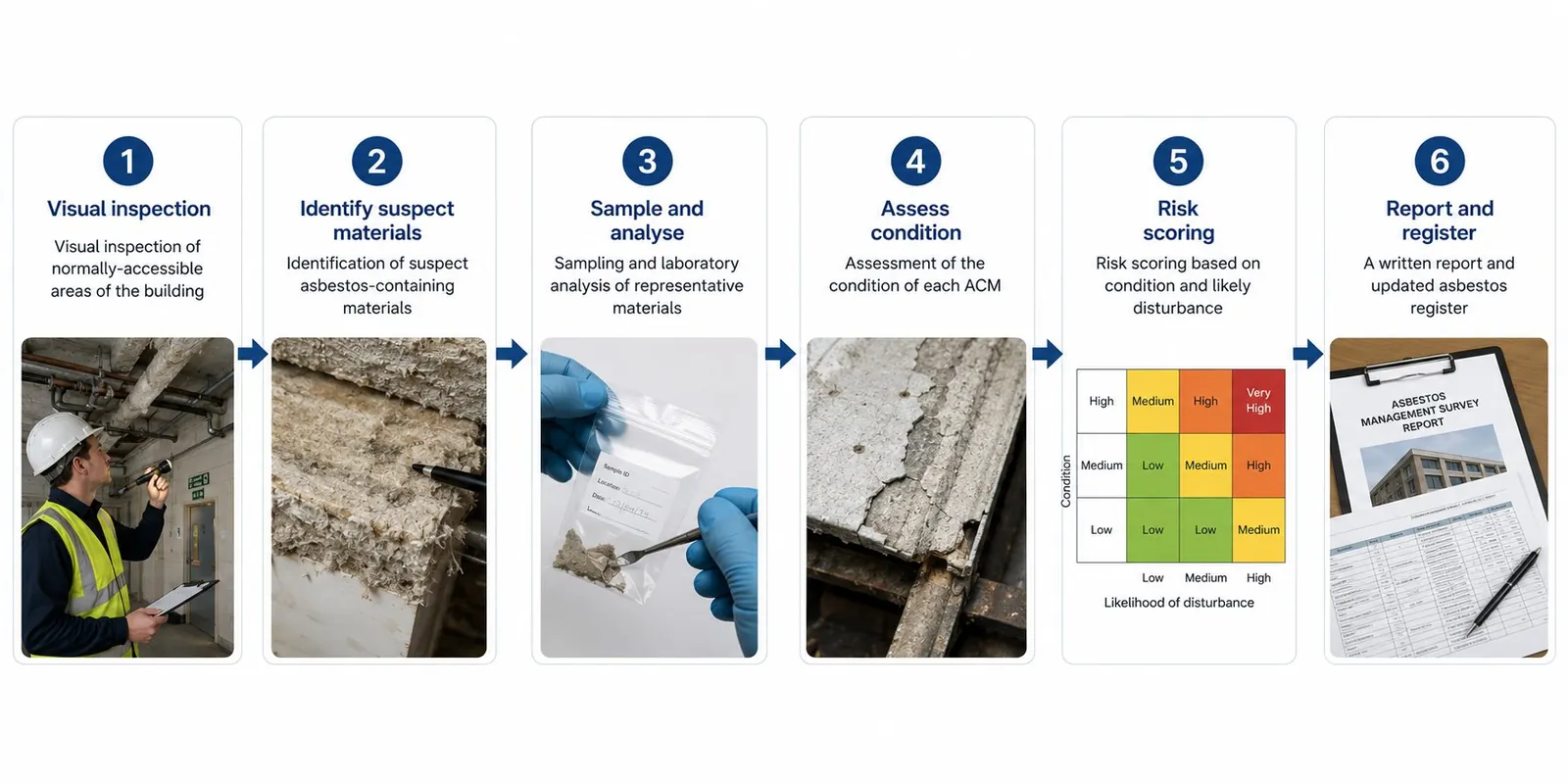
A management survey is the standard asbestos survey for a building in normal use. Its purpose is to locate, identify, and record asbestos materials that could be disturbed during routine occupancy and foreseeable maintenance.
What it includes:
- Visual inspection of normally-accessible areas of the building
- Identification of suspect asbestos-containing materials
- Sampling and laboratory analysis of representative materials
- Assessment of the condition of each ACM
- Risk scoring based on condition and likely disturbance
- A written report and updated asbestos register
Level of intrusion:
Limited. The surveyor will lift ceiling tiles, open access panels, look behind boilers and into airing cupboards, and inspect plant rooms — but they won’t drill into walls, lift floors, or break into sealed structural elements. Areas that can’t be safely accessed without damage are presumed to contain asbestos and recorded as such.
Sampling approach:
Representative sampling of suspect materials. The surveyor doesn’t sample every individual tile or panel; they sample enough to establish what the material is, then apply that finding to similar materials elsewhere in the building.
When it’s needed:
To support compliance with the duty to manage under Regulation 4 of the Control of Asbestos Regulations 2012. Most non-domestic premises built before 2000 should have a current management survey on record. The survey itself doesn’t need to be repeated every year — the asbestos register it produces is the document that gets updated through ongoing re-inspection.
Who commissions it:
The duty holder for the premises — typically the building owner, the tenant under an FRI lease, or the managing agent with responsibility for repair and maintenance. See our guide to the duty to manage asbestos for who counts as the duty holder.
The refurbishment and demolition survey
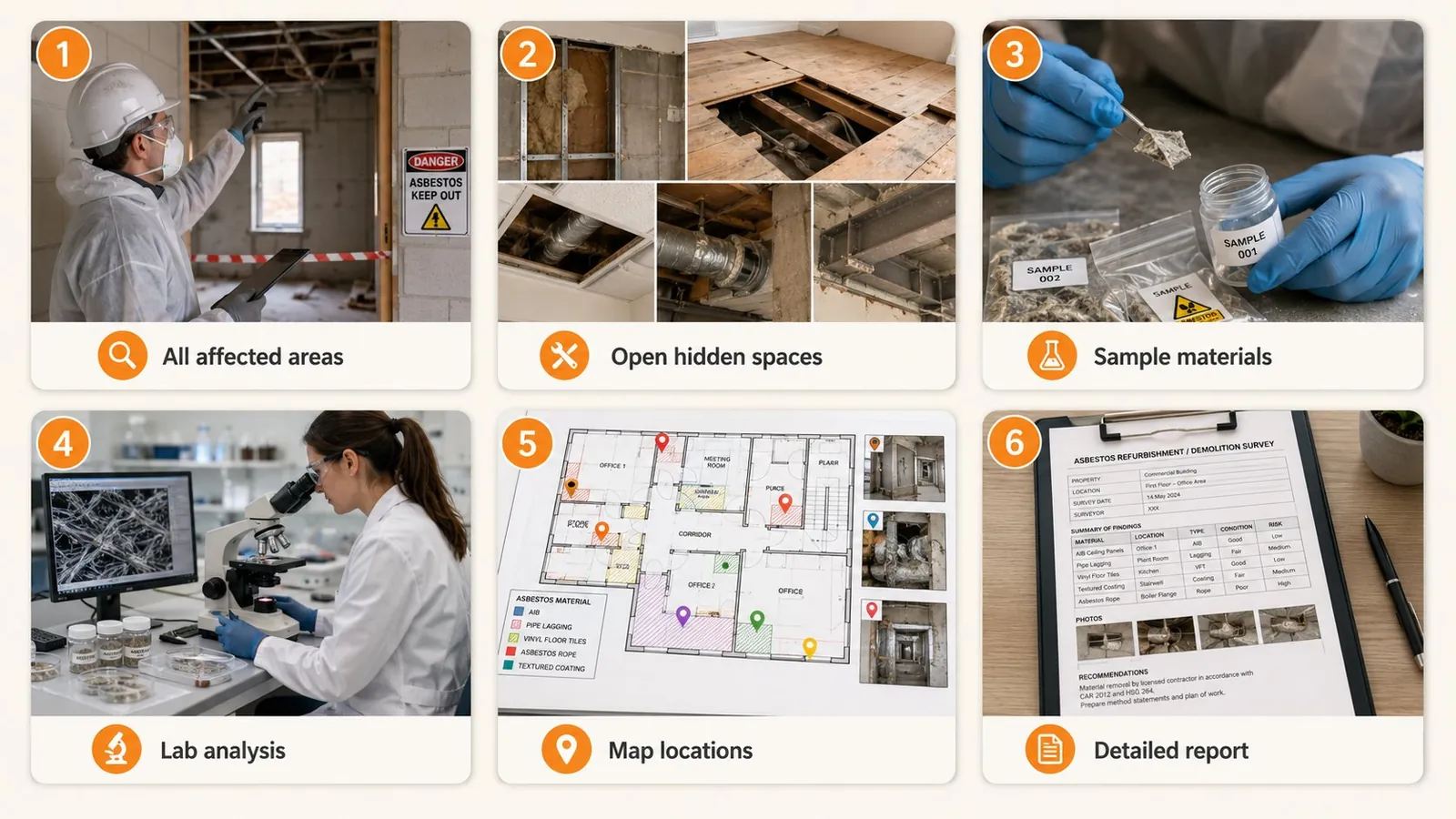
A refurbishment and demolition survey is what’s required before any work that could disturb the fabric of a building. It’s fully intrusive, destructive where necessary, and covers areas that a management survey wouldn’t.
What it includes:
- Full intrusive inspection of all areas affected by the planned work
- Destructive investigation of cavity walls, floor voids, ceiling spaces, service ducts, and structural elements
- Comprehensive sampling of all suspect materials
- Laboratory analysis to confirm or rule out asbestos content
- Detailed mapping of locations to allow safe removal planning
- A written report with sufficient detail to inform a removal contractor’s method statement
Level of intrusion:
Full and destructive. The surveyor breaks into the building to find what’s there. Ceilings come down. Wall linings come off. Floor coverings come up. The survey itself causes localised damage, which is why it’s normally only carried out on unoccupied premises or in areas that have been cleared for the work.
Sampling approach:
Comprehensive within the work area. Where a management survey samples representatively, a refurbishment survey samples thoroughly — including hidden materials that wouldn’t otherwise have been accessible.
When it’s needed:
Before any work that could disturb the building fabric in a pre-2000 building. This includes:
- Major refurbishment or fit-out work
- Demolition (full or partial)
- Structural alterations
- Strip-out before re-letting
- Some service replacement work that involves intrusive access
Carrying out refurbishment work on the basis of only a management survey is a common cause of HSE prosecution. The management survey wasn’t designed for that purpose, and the contractor relying on it doesn’t have the information they need to work safely.
Who commissions it:
Normally the client for the refurbishment work — the building owner, the developer, or the contractor with overall responsibility for the project under CDM 2015. The duty under Regulation 5 of the Control of Asbestos Regulations 2012 is on the employer of the workers who will carry out the work, but in practice the survey is commissioned upstream by the project client.
Comparison: management vs refurbishment/demolition survey
The two survey types compared across the points that matter in practice:
- Purpose. Management survey supports the ongoing duty to manage under Reg 4. Refurbishment/demolition survey is required before work that could disturb the fabric under Reg 5.
- Intrusion. Management survey is limited and non-destructive. Refurbishment/demolition survey is full and destructive where needed.
- Areas covered. Management survey covers normally-accessible parts of the building. Refurbishment/demolition survey covers all areas affected by the planned work.
- Sampling. Management survey uses representative sampling. Refurbishment/demolition survey uses comprehensive sampling.
- Building status. Management survey is carried out during normal occupation. Refurbishment/demolition survey usually requires the work area to be vacated.
- Output. Management survey feeds the asbestos register and management plan. Refurbishment/demolition survey produces a detailed map for removal planning.
- Frequency. Management survey is done once, then maintained through re-inspection. Refurbishment/demolition survey is done once per project.
- Old name (pre-2010). Management survey was Type 1 or Type 2. Refurbishment/demolition survey was Type 3.
Re-inspection — not a third survey type
A common point of confusion is the re-inspection that follows a management survey. This isn’t a third survey type; it’s the ongoing management activity required to keep the register current.
Re-inspection involves a competent person revisiting the materials identified in the original management survey, assessing whether their condition has changed, and updating the register accordingly. It doesn’t normally involve new sampling unless there’s a change that warrants it — a damaged material that needs re-categorisation, for example.
The frequency of re-inspection is risk-based rather than set by a fixed calendar. Materials in stable condition in low-disturbance locations may need only periodic checks. Materials in poor condition or in high-traffic areas need more frequent attention. The HSE guidance is that the duty holder should determine the schedule based on the risk assessment in the management plan.
Who is qualified to carry out an asbestos survey
The Control of Asbestos Regulations 2012 require the surveyor to be competent. Competence is demonstrated through a combination of training, qualifications, and experience.
The main UK qualifications and accreditations:
- BOHS P402 — the standard individual qualification for asbestos surveyors. Sets out the competence required to plan and carry out asbestos surveys. The BOHS exam is the most widely recognised individual credential for UK asbestos surveying.
- BOHS P404 — the analytical qualification for laboratory analysts working on asbestos samples.
- UKAS accreditation to BS EN ISO/IEC 17020 — the organisational standard for inspection bodies. A surveying company accredited to this standard has demonstrated systematic quality assurance for its survey work.
- UKAS accreditation to BS EN ISO/IEC 17025 — the organisational standard for testing and calibration laboratories. The laboratory analysing the samples should hold this accreditation.
- ABICS — the Asbestos Building Inspectors Certification Scheme, an individual certification scheme aligned with HSG264 competence requirements.
For most non-domestic premises, the appropriate combination is a surveyor with BOHS P402 or equivalent, working for an organisation with UKAS 17020 accreditation, using a laboratory with UKAS 17025 accreditation. This is the standard expected by competent buyers of survey services.
What a good survey report contains
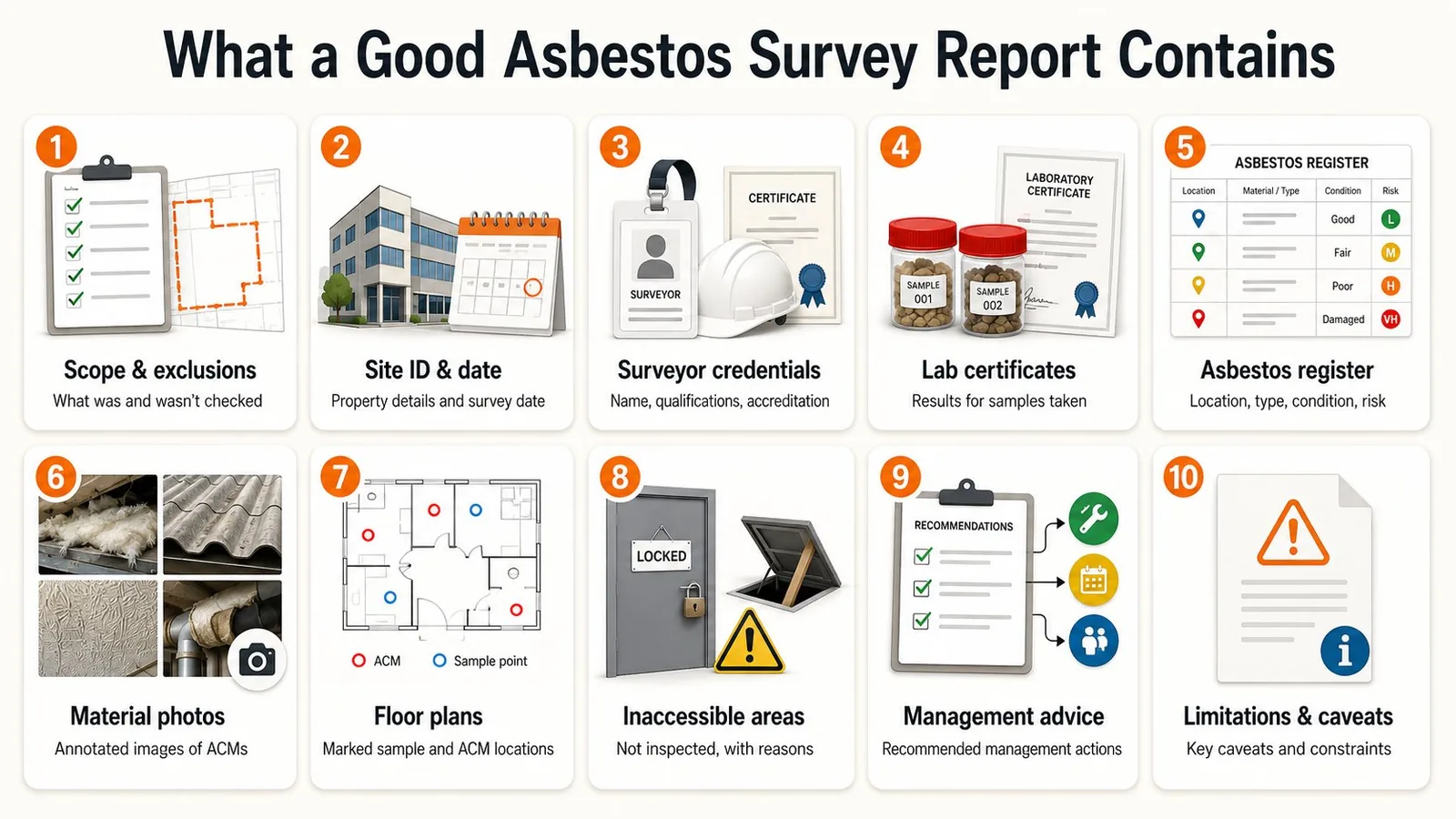
A competent asbestos survey report should include:
- A clear scope statement — what was surveyed and what wasn’t, and why
- Full site identification and survey date
- Surveyor name, qualifications, and accreditation
- Laboratory analysis certificates for all samples taken
- A complete asbestos register output, with location, material type, asbestos type, condition, and risk rating
- Photographs of identified materials, ideally annotated
- Building plans or floor plans showing sample and ACM locations
- A list of areas that couldn’t be accessed and the reason, with presumed-asbestos status applied
- Recommendations for management of each material
- Limitations and caveats
For a refurbishment and demolition survey, the report should also include the destructive access carried out, the work-area boundaries, and detail sufficient for a removal contractor to plan the work.
A report that doesn’t include sample analysis certificates, doesn’t identify the surveyor by name, or doesn’t state the limitations of the survey scope is incomplete. Don’t accept it without those elements.
Approximate costs

Survey pricing varies significantly with the size and complexity of the building, the level of intrusion required, and the geographic location. As broad informational guidance only:
- A management survey on a small commercial unit (under 200 square metres) typically runs in the range of a few hundred pounds
- A management survey on a larger commercial building runs into the low thousands depending on size and complexity
- A refurbishment and demolition survey costs more than a management survey of the same building — typically two to three times the management survey price, sometimes more — because of the additional intrusion, sampling, and report detail
These figures are illustrative only. Real quotes vary widely between providers and locations, and the cheapest survey isn’t always the most useful one. A thorough survey from a competent surveyor is what discharges the duty under CAR 2012; a cheap survey that misses materials creates liability rather than reducing it.
When do you legally need a survey?
The legal triggers map onto the regulatory framework:
- Regulation 4 (duty to manage) — every non-domestic premises and the common parts of blocks of flats should have current information about asbestos. A management survey is the standard way to obtain this.
- Regulation 5 (identification before work) — any work that could disturb asbestos requires the asbestos to be identified first. A refurbishment and demolition survey is what discharges this duty for projects that will disturb the building fabric.
- CDM 2015 — for construction projects, the principal designer and client have duties around pre-construction information, which includes asbestos information.
- CAR 2012 Regulation 6 — the written risk assessment for asbestos work requires identification of the type and condition of asbestos, which is what the relevant survey provides.
If you’re planning any work in a pre-2000 building that could touch the structure, plumbing, electrical wiring, ceilings, or floors, you need an asbestos survey of the right type before starting. Doing the work first and surveying after is not an option under UK law.
Frequently asked questions
How long does an asbestos survey take?
A management survey on a small commercial unit typically takes half a day to a day. A refurbishment and demolition survey takes longer, often spread over multiple days, because of the destructive access. Lab analysis adds a few working days after the on-site work.
Do I need a management survey if my building is empty?
Yes, if you’re maintaining ownership and the duty to manage applies. An empty building still has a duty holder, and asbestos in an unoccupied building still needs to be identified and managed. If you’re about to refurbish or demolish, you need a refurbishment and demolition survey instead.
What’s the difference between a management survey and a refurbishment survey?
Intrusion. A management survey is non-destructive — it inspects what can be seen without breaking into the building. A refurbishment and demolition survey is fully intrusive — ceilings, walls, and floors are opened up to find hidden asbestos. The two are not interchangeable: a management survey doesn’t tell you what’s in the cavity walls or under the floors.
Can I survey my own property?
The duty under CAR 2012 doesn’t prohibit a competent person carrying out their own survey, but “competent” is a high bar. For domestic property outside CAR scope, there’s no legal requirement to commission a survey at all — but if you want reliable identification, the qualifications, equipment, and laboratory access of a competent surveyor are difficult to replicate.
How often does an asbestos register need to be reviewed?
The register itself should be reviewed at least annually as part of the broader management plan review. The condition of individual materials should be re-inspected on a schedule that reflects their risk — anywhere from 6 months to 2-3 years depending on condition and location.
What qualifications should an asbestos surveyor have?
For an individual, BOHS P402 is the standard UK qualification. For the surveying organisation, UKAS accreditation to ISO/IEC 17020 demonstrates systematic competence. The laboratory analysing the samples should hold UKAS accreditation to ISO/IEC 17025.
For the legal duties that surveys support, see our guide to the duty to manage asbestos under Regulation 4 and the wider Control of Asbestos Regulations 2012 framework. For the materials that surveys are designed to find, see our reference guide to asbestos-containing materials in UK buildings.
For employers and supervisors who need to meet the Regulation 10 training duty for workers whose work in pre-2000 buildings could disturb asbestos identified in a survey, our CPD-accredited Asbestos Awareness Course covers the syllabus required under the Approved Code of Practice L143.
Related guides
- The duty to manage asbestos: registers, plans, and what Regulation 4 requires
- Asbestos-containing materials in UK buildings: a reference guide
- The Control of Asbestos Regulations 2012
Make sure your team meets the Regulation 10 training duty.
Explore the Asbestos Awareness Course →
Mark writes about workplace health & safety, asbestos awareness and accredited online training for Asbestos Awareness Course, part of Online CPD Academy.