
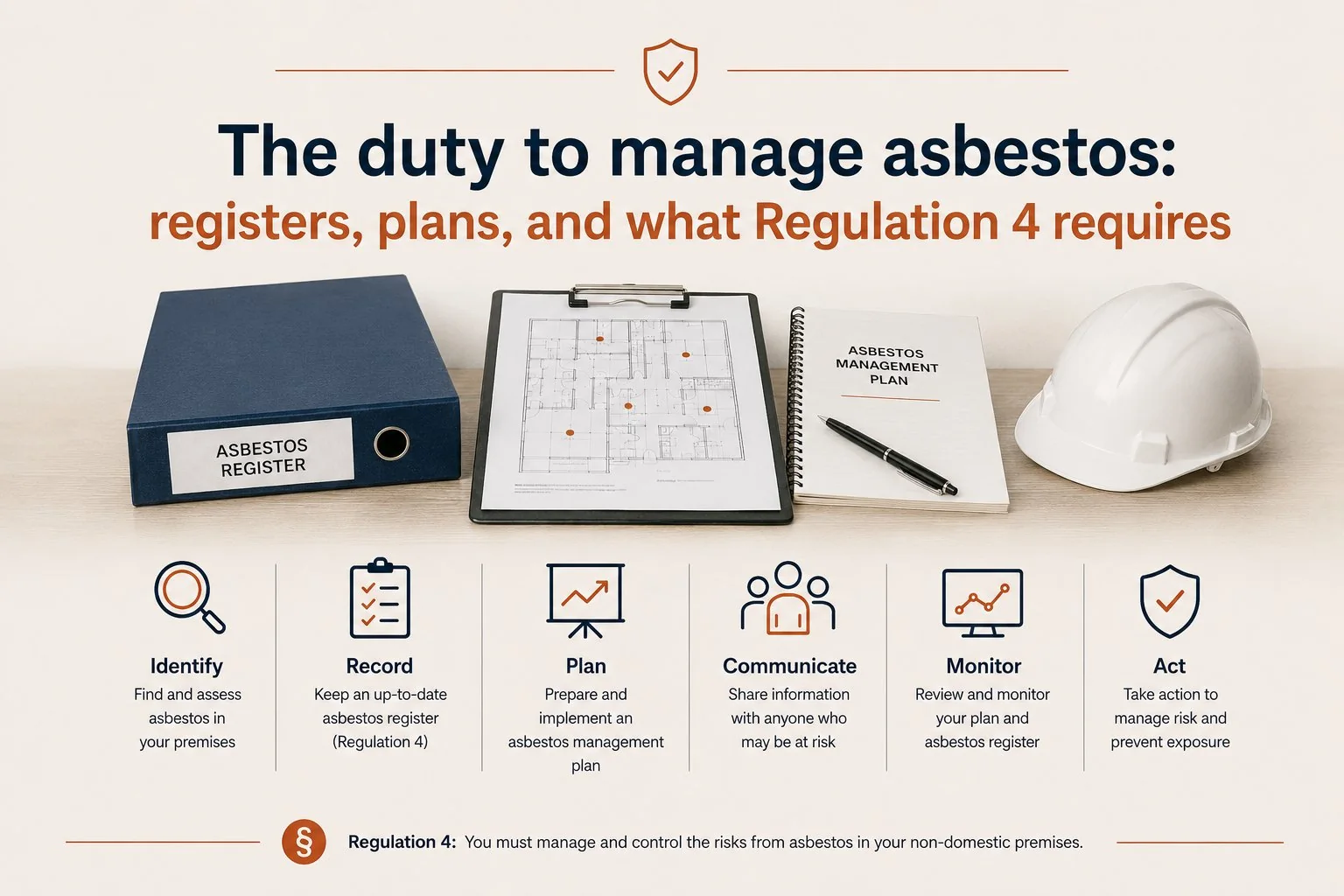
The duty to manage is the foundation of the modern UK asbestos regime. It places a positive responsibility on whoever has control of a non-domestic building to find the asbestos in it, record what's there, assess the risk, plan how to manage it, and tell anyone who might disturb it. The duty is set out in Regulation 4 of the Control of Asbestos Regulations 2012, and breaching it is a criminal offence.
This page covers who counts as a duty holder, what the asbestos register and management plan are supposed to contain, how often re-inspection should happen, and what the practical compliance pattern looks like in a small commercial premises or a block of flats.
What "duty to manage" means in plain English
The text of Regulation 4 is dense. The plain-English version is simpler: if you have control of a non-domestic premises, the law requires you to actively manage the risk from any asbestos materials that may be in it.
"Actively manage" breaks down into five things you have to do:
- Find out whether asbestos is present — through survey, existing records, or by reasonable enquiry
- Presume that materials contain asbestos unless evidence shows otherwise
- Record what's there in an asbestos register
- Assess the risk that anyone could be exposed
- Plan how the risks will be managed — through a written asbestos management plan
These five duties run in parallel with the duty to make sure anyone liable to disturb the asbestos (employees, contractors, visitors carrying out work) is properly informed about it.
The duty doesn't normally require removal. The default UK position is that asbestos in good condition, in a stable location, can stay where it is — provided it's recorded, the risk is assessed, and the management plan accounts for it.
Who is the duty holder?
This is the question that catches most building owners and tenants. The legal definition is:
Every person who has, by virtue of a contract or tenancy, an obligation of any extent in relation to the maintenance or repair of non-domestic premises or any means of access or egress to or from those premises.
In practice this means the duty holder is whoever is responsible for the maintenance or repair of the building. The exact identity depends on the contractual arrangements:
- In a building you own and occupy — you are the duty holder
- In a fully-repairing-and-insuring (FRI) lease — the tenant is normally the duty holder
- In a simple occupational lease where the landlord retains repair obligations — the landlord is the duty holder
- Where a managing agent has been contractually assigned maintenance duties — the managing agent is the duty holder
- In a block of flats with a residents' management company — the RMC is normally the duty holder for the common parts
- Where responsibility is split — multiple duty holders may share accountability for different parts of the same building
If you're not sure which category you fall into, look at the lease or contract. The clauses dealing with repair, maintenance, and the structural fabric of the building are usually where the duty sits.
Where there's no clear contract — informal arrangements, family-owned property let to friends, charity premises — the duty falls on whoever effectively has control of the maintenance. The HSE will look at the practical reality, not just the paperwork, in any enforcement action.
There's an important exception. Private domestic premises — houses occupied by their owners — are excluded from Regulation 4. The duty applies to non-domestic premises and to the common parts of domestic premises like the stairwells, lifts, plant rooms, and shared service ducts of blocks of flats. A residents' management company running a block of flats is a duty holder for those common parts even though no individual flat falls within scope.
The five-step compliance pattern
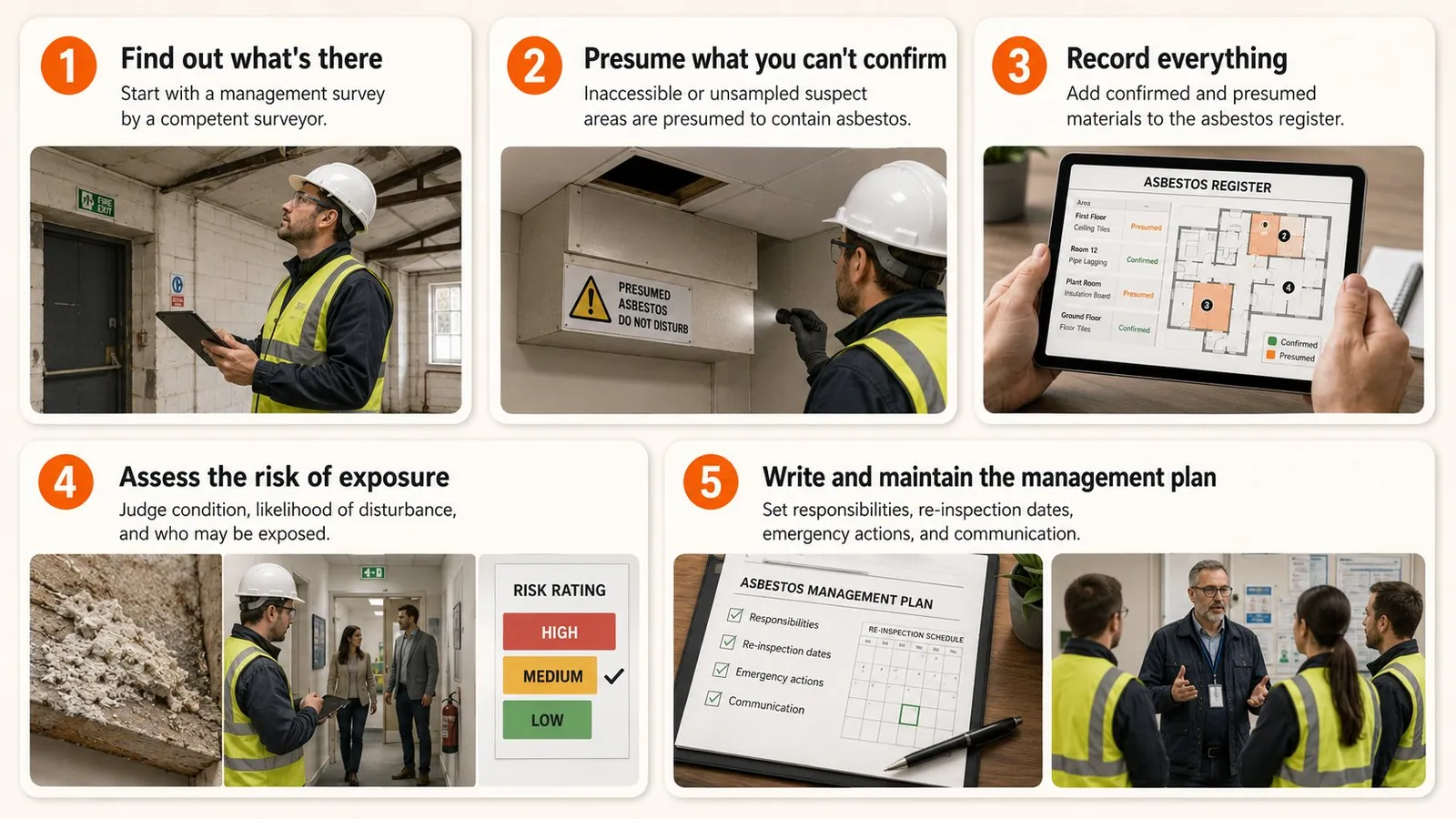
The practical implementation of Regulation 4 follows a sequence that maps onto the legal duties.
Step 1: Find out what's there. The default starting point is a management survey by a competent surveyor following HSG264. The survey identifies, samples, and records all suspect materials in normally-occupied parts of the building. For most non-domestic premises built before 2000, this is the first practical step toward compliance.
Step 2: Presume what you can't confirm. If the survey can't access some parts of the building, those parts are presumed to contain asbestos until evidence shows otherwise. The same applies to materials that look similar to ACMs but weren't sampled — the surveyor presumes rather than guesses.
Step 3: Record everything in the asbestos register. The register is the documented inventory of asbestos and presumed asbestos in the building. It captures location, type, condition, risk rating, and any actions taken.
Step 4: Assess the risk of exposure. For each material, the assessment considers whether it's likely to be disturbed in the normal use of the building, its condition, and who might be exposed. The output is a risk rating that drives the management response.
Step 5: Write and maintain the asbestos management plan. The plan sets out how each material will be managed, who is responsible, how often it will be re-inspected, what the emergency response is if it's disturbed, and how information will be communicated to people who need to know.
The register and the plan together are the documents an HSE inspector or an enforcing local authority officer will ask to see. Having them shows you've discharged the duty; not having them is evidence you haven't.
The asbestos register
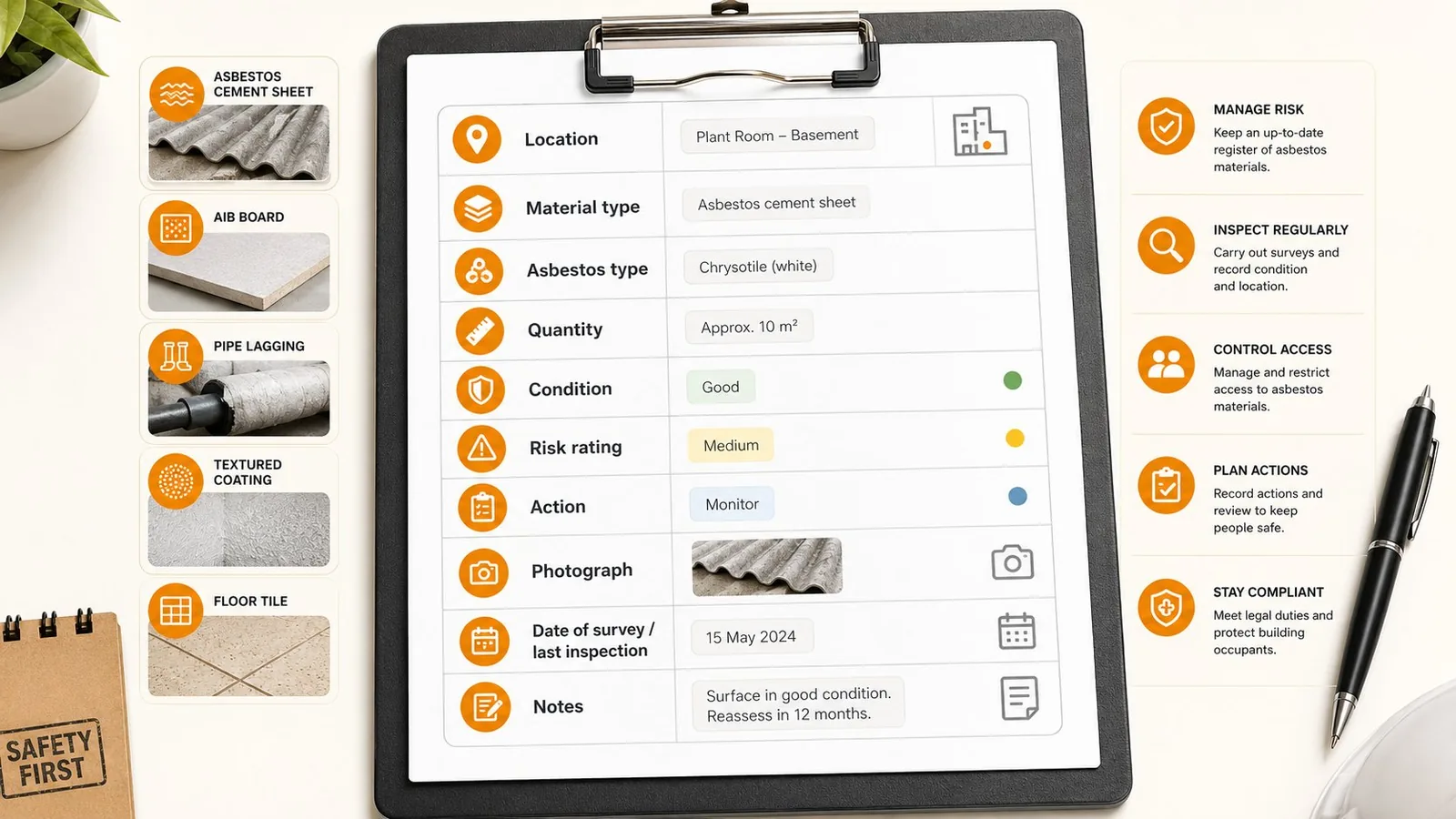
The register doesn't have to follow a specific format. What it has to contain is enough information for someone using the building — particularly a contractor about to start work — to know where the asbestos is and what condition it's in.
A workable asbestos register typically captures:
- Location — building, floor, room, specific position within the room
- Material type — asbestos cement, AIB, lagging, textured coating, floor tile, etc.
- Asbestos type — chrysotile, amosite, crocidolite, or presumed
- Quantity — approximate area or length
- Condition — good, damaged, severely damaged, with a scoring scheme
- Risk rating — typically combining condition with disturbance likelihood
- Action — manage in place, label, encapsulate, remove, monitor
- Photograph — increasingly standard, helpful for re-inspection comparison
- Date of survey or last inspection
- Notes — anything specific about the location or the material
Many duty holders use software to maintain the register; others use a structured spreadsheet. The format doesn't matter; the content does. A register that lives only in someone's head or in a paper file no one can find is no register at all.
The register has to be accessible to anyone who might need it — including contractors before they start work, employees whose work might disturb asbestos, and the HSE if asked.
The asbestos management plan
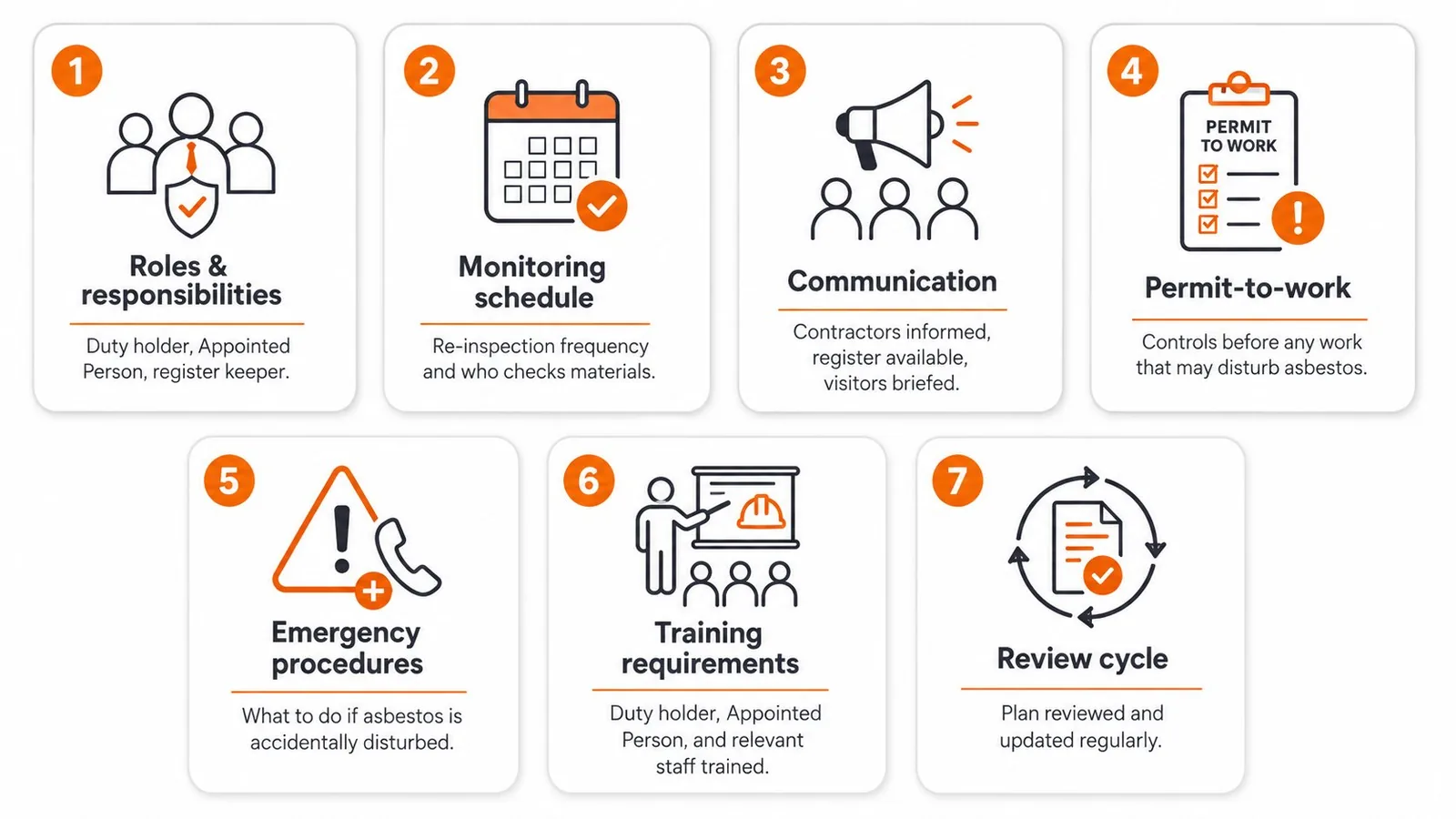
The management plan is the operational document that explains how the register is going to be used. Where the register says "what is there", the management plan says "what we do about it".
A management plan typically covers:
- Roles and responsibilities — who is the duty holder, who is the Appointed Person (the day-to-day manager), who maintains the register
- Monitoring schedule — how often each material is re-inspected and by whom
- Communication arrangements — how contractors are informed, how the register is made available, who briefs visitors
- Permit-to-work systems — for any work that might disturb known asbestos
- Emergency procedures — what to do if asbestos is accidentally disturbed
- Training requirements — what training the duty holder, Appointed Person, and other relevant staff have had
- Review cycle — how often the plan itself is reviewed and updated
The plan should be a living document. It gets updated when materials are removed, when new ACMs are found, when the building is altered, when there's a change in occupancy.
How often to re-inspect
Regulation 4 doesn't specify a fixed re-inspection frequency. What it requires is monitoring of the condition of asbestos materials, with intervals that reflect the risk.
In practice, most duty holders settle on:
- Annual review of the register and management plan as a baseline
- 6-monthly re-inspection for materials in poor condition or in high-disturbance locations
- 2- to 3-year re-inspection for materials in good condition in low-disturbance locations
Materials that are encapsulated, labelled, and stable can be on a longer cycle. Materials that are visibly deteriorating need more frequent attention or immediate action.
The principle is risk-based, not calendar-based. A pre-2000 office where staff and contractors regularly come and go needs more active monitoring than a sealed plant room that's only accessed twice a year for an inspection.
Telling people about the asbestos
A register that no one reads doesn't satisfy Regulation 4. Part of the duty is making sure anyone liable to disturb asbestos is told about it.
This means:
- Contractors must be given access to the relevant part of the register before they start any work that could disturb the building fabric. A site induction that includes the asbestos register is the standard approach.
- Employees whose work could disturb ACMs need to know what's where and what to do about it.
- Visitors carrying out work — surveyors, IT installers, alarm engineers, telecoms contractors — must be briefed at the point of arrival.
- The information must be specific. Telling a contractor "there's asbestos somewhere in the building" doesn't satisfy the duty. The information has to identify the locations and the materials.
A small but important point: contractors have their own duty under Regulation 5 to identify asbestos before work. The duty holder's obligation to inform them and the contractor's obligation to find out for themselves are complementary, not substitutes. Both apply.
Training for duty holders and Appointed Persons
The duty holder and anyone acting as the Appointed Person for day-to-day management need training appropriate to the role. This is not the same as Category A asbestos awareness training for tradespeople — it's a more focused course covering the management duties, the regulations, and the practical pattern of compliance.
UKATA, IATP, and other accredited providers offer specific Duty to Manage and Appointed Person training courses. For smaller premises where the duty holder is also the person operating the management plan day-to-day, this training is the standard route to demonstrating competence.
Workers and supervisors whose work could foreseeably disturb asbestos in the building still need asbestos awareness training under Regulation 10 — that's a separate duty.
What happens if you don't comply
Breaches of Regulation 4 are criminal offences. Conviction on indictment can result in an unlimited fine and imprisonment of up to two years. Local authority and HSE inspectors can issue improvement notices, prohibition notices, and prosecute where compliance is missing or seriously deficient.
The HSE publishes its asbestos prosecutions on its press centre. The pattern across recent cases includes:
- Building owners failing to commission any asbestos survey for premises clearly within scope
- Duty holders failing to inform contractors of known asbestos, leading to accidental exposure
- Managing agents failing to maintain an up-to-date register over multi-year periods
- Schools, NHS bodies, and local authorities prosecuted for systemic management failures
Beyond the criminal penalty, the civil liability picture is significant. Workers who develop asbestos-related disease decades after exposure can bring claims against the duty holders responsible. The latency of mesothelioma and asbestosis means the duty holder paying compensation today may be paying for compliance failures from many years earlier.
Frequently asked questions
Does the duty to manage apply to schools and NHS premises?
Yes. Schools, hospitals, GP surgeries, and other public sector premises are all non-domestic and within scope of Regulation 4. The duty holder is usually the public body responsible for the premises — the local authority, the academy trust, the NHS body, or the relevant facilities management arrangement.
Who is the duty holder if I rent part of a building?
It depends on the lease. In a fully-repairing-and-insuring lease, the tenant typically becomes the duty holder for their demise. In a simple occupational lease where the landlord retains the repair obligation, the landlord is the duty holder. In shared buildings, multiple duty holders can exist for different parts. Check the contract.
Is the asbestos register a legal requirement?
Not by that name, but in effect yes. Regulation 4 requires the duty holder to keep an up-to-date record of the location and condition of asbestos and presumed asbestos. The asbestos register is the standard form that record takes.
How often must I update the register?
Whenever there's a material change — new asbestos identified, condition deterioration, materials removed, or work completed. Many duty holders also schedule a routine annual review of the register even if no specific change has occurred.
What if my building was built after 2000?
The duty still applies, but the practical position is different. You'll usually be able to demonstrate via construction records that asbestos materials weren't used, which discharges the duty in respect of those records. Many duty holders for post-2000 buildings still keep a brief register documenting the position rather than nothing at all.
Can I manage asbestos myself or do I need a consultant?
The law doesn't require you to use a consultant; it requires the duty to be discharged. For small premises with a simple ACM picture, a competent duty holder can run the management plan personally after appropriate training. For larger or more complex premises, a consultant typically provides the survey, register, and plan, with the duty holder maintaining the system day-to-day.
Do I need a Management Survey or a Refurbishment/Demolition Survey?
A management survey for ongoing duty-to-manage compliance. A refurbishment/demolition survey is what's required before any work that could disturb the fabric of the building. The two are not interchangeable. Our guide to asbestos surveys covers the difference.
The duty to manage sits at the heart of the Control of Asbestos Regulations 2012, and it's the mechanism by which the asbestos already in UK buildings is managed safely until it's eventually removed. For the survey work that underpins the register, see our guide to the different types of asbestos survey. For the training duty on the worker side of the picture, see who needs asbestos awareness training.
For duty holders, Appointed Persons, and supervisors who need formal training to meet the Regulation 10 duty for their staff, our Asbestos Awareness Course covers the syllabus required under the Approved Code of Practice L143.
Related guides
- The Control of Asbestos Regulations 2012
- Types of asbestos surveys: management, refurbishment, and demolition explained
- Who needs asbestos awareness training?
Make sure your team meets the Regulation 10 training duty.
Explore the Asbestos Awareness Course →
Mark writes about workplace health & safety, asbestos awareness and accredited online training for Asbestos Awareness Course, part of Online CPD Academy.