

%201.svg)


If you've just disturbed something you think might be asbestos, this page is the practical guide to what to do next. The steps are sequential, designed to limit further fibre release, protect anyone else nearby, and create the paper trail that matters if exposure later turns out to have happened.
Before going into the steps, one piece of perspective that's worth keeping in mind. A one-off brief exposure is at the low-risk end of the asbestos spectrum. Most people in that position do not develop disease. The steps below aren't a panic response — they're a careful, sensible sequence to manage the immediate situation and put you on record for the future.
The immediate steps
.webp)
If you've just disturbed something you suspect is asbestos:
1. Stop work immediately. Don't continue. Don't try to clean up. Don't try to make the situation better by tidying. Any further activity in the area is likely to release more fibres.
2. Leave the area. Move calmly away. Take anyone else with you, including anyone working nearby who might not yet realise what's happened.
3. Close doors and windows behind you. This contains any airborne fibres to the area where the disturbance happened, rather than letting them migrate through the rest of the building on draughts.
4. Put up warning signs and isolate the area. If you're on a workplace site, this is the moment to physically block access. A simple "do not enter — suspected asbestos" sign and tape across the doorway is enough. The purpose is to stop the next person walking in unaware.
5. Don't dry-clean your clothing. This is the step most people get wrong. The instinct is to brush off any dust or fibres. Don't. Asbestos fibres on fabric are removed by wet-wiping with a damp cloth using a gentle patting action — never dry-brushing, shaking, or hoovering. The UKHSA gives this same advice on the gov.uk guidance for asbestos exposure.
6. Wash thoroughly. Shower, including your hair. Any clothing that may have fibres on it should be carefully bagged in a sealed plastic bag rather than worn through the rest of the day or taken home on the seat of a car. If the exposure is suspected to be significant, the clothing should be treated as asbestos waste rather than washed.
7. Tell someone in authority. At work, this is the supervisor, site manager, or health and safety lead. In a public building, this is the duty holder or facilities manager. At home, where you're the duty holder, the next step is to arrange testing of the disturbed material before doing anything else.
What NOT to do
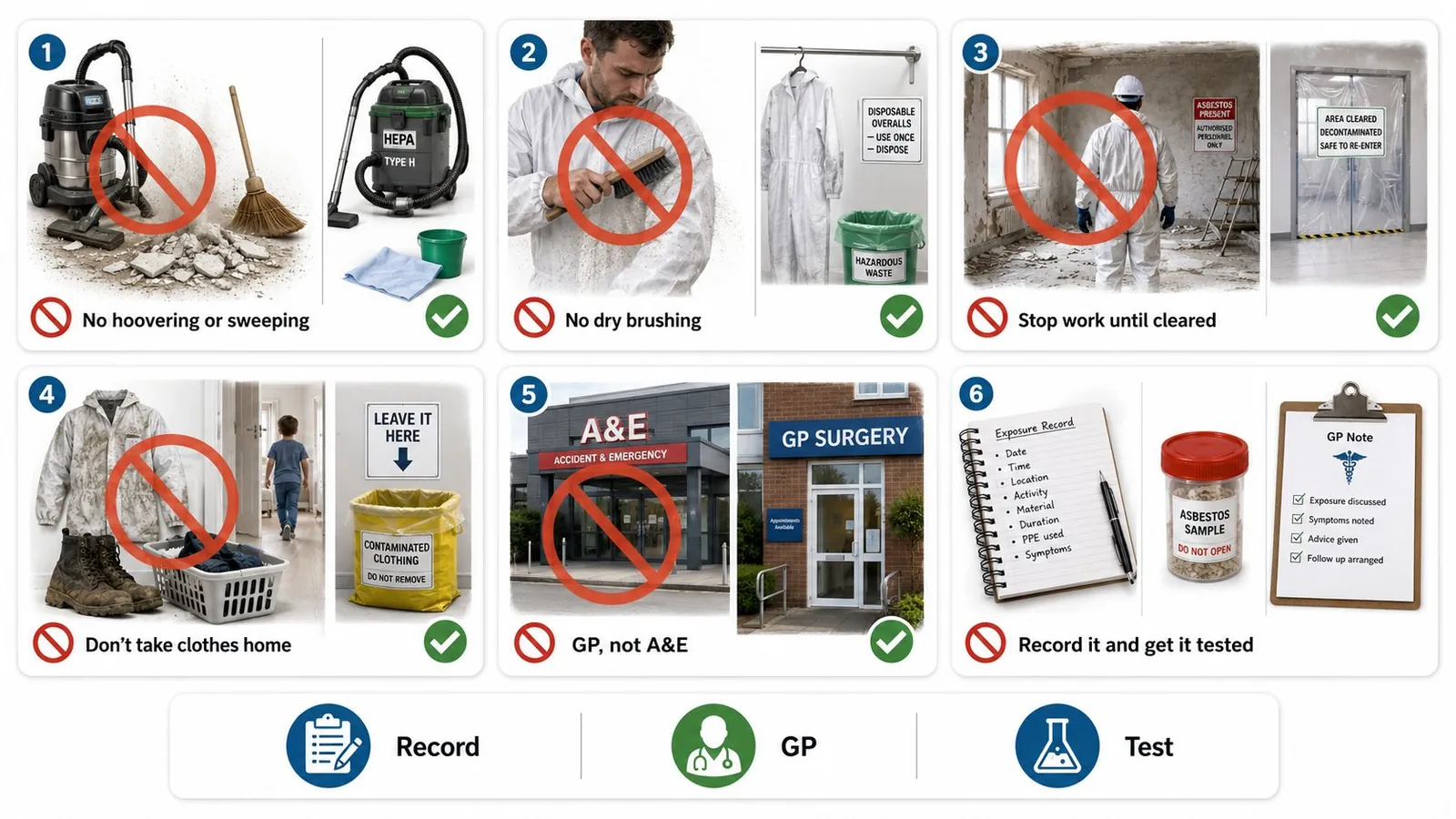
Some things make the situation worse:
- Don't hoover or sweep. Standard domestic and commercial vacuum cleaners don't have filters fine enough to capture asbestos fibres. Sweeping disperses fibres back into the air. The HSE recommends Type H vacuum cleaners (HEPA-filtered, asbestos-rated) and damp wiping for any asbestos-related cleanup.
- Don't dry-brush yourself or your clothes. It releases fibres back into the air at the point where you'd most want to avoid it.
- Don't continue working until the area is cleared. Even if you've finished cleaning yourself up, the room or area you disturbed is still potentially contaminated until properly decontaminated by competent personnel.
- Don't take your work clothes home. Particularly if you live with children or other vulnerable family members. Secondary exposure through household laundry is one of the well-documented pathways for take-home asbestos disease.
- Don't go to A&E unless you're injured. Asbestos exposure isn't a medical emergency in the immediate sense — no acute treatment alters the long-term picture. The right medical step is to see your GP at the next reasonable opportunity, not to occupy an A&E bay.
- Don't ignore it. Even if you've assessed the exposure as minor, record it. Tell your GP. Get the material tested. The cost of doing those things is low; the cost of not having a record decades later if disease develops can be high.
Decontamination — yourself, your clothes, the area
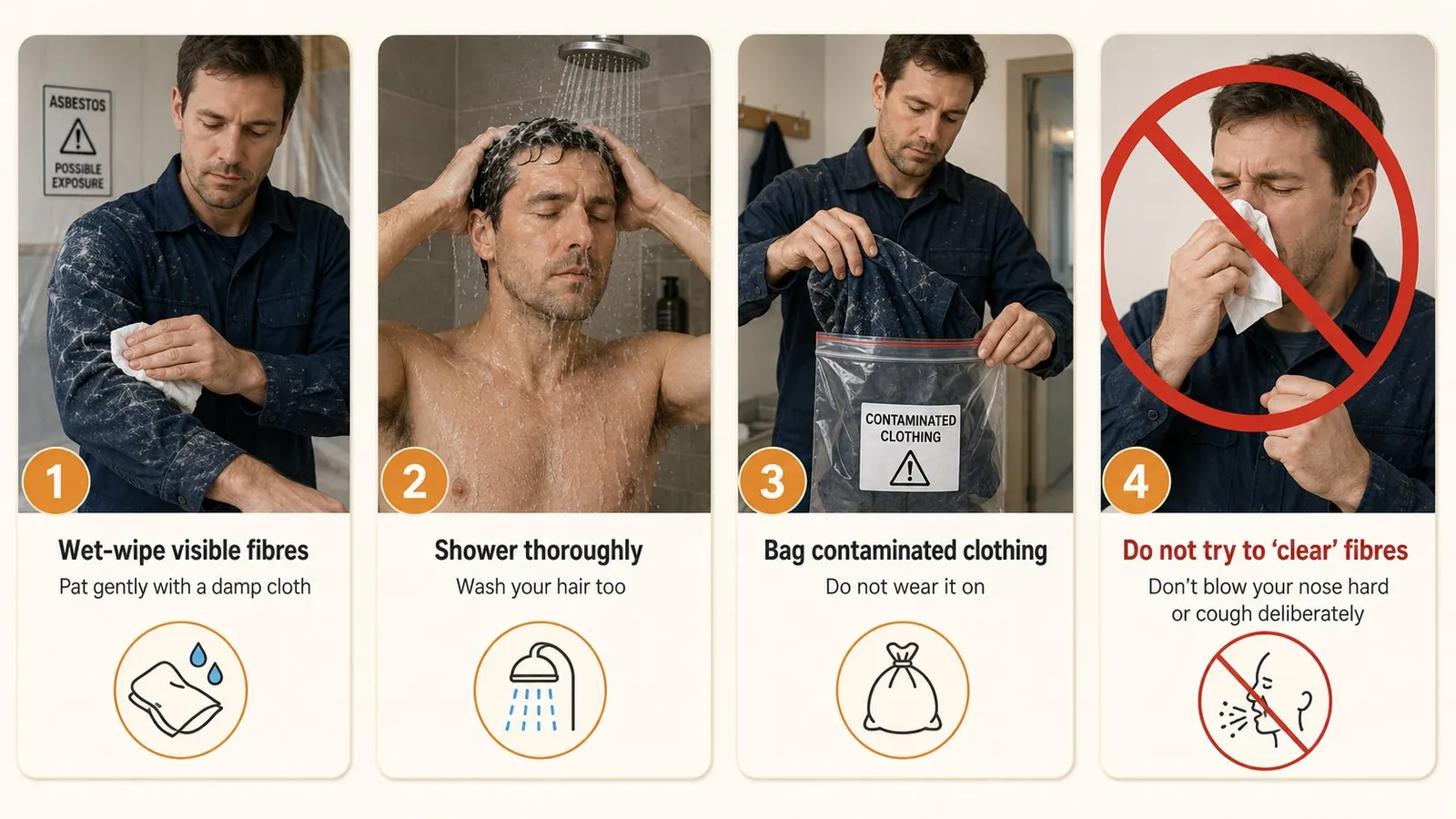
For the person who's been exposed:
- Wet-wipe with a damp cloth using a gentle patting motion to remove any visible fibres from skin and clothing
- Shower thoroughly, including washing your hair
- Bag any clothing that may have been contaminated rather than wearing it on
- Do not blow your nose hard or cough deliberately to "clear" fibres — there's no clearing fibres that have already been inhaled, and the action can be misleading about what's been achieved
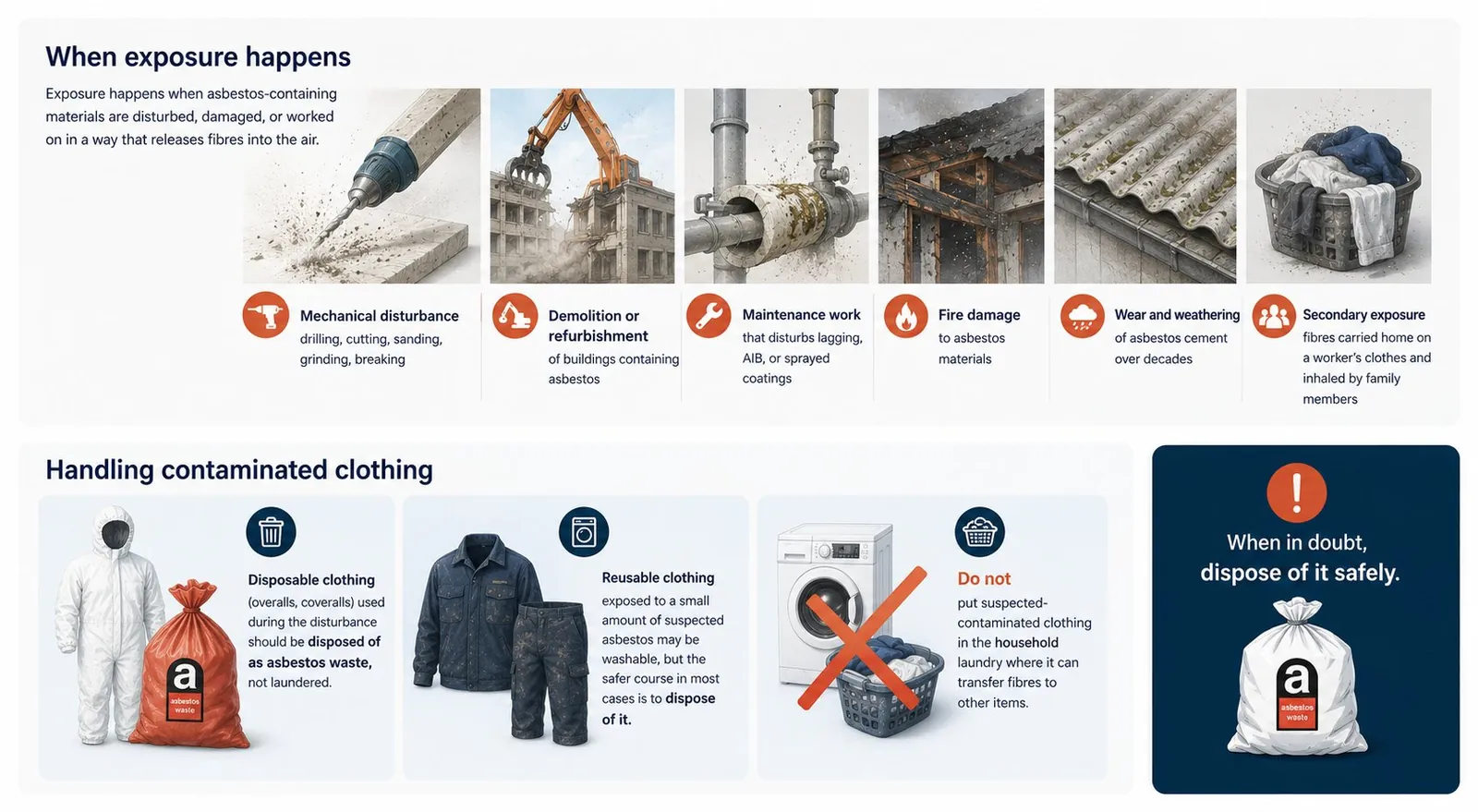
For the clothing:
- Disposable clothing (overalls, coveralls) used during the disturbance should be disposed of as asbestos waste, not laundered
- Reusable clothing exposed to a small amount of suspected asbestos may be washable, but the safer course in most cases is to dispose of it
- Do not put suspected-contaminated clothing in the household laundry where it can transfer fibres to other items
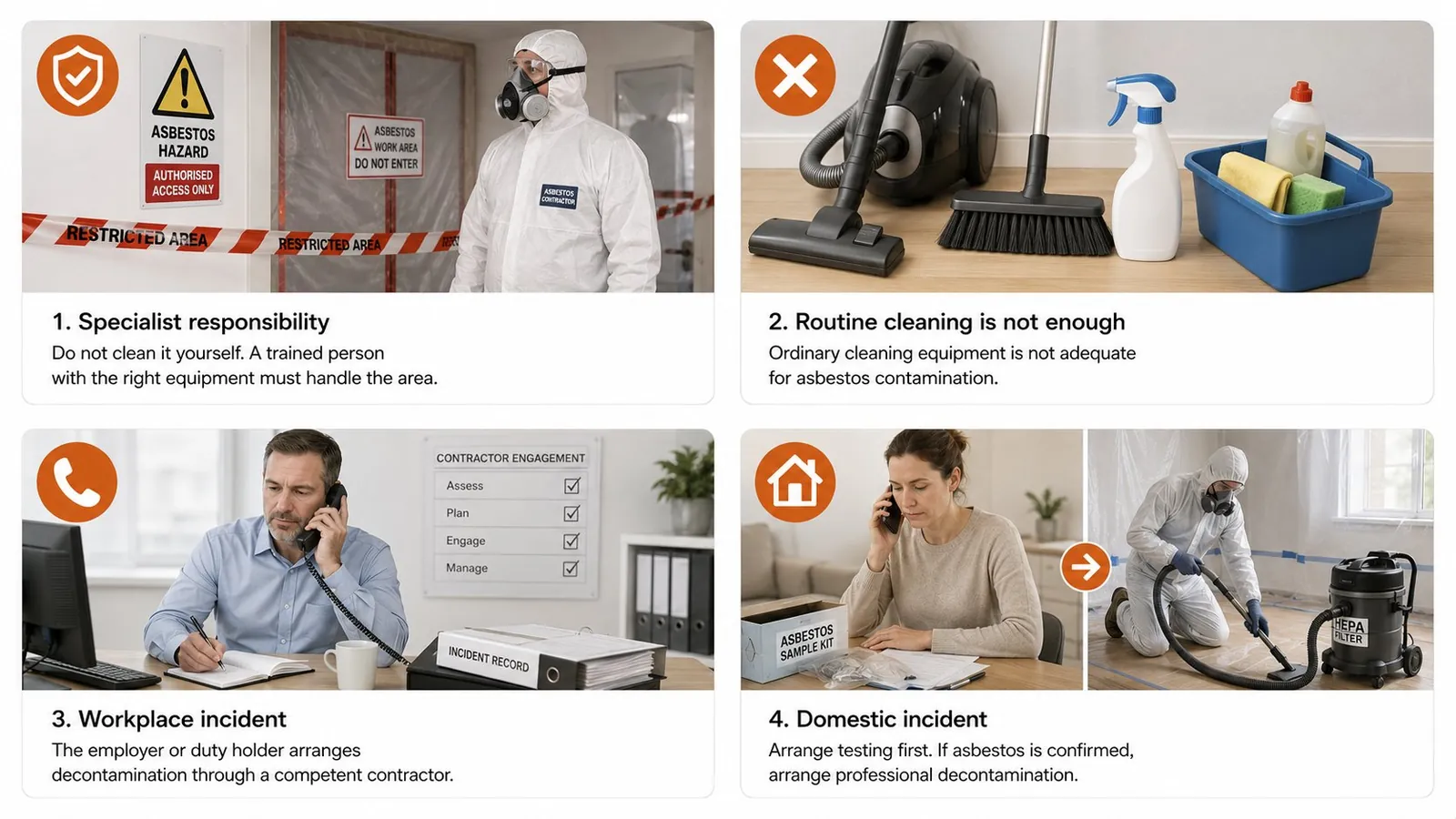
For the area itself:
- This is the responsibility of someone with appropriate training and equipment, not the person who caused the disturbance
- Routine cleaning equipment is not adequate
- For a workplace incident, the duty holder or employer arranges decontamination through a competent contractor
- For a domestic incident, the householder arranges testing first, then decontamination if asbestos is confirmed
Reporting — workplace versus home
The reporting requirements depend on where the exposure happened.
At work, the chain of events is:
- Tell your supervisor or employer immediately
- The employer must consider whether the incident is reportable under RIDDOR — accidental release of asbestos fibres in a quantity sufficient to harm health is classified as a "dangerous occurrence" and must be reported to the HSE
- The asbestos management plan for the premises should specify the emergency response — follow it
- The exposure should be recorded in the workplace accident book and on your personal record
At home or in a private domestic setting:
- Stop work and isolate the area
- Get a sample tested at a UKAS-accredited lab before doing anything else
- If asbestos is confirmed and the disturbance was significant, contact your local council's environmental health team — they can advise on safe management and disposal
- Document what happened, including dates, the material involved, and what you did
In a public or commercial building you don't own:
- Report immediately to the building manager, duty holder, or facilities lead
- They have the legal duty under CAR 2012 to manage the response
- Make sure you receive a written acknowledgement of your report — this is your record for any future medical or legal need
Telling your GP
Whatever the setting, tell your GP. This is the single most important step from a personal health perspective, and it's the one most easily overlooked.
The reason is documentation. Asbestos-related diseases have long latency periods — 10 to 60 years between exposure and symptoms. If you develop respiratory symptoms decades from now, the GP who sees you then will be looking at a record that either does or doesn't mention asbestos exposure. A record that mentions it triggers a different diagnostic pathway: chest imaging, referral, consideration of asbestos-related causes. A record that doesn't mention it may delay diagnosis if disease eventually develops.
Tell the GP:
- When the exposure happened
- What the material was (suspected or confirmed)
- The circumstances — workplace, home, public building
- Whether any test results are available
- Whether protective equipment was being worn
The GP isn't going to do anything dramatic at the appointment. There's no acute treatment for asbestos exposure. The point is to get the exposure on record. The NHS provides specific information about asbestos-related conditions for anyone seeking more medical context.
Was it actually asbestos? Getting the material tested
Until you've had a sample tested, you don't know whether the disturbance involved asbestos at all. In a pre-2000 UK building, the cautious default is to presume asbestos until shown otherwise — but the actual answer comes from the lab, not from visual identification.
For workplace incidents, the employer or duty holder arranges sampling and testing as part of their CAR 2012 duties.
For domestic incidents, you can either engage a competent asbestos surveyor to take and submit the sample, or use a home testing kit which posts the sample to a UKAS-accredited lab. The lab-tested element is non-negotiable; only an accredited lab using polarised light microscopy can confirm or rule out asbestos content. Results normally come back within a few working days.
If the test confirms asbestos, the situation moves into management mode — decontamination, removal where necessary, addition to the asbestos register if it's a non-domestic premises.
If the test rules out asbestos, document the result, file it, and update any management records that referenced the material as "presumed". A clean test result is itself useful evidence.
What if it was a single brief exposure?
The honest answer, which is also the reassuring one for most readers: a single brief exposure is at the low end of the asbestos risk spectrum. The cumulative dose principle means that most people who have had one short exposure event don't develop asbestos-related disease.
That doesn't mean the exposure was harmless. There's no proven safe threshold, and any exposure carries some statistical risk. But "statistical risk" at this scale is the same kind of risk that surrounds many everyday hazards — present, real, and best managed by sensible precautions rather than panic.
The right response to a single brief exposure is the sequence above: stop, contain, decontaminate, report, see your GP, document. The wrong response is to either ignore it or to assume the worst. Both extremes mishandle a situation that has a clear and well-established management pathway.
Frequently asked questions
What should I do right after disturbing asbestos?
Stop work, leave the area, close doors and windows behind you. Don't try to clean up yourself. Wet-wipe any visible fibres from your skin or clothes with a damp cloth using a gentle patting motion. Shower. Tell someone in authority. Get the material tested.
Do I need to tell my GP?
Yes. The exposure should be recorded in your medical history. Asbestos-related diseases have long latency periods, and a future GP looking at your record will benefit from knowing about the exposure even if you have no symptoms now.
Is one-off exposure dangerous?
A single brief exposure is at the low-risk end of the spectrum. Most people in that situation don't develop disease. That said, there's no proven safe threshold, so the response should still include the basic management steps — record, report, see your GP.
How do I clean asbestos off my clothes?
Don't dry-brush, shake, or hoover. Wet-wipe with a damp cloth using a gentle patting motion. For significant exposure, dispose of the clothing as asbestos waste rather than attempting to clean it. Never wash potentially-contaminated work clothes in a domestic washing machine — secondary exposure to family members is a documented disease pathway.
Should I report the exposure to anyone official?
At work, yes — tell your employer, who must consider whether the incident is reportable under RIDDOR as a dangerous occurrence. In a public building, tell the duty holder. At home, document it for your own record and engage an asbestos surveyor.
Can I shower at home after exposure?
Yes, in fact you should shower thoroughly including washing your hair. Bag any potentially-contaminated clothing rather than wearing it through the rest of the day or putting it through household laundry.
Will I get asbestos disease from one exposure?
Most likely not. Asbestos disease risk is broadly dose-dependent and a single brief exposure is a small dose. But the only honest answer is that no one can predict an individual outcome — which is why the management response is the same regardless: record it, see your GP, presume the exposure happened, don't repeat it.
For more on the diseases asbestos can cause and the latency periods involved, see our page on asbestos exposure, symptoms, and the timeline of harm. For the wider context of how asbestos is regulated in the UK and what the legal duties are, see our guide to asbestos awareness in the UK and the Control of Asbestos Regulations 2012.
For workers and supervisors whose work in pre-2000 UK buildings means accidental exposure is a foreseeable risk, our UKATA-approved Asbestos Awareness Course covers the syllabus required under Regulation 10 — including the emergency procedures to follow if asbestos is disturbed.