
%201.svg)


If your work involves entering, repairing, maintaining, or refurbishing buildings constructed or substantially refurbished before 2000, the chances are you fall within the scope of Regulation 10 of the Control of Asbestos Regulations 2012 — which makes asbestos awareness training a legal requirement.
This page answers the practical question — does this apply to me? — and corrects a couple of persistent misunderstandings about which category of training is needed for which work, and how often refresher training has to happen.
The legal requirement, in plain English
Regulation 10 of CAR 2012 places the duty on the employer. It says that every employer must make sure their employees are given adequate information, instruction, and training where those employees are, or might be, exposed to asbestos in their work, or where they supervise such employees.
The supporting Approved Code of Practice (L143) is more specific about who this means in practice. It says that asbestos awareness training should be given to "employees whose work could foreseeably disturb the fabric of a building and expose them to asbestos, or who supervise or influence the work". That's the working test: if a normal day of your job could plausibly involve drilling into a wall, lifting a ceiling tile, running cabling through a floor void, or working on the fabric of a pre-2000 building, you're in scope.
The duty falls on the employer, but it also applies to the self-employed in relation to their own work — a sole-trader electrician working on commercial premises has the same training duty as the supervisor of an electrical team. And the duty to receive training rests on the worker. Employers must provide it; workers must take it.
The three categories of training
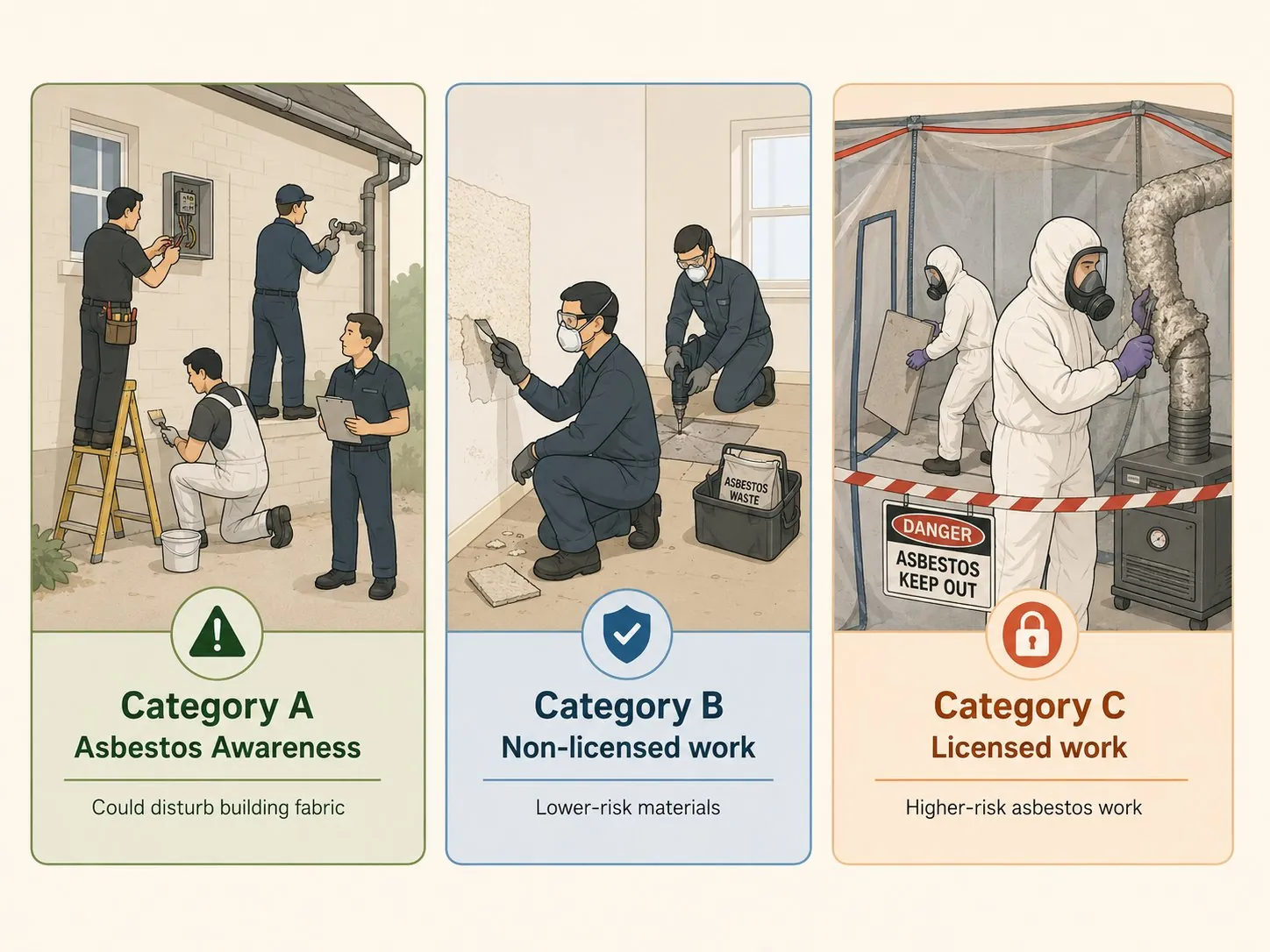
CAR 2012 and L143 set out three tiers of asbestos training, each matched to a different level of risk:
Category A — Asbestos Awareness. The baseline. For people who might encounter asbestos in their work but are not deliberately working with it. The aim is to teach them how to recognise asbestos-containing materials, understand the risks, and avoid disturbing anything they shouldn't. Category A doesn't qualify anyone to remove, repair, or work on asbestos.
Category B — Non-licensed work training. For workers who will deliberately disturb lower-risk asbestos materials — drilling holes through asbestos cement, lifting bonded floor tiles, removing small areas of textured coating. Covers safe work practices, control measures, personal protective equipment, and waste handling. Notifiable non-licensed work (NNLW) sits within this category and carries additional medical surveillance and notification requirements.
Category C — Licensed work training. For workers carrying out higher-risk asbestos removal that requires the contractor to hold an HSE asbestos licence — work on lagging, sprayed coatings, and AIB above defined thresholds. The most intensive training; usually delivered in-person with practical assessment.
The most common error in matching workers to categories is assuming that Category A is enough for any contact with asbestos. It isn't. If the work involves deliberately disturbing an asbestos-containing material — even a single hole drilled through a chrysotile cement sheet for a cable run — that's non-licensed work and requires Category B training, not just awareness.
Which trades typically need Category A awareness training
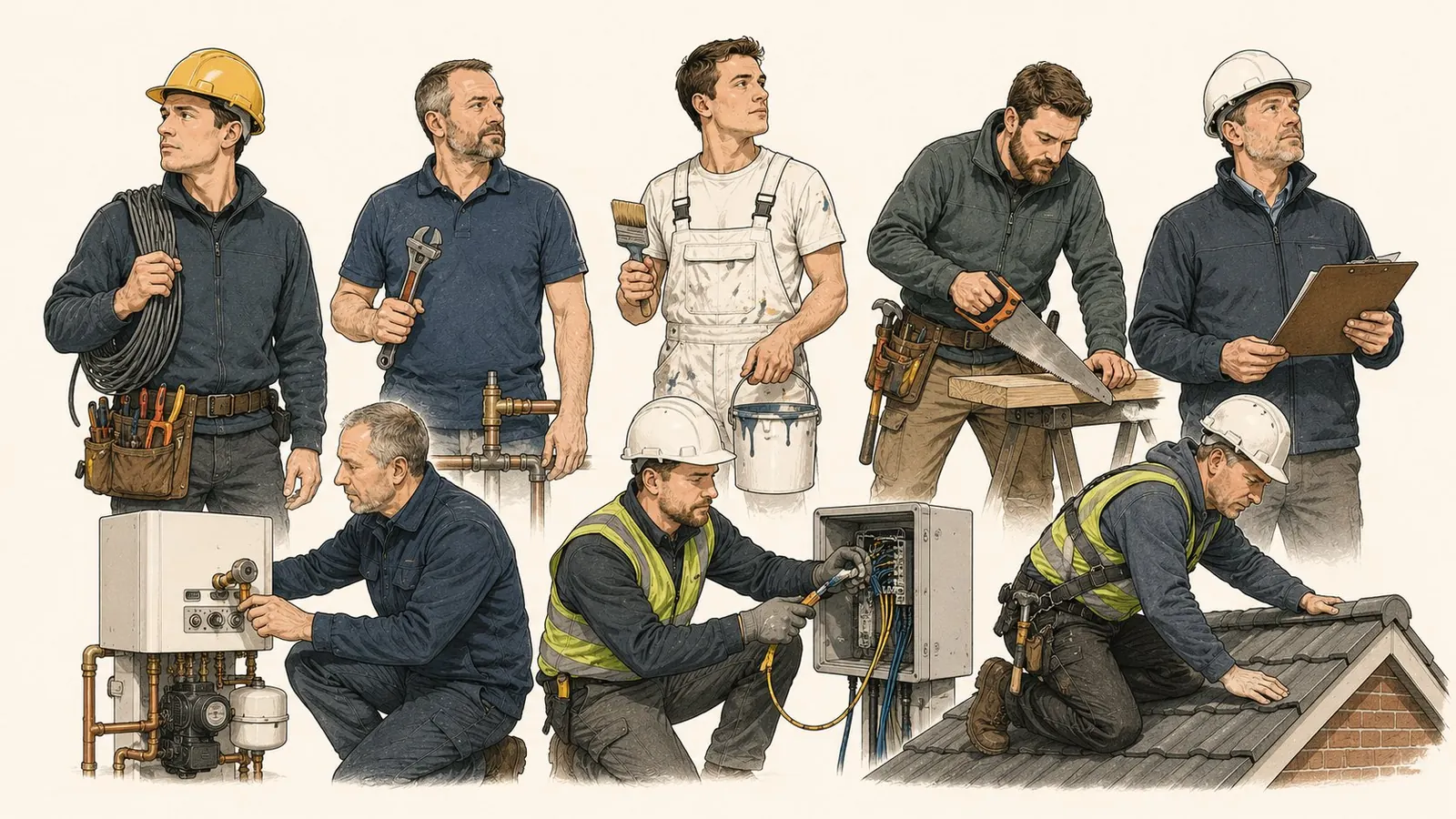
The list below is the standard set of occupations the HSE identifies as needing Category A asbestos awareness training. It's not exhaustive; the test is the L143 wording — could your work foreseeably disturb the fabric of a pre-2000 building?
- General building and maintenance workers
- Electricians and electrical engineers
- Plumbers and pipefitters
- Gas engineers and heating engineers
- Joiners and carpenters
- Painters and decorators
- Plasterers
- Roofers
- Demolition workers (Category A as a foundation; many will need Category B or C on top)
- Heating and ventilation engineers
- Telecoms and IT installers — anyone running cabling through structures
- Alarm and security system installers
- Shopfitters
- Surveyors and architects who inspect older buildings
- Facilities and estates staff
- Caretakers and site managers
- Fire and security risk assessors
- Asbestos removal contractors (as a baseline, before specialised training)
- Refurbishment project managers
- Building services engineers
Supervisors and managers of any of the above also need awareness training, because the duty under Regulation 10 extends to those who supervise or influence the work. A site manager who never picks up a tool but directs the work of people who do is in scope.
Trades that need Category B (non-licensed work)

If the work goes beyond "might encounter" into "will deliberately disturb", awareness training isn't enough. Examples of jobs that need Category B training as a minimum include:
- Removing bonded asbestos floor tiles and the associated mastic adhesive
- Drilling into asbestos cement for fixings or service penetrations
- Removing small areas of textured coatings (Artex)
- Working on or removing asbestos cement gutters, downpipes, or soffits
- Limited work on AIB where the scope falls below the licensed-work threshold
Notifiable non-licensed work — a subset of Category B — also carries additional duties: notification to the enforcing authority, medical surveillance for workers, and detailed record-keeping. Removing paper-backed asbestos floor tiles is one of the most common examples of NNLW.
Trades that need Category C (licensed work)

The highest-risk work — anything involving friable, high-fibre-release materials — must be carried out by a contractor holding an HSE asbestos licence. The workers doing it need Category C training. Examples:
- Removal of asbestos lagging from pipes, boilers, or calorifiers
- Removal of sprayed coatings (limpet) from structural steel
- Work on AIB above the time and scope thresholds set out in HSG247
- Removal of loose-fill asbestos insulation
Category C training is normally delivered as a multi-day course with practical assessment, not online.
Who arranges the training
The employer. That's the position under Regulation 10, and it doesn't change because the training is online or the workforce is small.
The principle extends to the self-employed: a self-employed worker takes on the employer duty in relation to their own work. A sole-trader plumber working on commercial premises is legally responsible for their own asbestos awareness training, and they should be able to produce evidence of it if asked.
Subcontracted labour is the area where this most often goes wrong. A main contractor on a refurbishment project can't assume that subcontractors have trained their own people. The main contractor's CDM and CAR duties typically require them to verify the training of everyone on site, particularly where work could disturb asbestos. In practice this means asking for training certificates and recording them in the site induction.
How often is refresher training actually required?
This is the most-asked and most-misunderstood question in the topic.
The HSE position, set out clearly on the HSE asbestos training page, is that there is no legal requirement to repeat an entire formal awareness refresher course every 12 months. What Regulation 10 requires is that training is "given at regular intervals" and "adapted to take account of significant changes" in the work. The form the refresher takes — a full course, a toolbox talk, an e-learning module, an in-house briefing by a competent supervisor — is for the employer to decide based on the risk and the workers' needs.
Many training providers issue certificates with a 12-month expiry. That's a provider policy, not a legal requirement. The expiry of a certificate doesn't automatically trigger a need for full retraining; it's a prompt to review whether refresher knowledge is needed.
For most construction and maintenance employers, a sensible practical approach is to:
- Give every new starter Category A training as part of induction
- Provide an annual update — which can be a short e-learning refresher, a toolbox talk, or an in-house briefing — to keep awareness current
- Repeat the full Category A course every two to three years, or sooner if there's a significant change in the work
- Keep records of all training, including refreshers and toolbox updates
Online learning is recognised by the HSE as a valid delivery method for Category A awareness, provided the course meets the syllabus set out in L143. That makes annual e-learning refreshers a low-friction, low-cost way to satisfy the regulation.
What to look for in an accredited training provider
The legal duty is for "adequate" training, not specifically for accredited training. But accreditation by a recognised body is the standard way to demonstrate that a course meets the L143 syllabus. The main UK accreditations to look for:
- UKATA — the UK Asbestos Training Association, the most widely recognised asbestos-specific accreditation in the UK
- IATP — Independent Asbestos Training Providers, the other principal asbestos-specific body
- BOHS — the British Occupational Hygiene Society, particularly for higher-tier qualifications
- RoSPA — general health and safety accreditation, often supporting asbestos awareness courses
- CPD — the CPD Certification Service and equivalent CPD accreditation bodies, a recognised framework confirming that a course meets a defined quality and learning standard; widely used for asbestos awareness (Category A) training
- CITB — recognised in the construction sector, particularly for site-card schemes
For Category A awareness, what matters most is that the course is adequate and covers the full L143 awareness syllabus. A course accredited by an asbestos-specific body (UKATA or IATP) is the most widely recognised route, but a CPD-accredited awareness course that covers the required syllabus is equally fit for purpose for most employers, particularly when delivered online. For Category B and C, look for in-person practical training from a provider with the specific accreditations for that level.
Frequently asked questions
Do I legally need annual refresher training?
No. The HSE position is that there's no legal requirement for annual refresher training. Regulation 10 requires adequate information, instruction, and training given at regular intervals appropriate to the work. Annual refreshers are sensible practice for many employers and many providers offer them, but they aren't specifically required by law.
Is online asbestos awareness training valid?
Yes, for Category A. The HSE recognises e-learning as a viable delivery method for asbestos awareness, provided the course meets the requirements of Regulation 10 and the L143 syllabus. For Category B and C, in-person delivery with practical assessment is more common.
Does Category A training qualify me to work with asbestos?
No. Category A is awareness training only. It teaches you how to recognise asbestos and avoid disturbing it. It does not authorise you to remove, repair, drill, or otherwise work with asbestos-containing materials. For that you need Category B or Category C training appropriate to the work.
Do supervisors and managers need training too?
Yes. Regulation 10 specifically requires training for those who supervise or influence the work of employees who might be exposed to asbestos. A site manager who never touches a tool still needs awareness training if they direct the work of people who do.
Do I need training if I'm self-employed?
Yes. The duty under CAR 2012 applies the obligations of both employer and employee to self-employed workers. A self-employed worker whose work could foreseeably disturb asbestos needs the relevant training.
How long does asbestos awareness training take?
A typical online Category A course takes between one and a half and three hours, depending on the provider and the depth of the modules. In-person delivery is typically half a day for an initial course.
What's the difference between UKATA and IATP?
Both are UK-based asbestos training accreditation bodies. UKATA is the larger and most widely recognised by employers and main contractors. IATP is an independent alternative covering similar territory. A course from either should meet Regulation 10 requirements; the choice between them is usually a question of provider availability and employer preference.
Do office workers in an old building need asbestos awareness training?
Generally no. Asbestos awareness training is for workers whose work could foreseeably disturb the fabric of the building. Routine office work — sitting at a desk, walking corridors — doesn't disturb the fabric. The exception is roles like facilities management, caretaking, or estate maintenance, where contact with the building's structure is part of the job.
If you're an employer or supervisor working out the training position for your team, the core legal text is set out in the Control of Asbestos Regulations 2012, with the duty to manage asbestos on the premises side covered separately in our guide to Regulation 4 and the duty to manage.
For workers and supervisors who need Category A training to meet the Regulation 10 duty, our UKATA-approved Asbestos Awareness Course covers the syllabus required under L143 and provides a certificate on completion.