.webp)

%201.svg)


If you've lifted a carpet in a UK home built between the 1950s and late 1980s and found old vinyl or thermoplastic tiles underneath, there's a reasonable chance they contain asbestos. The good news is that asbestos floor tiles are one of the lower-risk asbestos materials you'll come across in a domestic setting — they're non-friable, which means the fibres don't release easily unless you cut, sand, snap, or grind them. The less good news is that the adhesive holding them down may be a separate hazard, and that some tiles have a paper backing that pushes the work into a different legal category altogether.
This guide explains how to spot asbestos floor tiles, why the 9-inch square is such a strong signal, the two adhesive-related traps people miss, and what UK regulations allow you to do once you've found them.
Why floor tiles so often contained asbestos
Asbestos was added to vinyl and thermoplastic floor tiles for the same reasons it was added to most other building products of the era: it made them harder, more dimensionally stable, more resistant to heat and wear, and cheaper to manufacture than alternatives. Chrysotile — white asbestos — was the type used in nearly all asbestos-containing tiles, typically at between 10 and 25 per cent by weight, bound into a vinyl or asphalt matrix.
Production in the UK peaked from the 1950s through to the late 1970s, then declined sharply after the 1985 prohibition of crocidolite and amosite raised awareness of asbestos as a hazard generally. Some chrysotile-containing tiles were still being installed into the early 1990s, partly because manufacturers kept selling existing stock and partly because chrysotile itself wasn't banned until 1999.

How to recognise asbestos floor tiles
There are four signals worth weighing together: the age of the building, the tile size, the appearance, and what's underneath. None of them is conclusive on its own — only laboratory analysis can confirm the presence of asbestos — but together they give you a reliable sense of probability.
Building age. Any tile installed before 2000 in a UK property should be treated as suspect unless you have documentation proving otherwise. Tiles in buildings constructed between 1950 and 1985 are the highest-probability category.
Tile size. The strongest visual indicator. Asbestos floor tiles were almost universally manufactured in imperial dimensions — 9 inches square is the classic signal, with 12 inches and 18 inches also common. Modern tiles are typically metric and come in sizes like 30 centimetres, 45 centimetres, or 60-centimetre planks. If your tiles measure exactly 9 by 9 inches, you're looking at almost certainly pre-1985 manufacture.
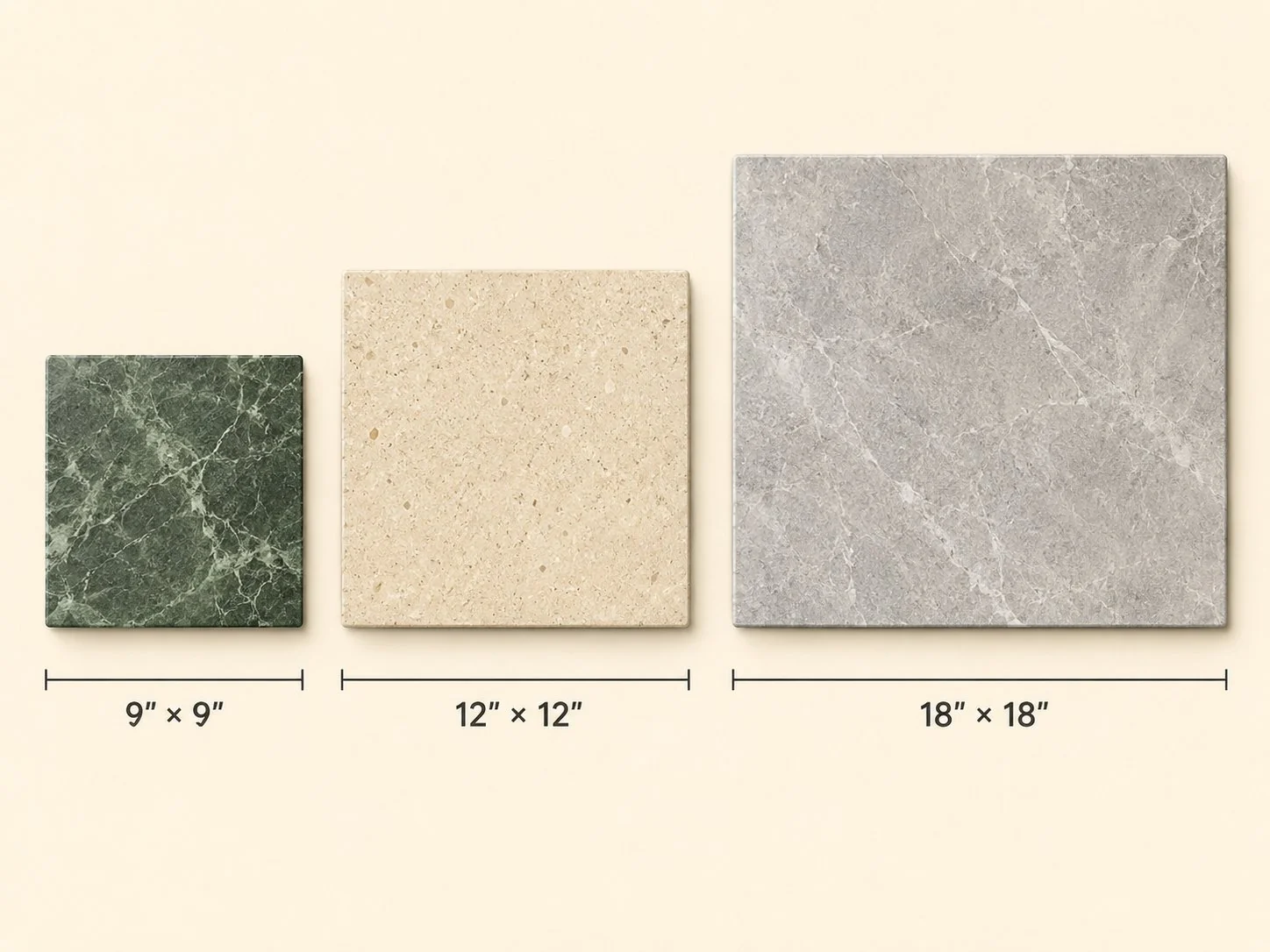
Appearance. Look for marbled, mottled, or speckled patterns in colours like brown, grey, green, cream, beige, or pale pastels. Black or very dark single-colour tiles often indicate an asphalt-based product, which is its own category of likely asbestos content. The surface may look dull, slightly oily, or yellowed at the edges. Asbestos tiles tend to be more brittle than modern vinyl — they snap rather than flex.
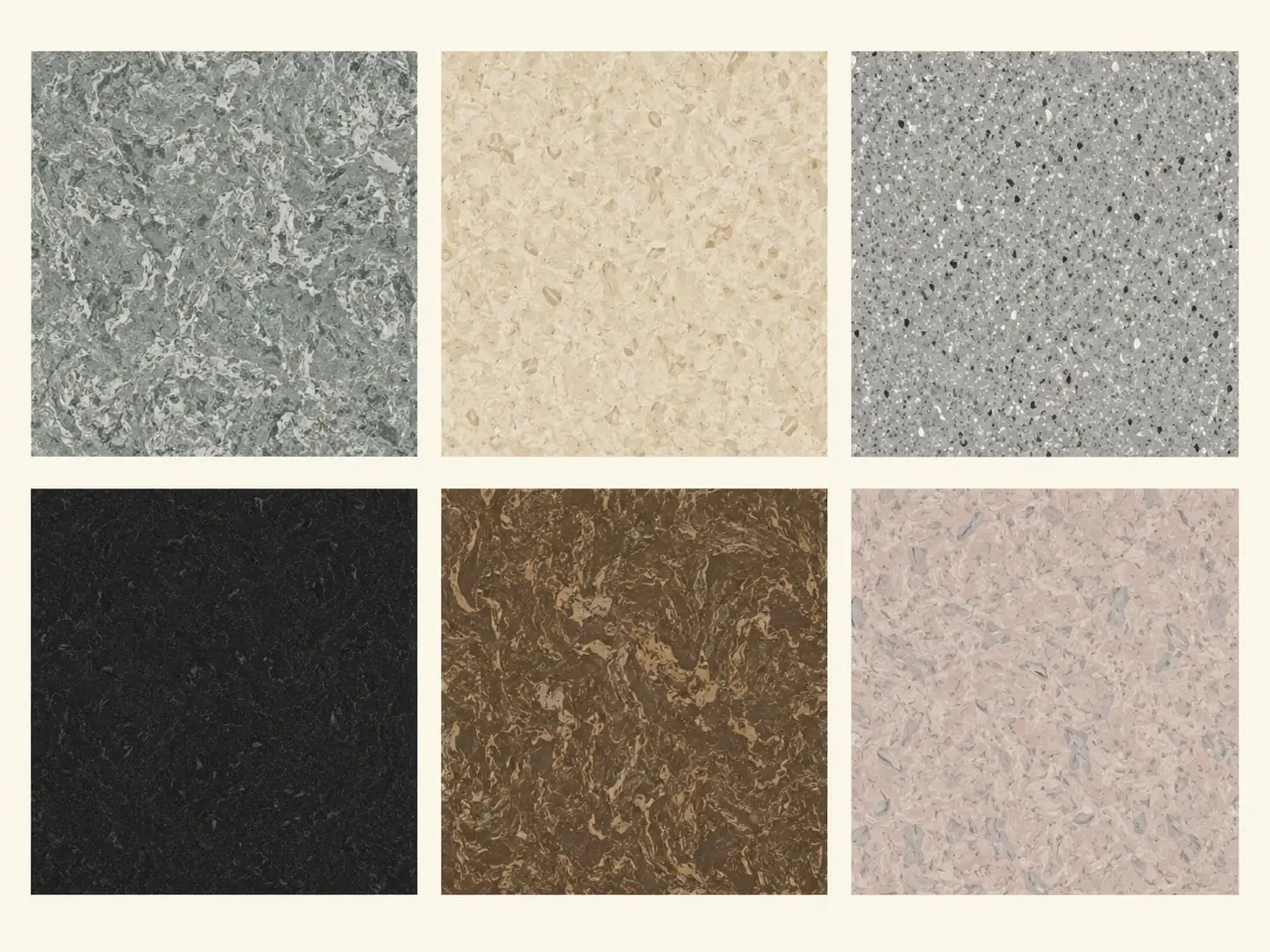
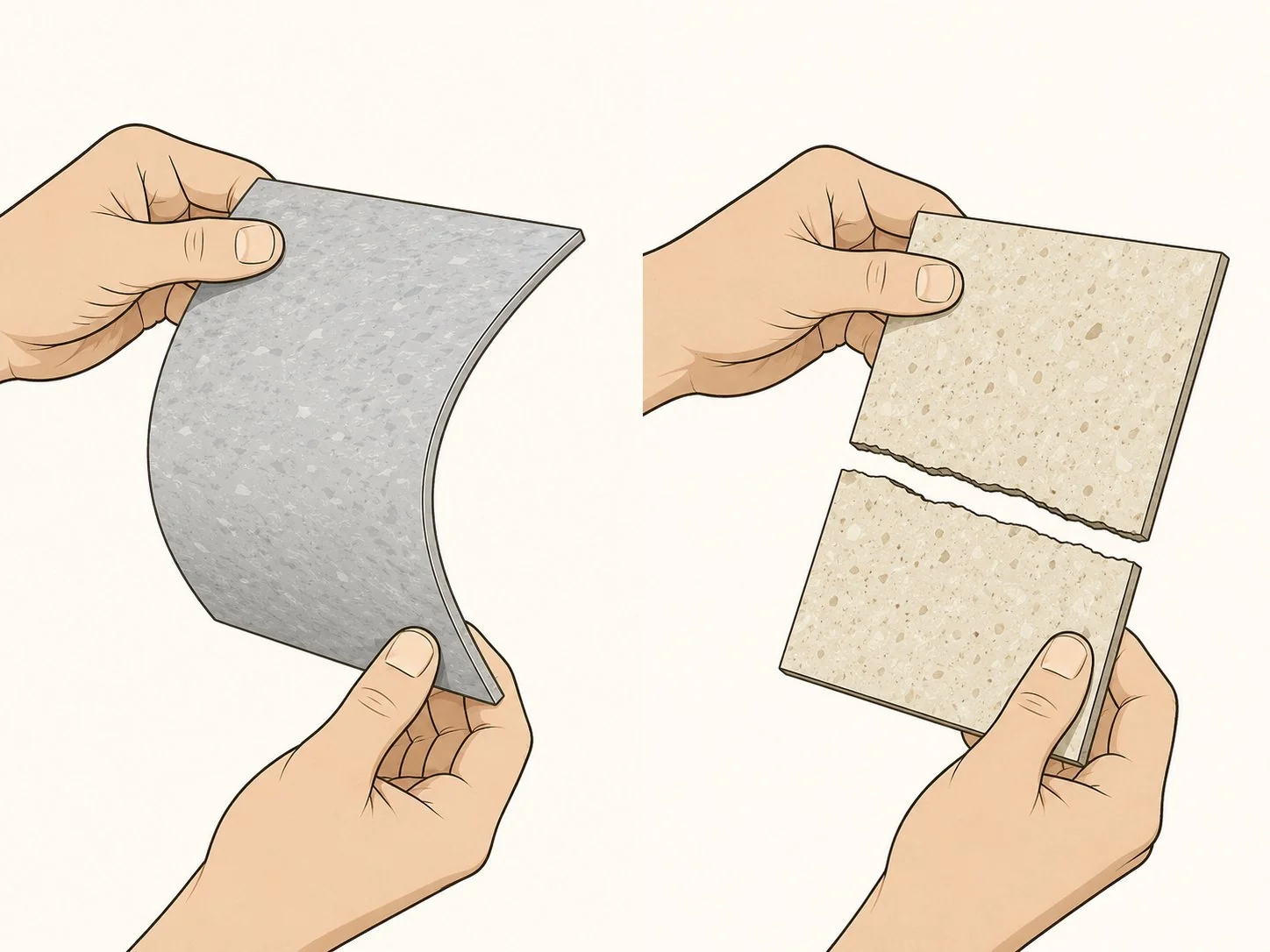
What's underneath. When you lift a tile, what you see on the back and on the subfloor matters as much as the tile itself. Two distinct things to look out for.
The 9-inch tile: the strongest visual indicator
If you take only one thing from this guide, take this: a 9-inch square floor tile in a UK building is the strongest single visual signal for likely asbestos content. The dimension is so specific and so tied to the manufacturing era that it functions almost as a date stamp.
Modern flooring manufacturers occasionally produce 9-inch tiles in vintage-style ranges, deliberately replicating the look of mid-century floors. These reproductions are asbestos-free, but they're indistinguishable from the originals without testing. So while a 9-inch tile in a 1960s house is very likely asbestos, a 9-inch tile in a 2010s refurbishment in the same house could go either way. The age of the flooring installation, not just the building, is what matters.
The other dimension worth knowing about is 9 by 9 with a slightly thicker profile and a more rigid feel — these are asphalt tiles, sometimes called asphalt floor tiles or asphalt thermoplastic tiles. They were popular for institutional floors (schools, hospitals, public buildings) and are often very dark or black. They were almost universally asbestos-containing.
The black mastic adhesive trap

This is the risk most homeowners don't see coming. Even if the tile itself turns out to be asbestos-free, the adhesive holding it to the subfloor may contain asbestos. Black mastic — sometimes called cutback adhesive or bitumen adhesive — was the standard glue used to fix vinyl and thermoplastic tiles throughout the asbestos era, and it routinely contained chrysotile.
You'll recognise it as a thick, tar-like black layer on the back of the tile or on the subfloor when a tile lifts away. It's sticky when warm, brittle when cold, and ages to a glossy, almost lacquer-like finish. The danger with mastic isn't usually the tile being lifted whole — that part is low-fibre-release. The danger is when someone scrapes, grinds, or sands the residue off the subfloor to lay new flooring. That's the work activity that generates airborne fibre.
If you find black mastic, treat it as presumed asbestos until you've had it sampled. A removal contractor will normally encapsulate it (lay new flooring over the top, sealed) rather than scrape it off, both because scraping is the high-risk part and because encapsulation is allowed under the regulations for materials in stable condition.
The paper-backed tile trap
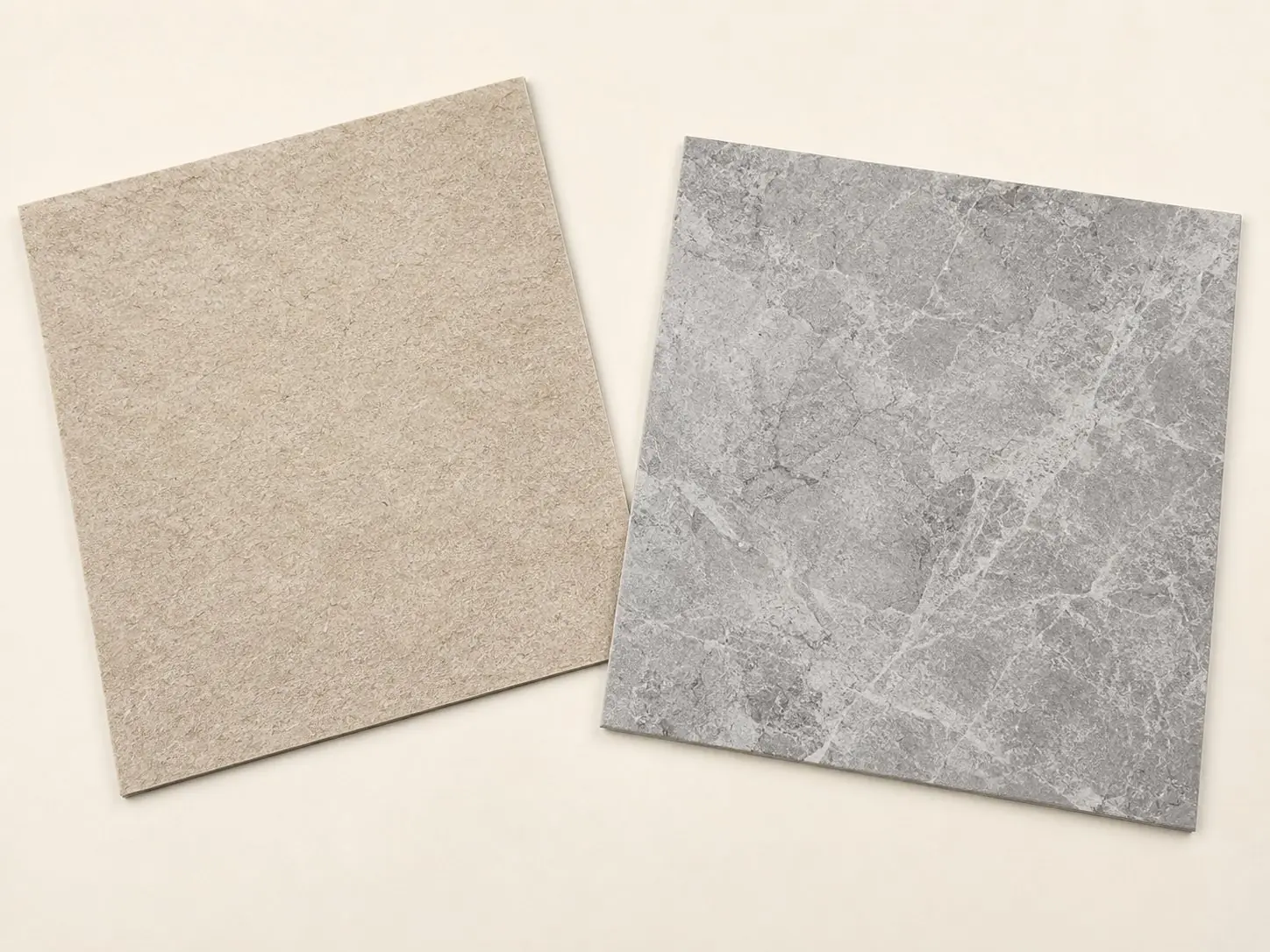
Some asbestos floor tiles — particularly the older asphalt-based ones — were manufactured with an asbestos paper backing for added strength and dimensional stability. Visually, you'll see a thin felt-like or paper-like layer on the underside when you lift the tile.
This matters because it changes the legal category of the work. The Health and Safety Executive classifies the removal of intact asbestos floor tiles as non-licensed work — most competent contractors can do it without holding an asbestos licence. The moment you're dealing with paper-backed tiles, though, the work becomes notifiable non-licensed work (NNLW), which means the contractor has to notify the relevant enforcing authority before starting and meet additional record-keeping and medical-surveillance requirements.
If you're a homeowner planning to engage a contractor, ask them directly whether they're carrying out the work as non-licensed or NNLW. If they look blank, find someone else.
A note on Marley floor tiles
Marley is the brand most often associated with asbestos floor tiles in the UK, partly because it was a dominant manufacturer through the 1950s, 60s and 70s, and partly because the company-branded tiles often survive in identifiable form. There's a persistent assumption that any tile branded Marley is automatically asbestos.
That isn't quite right. Marley manufactured both asbestos-containing and asbestos-free tiles, and continued producing flooring after the asbestos era ended. The brand on the tile tells you a manufacturer; it doesn't tell you the composition. What determines the answer is the year of manufacture and the product line. If a tile is identifiably Marley and was installed before the mid-1980s and matches the standard 9-inch dimension, the probability is high. Move the installation date forward a decade or change the dimension, and the probability drops sharply.
The same applies to other period brands you might find marked or stamped on tiles: the brand is a clue, not a verdict.
Are asbestos floor tiles dangerous if left alone?
In good condition and undisturbed, asbestos floor tiles present a low risk. The chrysotile fibres are tightly bound within the vinyl or asphalt matrix and don't release into the air unless the material is broken, abraded, or burnt. A well-laid asbestos floor in a residential property, covered by carpet or laminate, is not actively hazardous to the people living above it.
The risk comes from disturbance — and the typical disturbance scenarios are predictable. Lifting and breaking tiles during renovation. Sanding the floor before laying laminate. Cutting tiles with a power saw to fit a pipe run. Sweeping up tile dust dry rather than wet. A flood or fire that damages the tiles. Each of those activities can release fibres at levels that warrant proper precautions.
The "leave it alone" approach is a perfectly valid management strategy if the tiles are stable and you have no immediate need to disturb them. Many UK homes are still living happily on top of original 1960s asbestos floors with newer covering laid over.
Can I remove asbestos floor tiles myself?
This is the most-asked question on the topic, and the answer has two layers.
The legal layer is that the Control of Asbestos Regulations 2012 do not prohibit a homeowner from removing asbestos floor tiles in their own home. Private domestic premises sit outside most of the regulatory framework that governs commercial buildings. There's no licensing requirement that says a householder can't do it.
The practical layer is that even legal DIY removal has to follow safe-working principles or you generate fibre release that could harm you, your family, and your neighbours' air quality during disposal. The HSE's asbestos guidance for workers sets out the principles for non-licensed work — wet methods, proper RPE rated for asbestos, no power tools without dust extraction, no dry sweeping, contained disposal. Those principles are sensible whether you're a contractor or a homeowner.
For most people, the realistic options are:
- Leave the tiles in place and cover them. Lowest cost, lowest risk, lowest disturbance.
- Engage a non-licensed contractor. Most asbestos removal firms will lift bonded floor tiles for a few hundred pounds depending on the area. They'll bag, label, and dispose of the waste lawfully.
- DIY only if you are competent and have appropriate respiratory protection, disposal arrangements, and a willingness to follow the controls properly. The savings are real, but so are the consequences of doing it badly.
If your tiles are paper-backed, the work shifts to NNLW and a competent contractor is the right answer.
How to dispose of asbestos floor tiles
Asbestos waste — including bonded floor tiles — is classified as hazardous waste in the UK and cannot be put out with normal household refuse. Local authorities operate household waste recycling centres that accept small quantities of bonded asbestos from householders, but you generally need to book a slot in advance and bring the waste double-bagged in proper asbestos waste bags.

The double-bag method is the standard. You place the broken tile pieces into a red labelled asbestos bag, seal it with heavy-duty tape, then place that bag inside a clear outer bag and seal again. The red inner bag indicates "danger asbestos" to anyone handling the waste downstream; the clear outer bag allows the contents to be visually checked at the disposal point. UN-certified asbestos waste bags can be bought online for a few pounds.
For larger volumes, or where the waste is from a commercial property, the work falls under the Hazardous Waste Regulations and you'll need a licensed waste carrier with a consignment note. A non-licensed asbestos contractor will normally manage the entire disposal pathway as part of the job, which is one of the reasons paying for professional removal is often the simpler choice.

Frequently asked questions
Are 12-inch and 18-inch tiles also potentially asbestos?
Yes. The 9-inch tile is the most iconic indicator, but 12-inch (300mm) and 18-inch (450mm) imperial-sized tiles from the same era can also contain asbestos. Tile size shifts the probability — it doesn't rule asbestos in or out by itself.
Can asbestos floor tiles be sealed instead of removed?
Yes, encapsulation is a legitimate management approach. New flooring laid over a stable asbestos tile floor is one of the most common solutions, and it's consistent with HSE guidance on managing asbestos in non-domestic premises.
Is the black mastic under my floor more dangerous than the tile?
Often, yes. The mastic can be friable when scraped, sanded, or heated, whereas the bonded tile is much more stable. When in doubt, assume both the tile and the adhesive are asbestos-containing until sampled.
Do modern floor tiles ever contain asbestos?
Tiles manufactured for sale in the UK after 24 November 1999 should not contain asbestos. The risk on a modern build is essentially zero unless older stock was used. Reclaimed or salvaged tiles are a different matter — provenance unknown.
How much does professional removal cost?
For a typical domestic floor area of 10 to 20 square metres, professional non-licensed removal usually runs from a few hundred to around a thousand pounds, depending on access, condition, and disposal volume. NNLW work (paper-backed tiles) costs more because of the additional administrative requirements.
Can I lay new flooring directly over asbestos tiles?
Yes, provided the existing floor is sound, level, and the tiles aren't broken. This is one of the most pragmatic management strategies for residential properties — you remove the disturbance risk entirely and the new floor isolates the tiles from foot wear.
Asbestos floor tiles are one of the more manageable categories of asbestos material you're likely to find in a UK home. If you'd like to understand the wider picture — where else asbestos appears in pre-2000 buildings, what the legal duties are, and what training is required for tradespeople who work in these properties — our complete guide to asbestos awareness in the UK brings the topic together. For tradespeople and supervisors who need formal training, our Asbestos Awareness Course covers the core syllabus required under Regulation 10 of the Control of Asbestos Regulations 2012.