
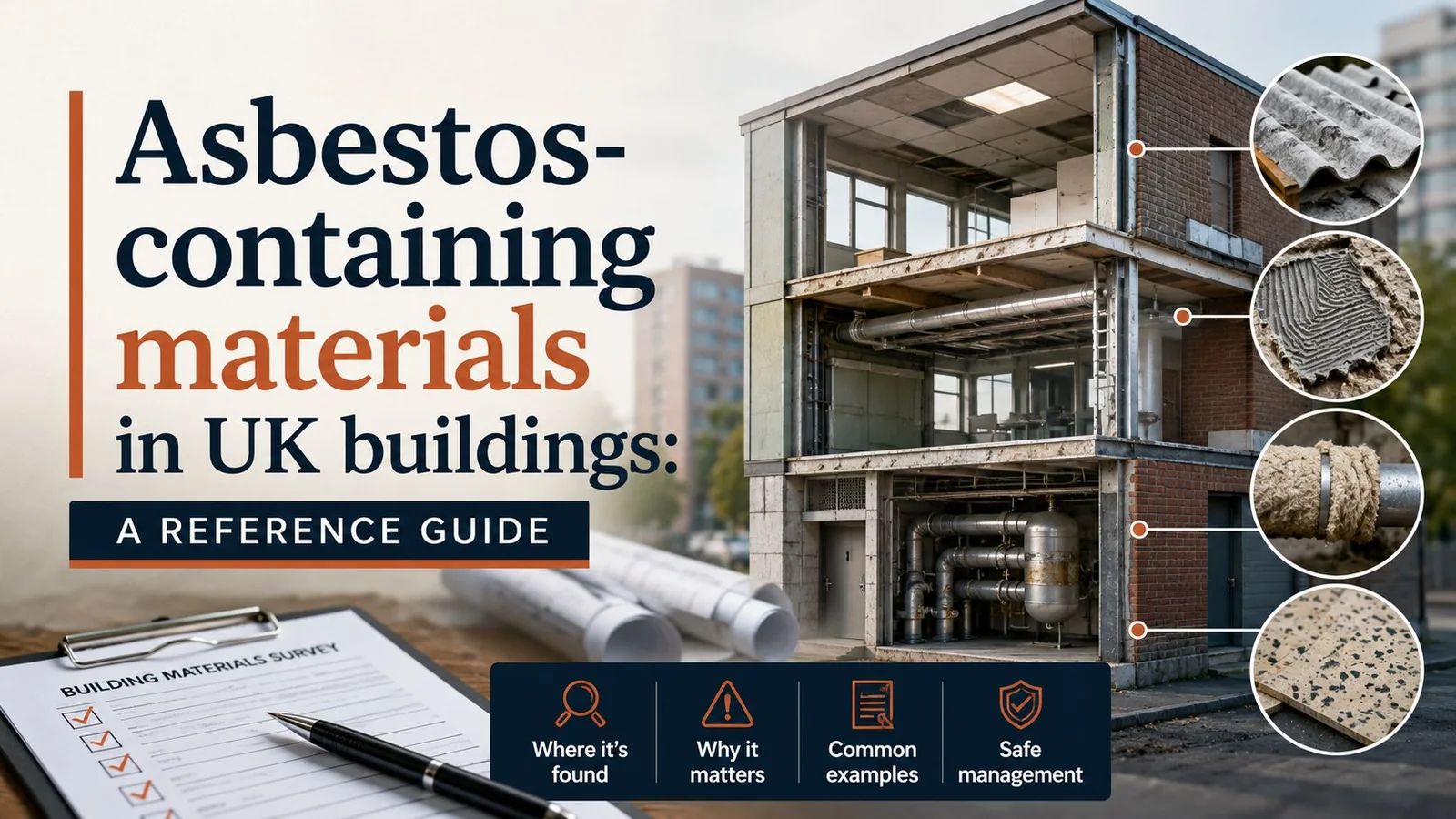
The Control of Asbestos Regulations 2012 work on a simple principle: any UK building constructed or substantially refurbished before 2000 should be presumed to contain asbestos unless evidence shows otherwise. The substance was added to so many different building products over so many decades that no single page can list every possible location. What this guide does is cover the categories of asbestos-containing material — usually shortened to ACMs — that you're most likely to encounter in UK buildings, grouped by material type, with the year ranges, locations, and risk levels for each.
Treat this page as a reference. The detail per material is more depth than most readers need in one sitting; the point is that when you're trying to identify what you've found in a building, you can come here and read the relevant section.
A reminder before going further: visual identification can raise suspicion, but only laboratory analysis at a UKAS-accredited lab can confirm asbestos. Everything below is about probability, not certainty.
Where to look first: an overview
If you're starting from scratch in a pre-2000 UK building and you want to know where to focus the inspection, the highest-probability locations are:
- Roof spaces — pipe lagging, water tanks, loose-fill insulation, AIB around tanks
- Boiler rooms and plant rooms — lagging, gaskets, panels around the boiler, flue
- Ceilings — textured coatings (Artex), AIB ceiling tiles
- Walls — AIB partitions, behind fuses and fire surrounds, in service ducts
- Floors — vinyl and thermoplastic tiles, mastic adhesives
- Roofs (external) — asbestos cement sheets on outbuildings, garages, soffits, gutters
- Service routes — pipes, ducts, risers, behind panels
The Health and Safety Executive publishes diagrams showing typical asbestos locations in domestic and commercial buildings, which is the visual reference most surveyors and trainers use.
Pipe lagging and thermal insulation
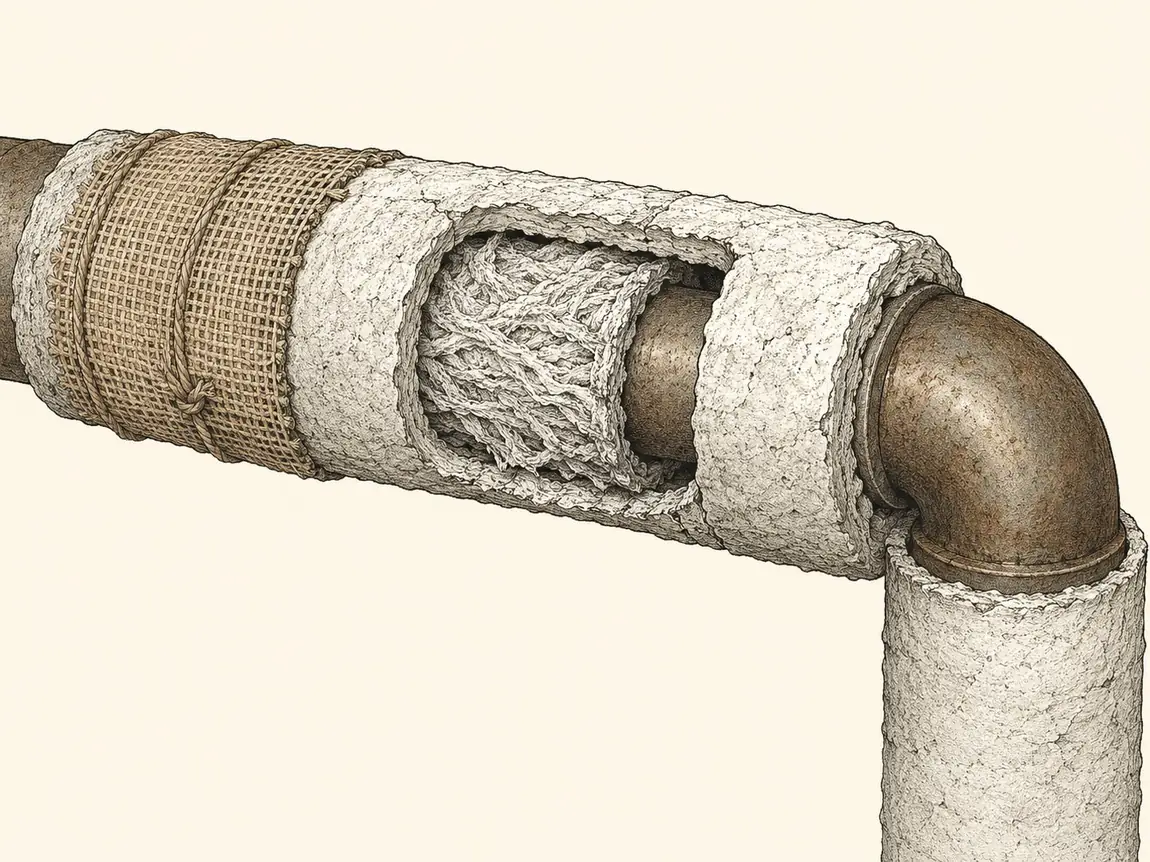
Asbestos was widely used to insulate pipes, boilers, calorifiers, and hot-water cylinders, particularly in commercial, industrial, and public buildings. The material was usually applied wet to a hessian or scrim wrap, then shaped around the pipework and painted.
- Year range: 1900s to the late 1970s in heavy commercial use; some installations into the 1980s
- Typical locations: Heating and steam pipes in boiler rooms, plant rooms, basements; around boilers and calorifiers; in service risers; on the underside of suspended ceilings; sometimes in residential airing cupboards
- Visual signal: A thick, plaster-like coating on pipes, often wrapped in cloth or canvas, frequently painted over so colour varies from white to grey to coloured. The interior, exposed where the lagging is damaged, looks fibrous and crumbly
- Friability: High. Lagging is one of the most readily fibre-releasing asbestos materials
- Risk classification: Most work on lagging is licensed asbestos work and must be done by an HSE-licensed contractor
Pipe lagging is one of the most dangerous categories. The friable nature means that a knock with a tool, a brush against a pipe, or weathering damage can release visible fibres. The disease history of laggers themselves — the workers who applied and stripped it — is one of the heaviest occupational disease burdens of the asbestos era.
If you find what you think is pipe lagging in a pre-2000 building, don't touch it, don't probe it, don't try to confirm by breaking off a piece. Report it, isolate the area, and arrange for a licensed survey.
Loose-fill insulation
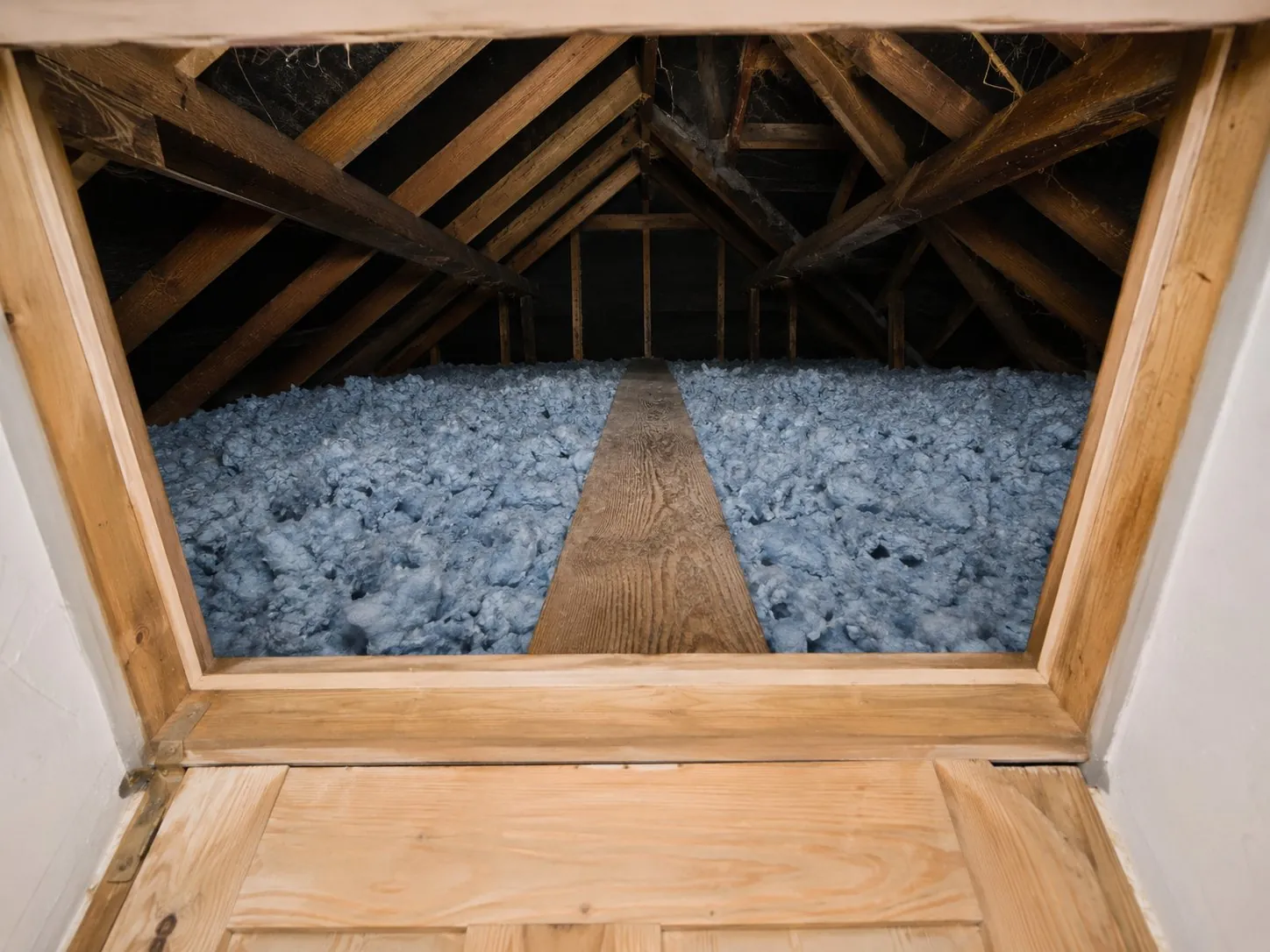
Loose-fill asbestos was used to insulate lofts, fill cavity walls, pack around cables, and provide sound insulation between floors. Unlike most other ACMs, it's essentially pure asbestos fibre — usually amosite or a mix of amphibole types — blown or poured into the cavity.
- Year range: Roughly 1930s to 1970s, with reducing use into the 1980s
- Typical locations: Lofts of older domestic and commercial properties; cavity walls in some mid-century social housing; sound packing between floors
- Visual signal: A loose, fluffy, candyfloss-like material — usually blue-grey or off-white, sometimes with a slight oily look. It moves easily; a draught from opening a loft hatch can disturb it
- Friability: Highest of any ACM category — the fibres are essentially loose
- Risk classification: Licensed asbestos work without exception
If you lift a loft hatch and see a grey, fluffy material that doesn't look like modern mineral wool, stop. Don't enter the loft. Don't move anything. The fibre release potential of loose-fill is the highest in the asbestos catalogue, and even brief disturbance can produce significant airborne concentrations.
Sprayed coatings
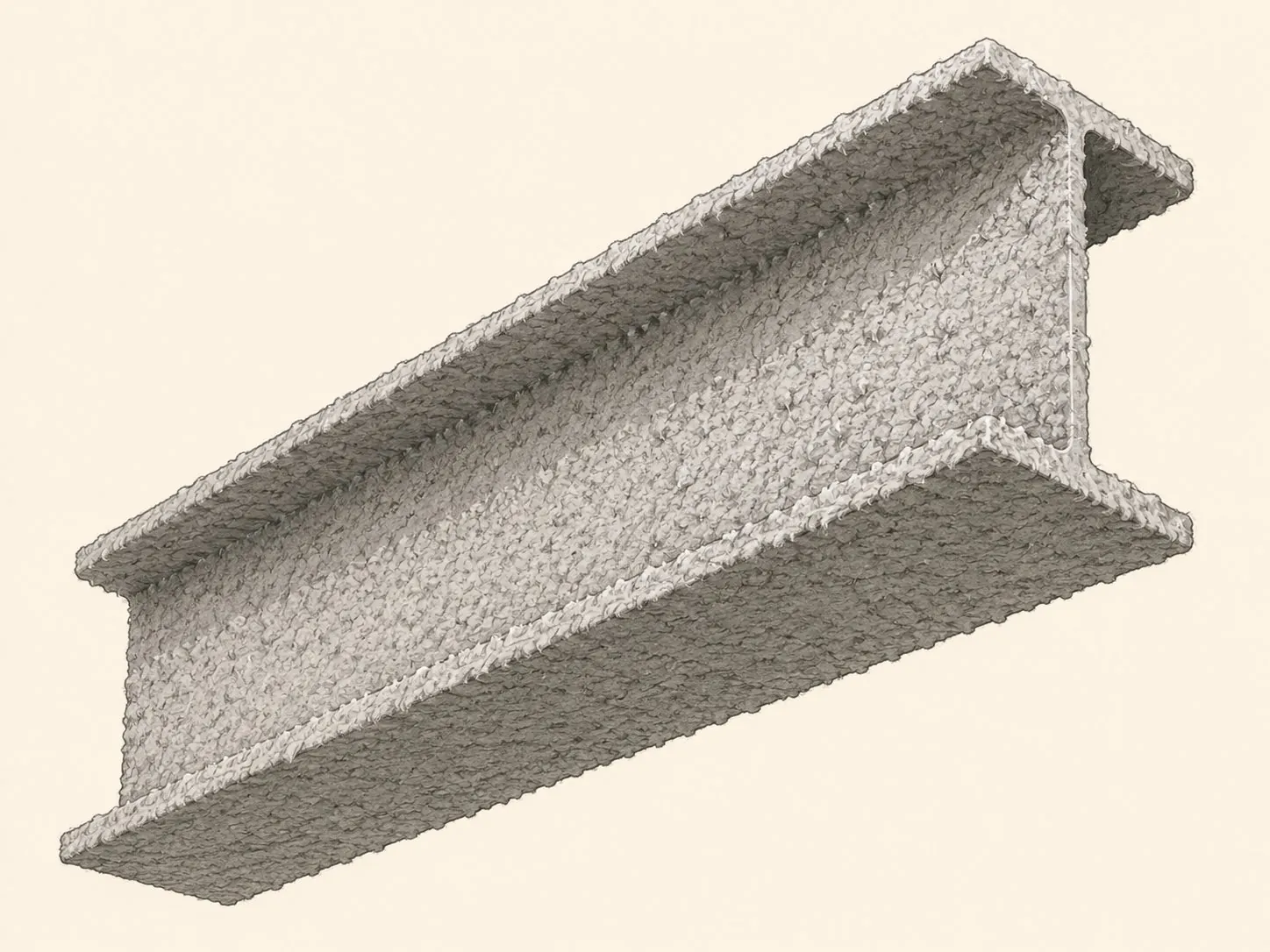
Limpet spray and other sprayed asbestos coatings were applied to structural steel, the underside of concrete floors, and ceilings in commercial buildings from the 1940s to the late 1970s. The primary purpose was fire protection of steel beams and columns; thermal insulation and acoustic damping were secondary uses.
- Year range: 1940s to late 1970s
- Typical locations: Underside of steel-framed commercial buildings, including the structural members above suspended ceilings; underside of concrete floors; sometimes on the inside of external walls and the underside of roofs
- Visual signal: A textured, fibrous, popcorn-like surface — clearly not a smooth paint or plaster finish. Colour ranges from grey to white to off-white, sometimes painted over
- Friability: Very high. Easily disturbed; major fibre release potential
- Risk classification: Licensed asbestos work
Sprayed coatings are particularly problematic because they tend to age badly. The binder degrades; the fibre becomes loose; small impacts release visible quantities of dust. Buildings of the relevant era — particularly 1950s to 70s commercial structures — may have sprayed coatings hidden in ceiling voids, requiring careful refurbishment or demolition surveys before any work.
Asbestos insulating board (AIB)
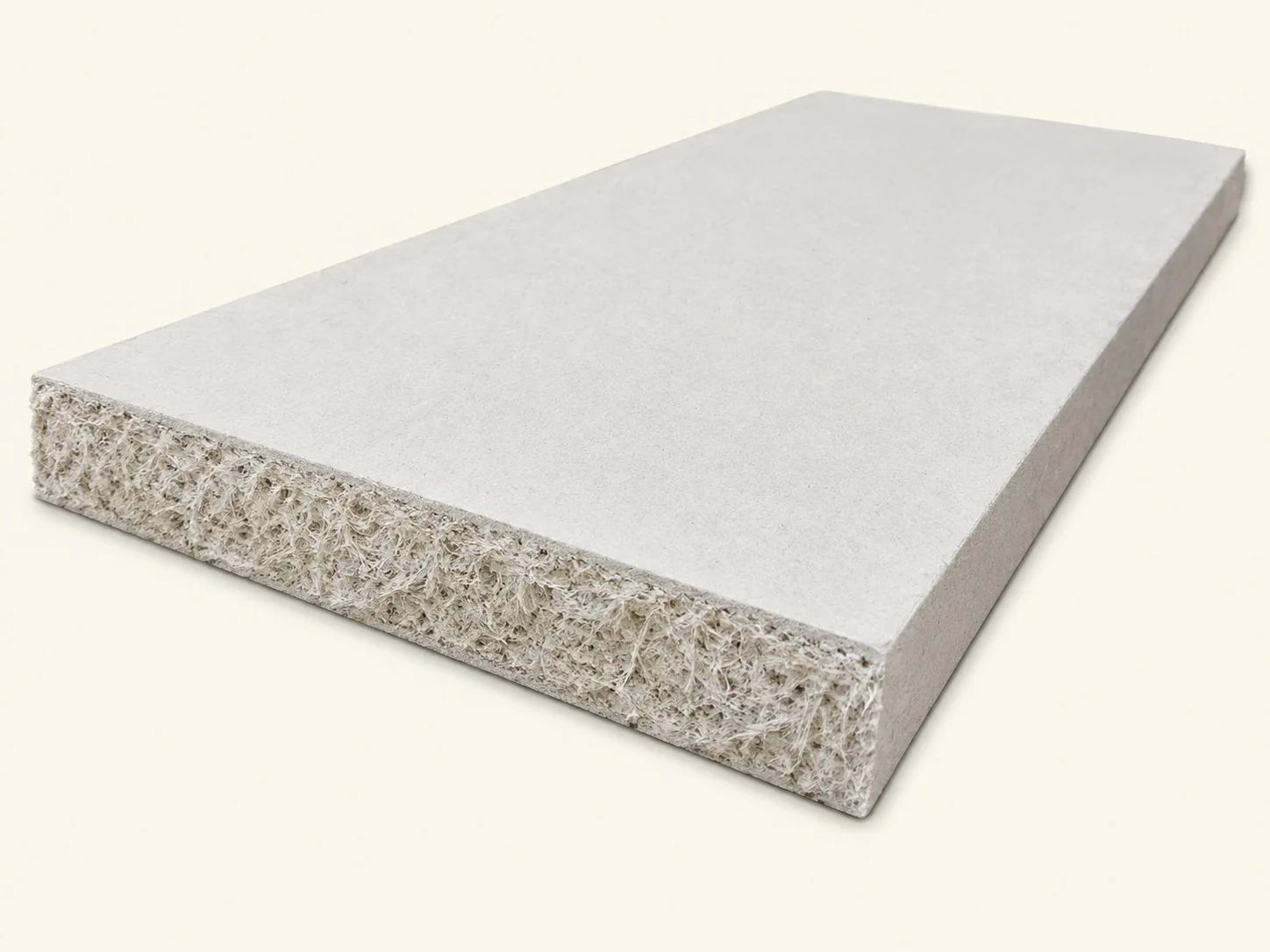
AIB is one of the more commonly encountered asbestos materials in UK commercial buildings. It typically contained 15 to 40 per cent amosite bonded into a calcium silicate or cement matrix, and was used as a fire-resistant, lightweight, machinable board.
- Year range: 1950s to mid-1980s, with declining use into the early 1980s and effectively zero after 1985 with the amosite ban
- Typical locations: Ceiling tiles in suspended ceiling grids; wall panels and partition boards; soffit panels; service riser linings; behind fire surrounds and around fire doors; behind electrical fuse boxes and switchgear; lining of plant rooms; around boilers and heating equipment; in airing cupboards; as fascia and soffit boards on building exteriors; lift shaft linings
- Visual signal: A grey or off-white fibrous-feeling board, slightly softer than fibre cement, with a recognisable but easily-confused appearance. Modern equivalents (gypsum board, mineral fibre tiles) can look very similar
- Friability: Moderate. Fibres release more easily than cement but less than lagging or sprayed coatings
- Risk classification: Work on AIB sits across the spectrum. Small-scale, short-duration work on AIB in good condition may be non-licensed work. Larger-scale work, work on damaged AIB, or work above defined thresholds in HSG247 is licensed asbestos work
AIB is the material that most often catches inexperienced workers out. It looks like other lightweight building boards, it can be cut with hand tools, and it crops up in places people don't expect — around fuse boxes, behind fires, inside fire-door linings. A drill bit through an unmarked panel in a 1970s office can release a meaningful fibre dose if the panel turns out to be AIB.
Asbestos cement: roof sheets and garage roofs
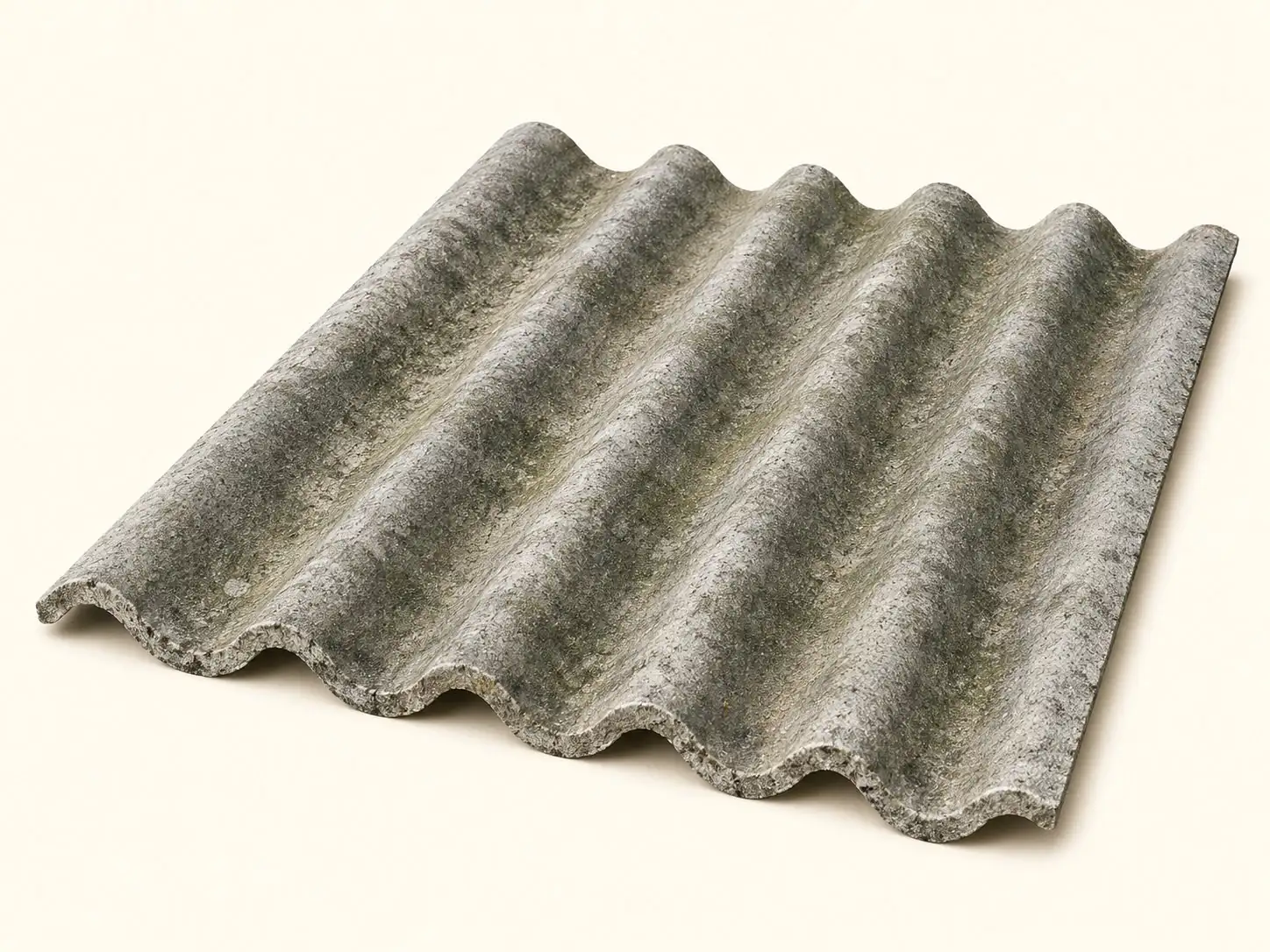
Asbestos cement sheets are the single most common asbestos material in UK buildings by volume. The composition was typically 10 to 25 per cent chrysotile (sometimes with amosite or crocidolite in older sheets) bound into a Portland cement matrix.
- Year range: 1900s to late 1990s; UK manufacturing of asbestos cement was continuing into the late 1990s
- Typical locations: Corrugated roof sheets on garages, sheds, outbuildings, agricultural buildings, industrial buildings; flat sheets used for weatherboarding and panelling; slate-style cement tiles on residential roofs
- Visual signal: Grey or weathered grey-green sheets with the characteristic wavy corrugated profile or flat panel form. Often painted; surface can weather to a mossy or stained appearance over decades
- Friability: Low. The fibres are bound into the cement matrix and don't release in normal conditions
- Risk classification: Non-licensed work for most activities; licensed work only for unusual situations (very poor condition, large-scale demolition)
Asbestos cement is the most encountered ACM and one of the more manageable. In good condition and undisturbed, it doesn't present a meaningful exposure risk. The hazardous activities are drilling, cutting, breaking, and disposal — and each of these has defined safe-working procedures set out in the HSE's Asbestos Essentials task sheets.
Asbestos cement: gutters, downpipes, soffits
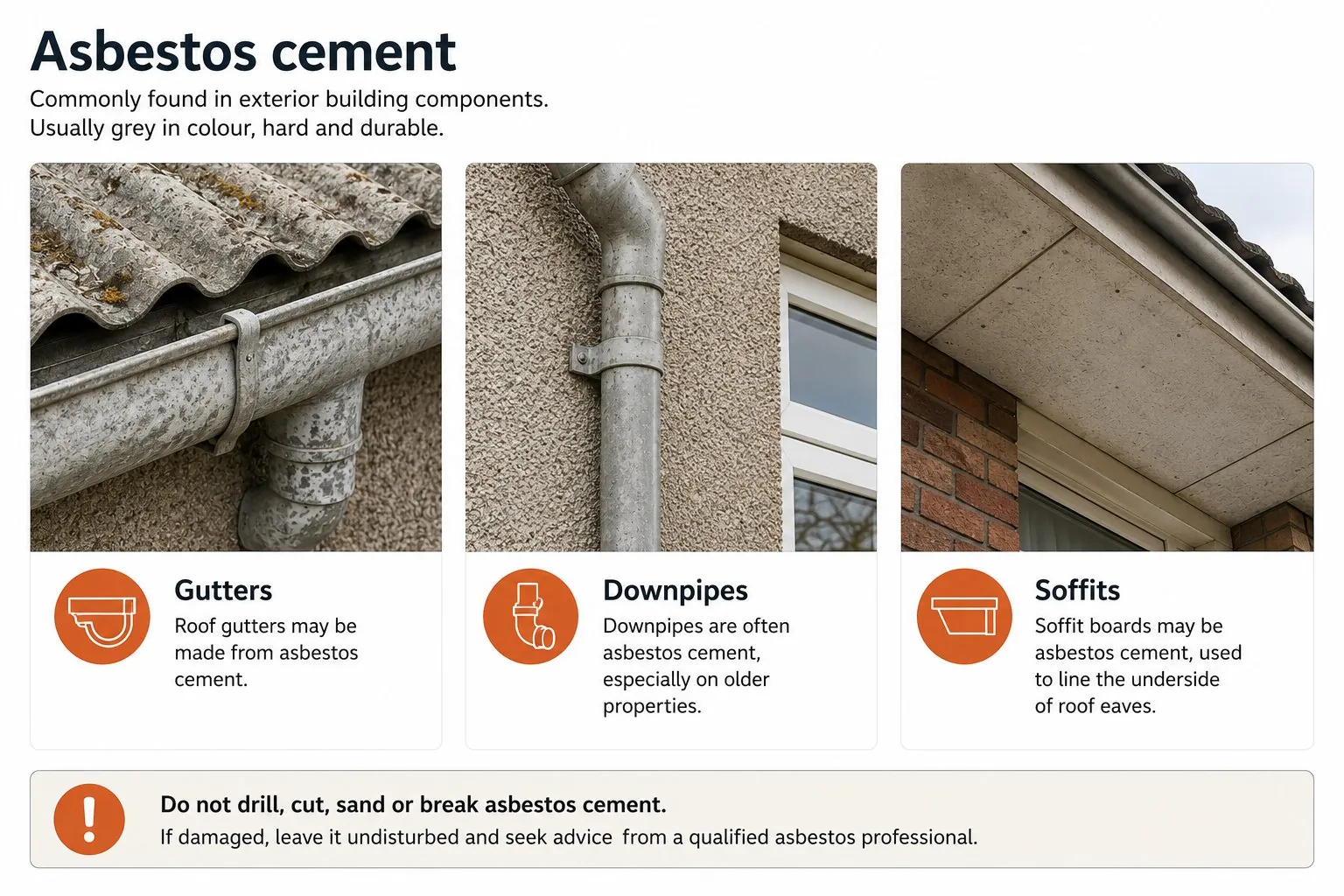
The same asbestos cement material was used in many other building products beyond roof sheets. The composition, friability, and management approach are similar to cement roof sheets — but the locations are different and the working environment when doing maintenance is often different too.
- Year range: 1900s to late 1990s
- Typical locations: Rainwater goods: gutters, hoppers, downpipes; soffit boards, eaves, and fascia panels; cladding sheets on building exteriors; garden products: planters, fence posts, panels
- Visual signal: Grey or weathered grey-green, sometimes painted. Rainwater goods often have a distinct shape that distinguishes them from modern uPVC equivalents (thicker walls, less consistent finish, sometimes joined with cement rather than plastic clips)
- Friability: Low in good condition; higher if weathered and crumbling
- Risk classification: Mostly non-licensed work; specific care for cutting and disposal
Asbestos cement: water tanks, flues, soil pipes
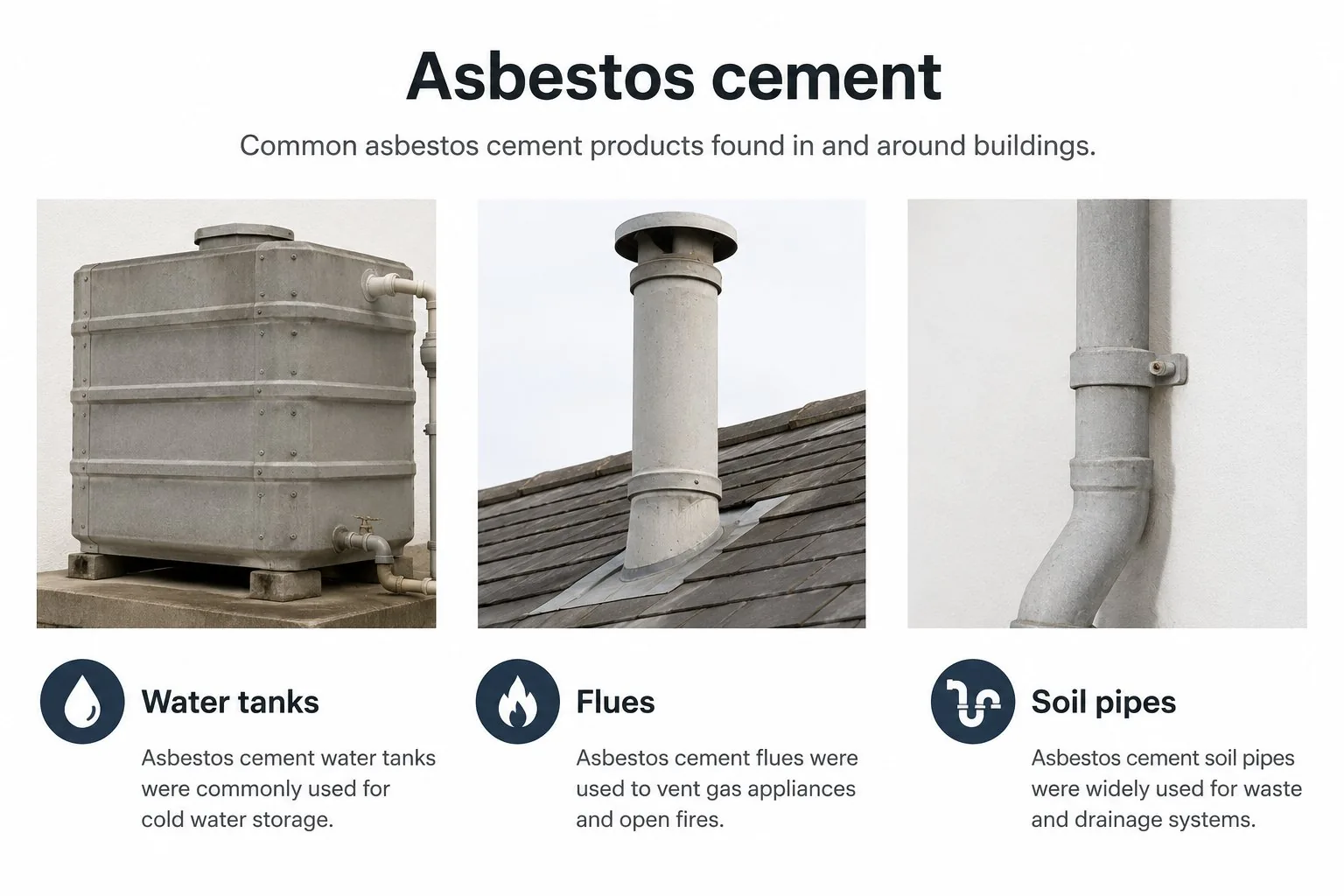
Asbestos cement was also used for products that handle water or combustion gases — applications where its corrosion and heat resistance made it well-suited.
- Year range: 1930s to 1980s
- Typical locations: Cold water storage tanks in lofts; flue pipes from gas and solid-fuel appliances; soil pipes (less common, but used in some 1950s/60s installations); cisterns and pipes in commercial plumbing
- Visual signal: Grey-cement appearance. Water tanks are often rectangular or square with a heavy, cement-like wall thickness; flues are circular section
- Friability: Low in good condition
- Risk classification: Mostly non-licensed work for replacement; flue removal requires care because of the potential for breakage
Asbestos floor tiles and mastic adhesive
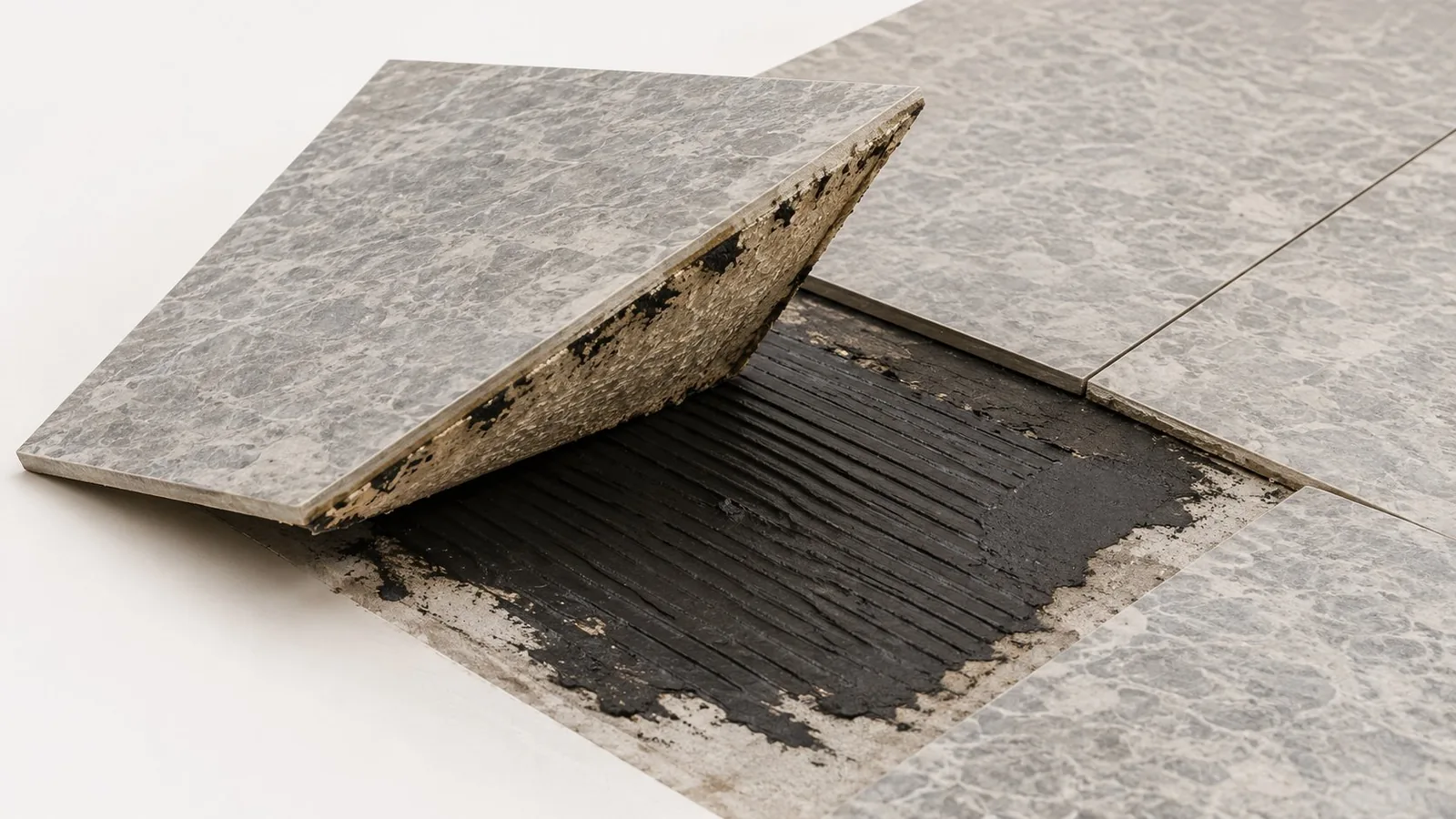
Asbestos was added to vinyl and thermoplastic floor tiles for dimensional stability and wear resistance. The tiles themselves typically contained 10 to 25 per cent chrysotile. Equally important — and often missed — is the mastic adhesive used to fix the tiles, which often contained chrysotile in its own right.
- Year range: 1950s to late 1980s for tiles; mastic adhesives used into the early 1990s
- Typical locations: Vinyl and thermoplastic floor tiles in kitchens, hallways, bathrooms, corridors, commercial floors
- Visual signal: Often 9-inch square tiles (the strongest single visual indicator), sometimes 12-inch or 18-inch. Marbled, mottled, or speckled patterns in greens, browns, greys, creams. Black or dark single-colour tiles are often asphalt-based
- Friability: Low for tiles in good condition; higher for mastic when scraped or sanded
- Risk classification: Non-licensed work for tile removal; notifiable non-licensed work (NNLW) if the tiles have paper backing
Our dedicated guide to asbestos floor tiles covers identification, the mastic adhesive trap, the paper-backing complication, and disposal in detail.
Ceilings: AIB tiles
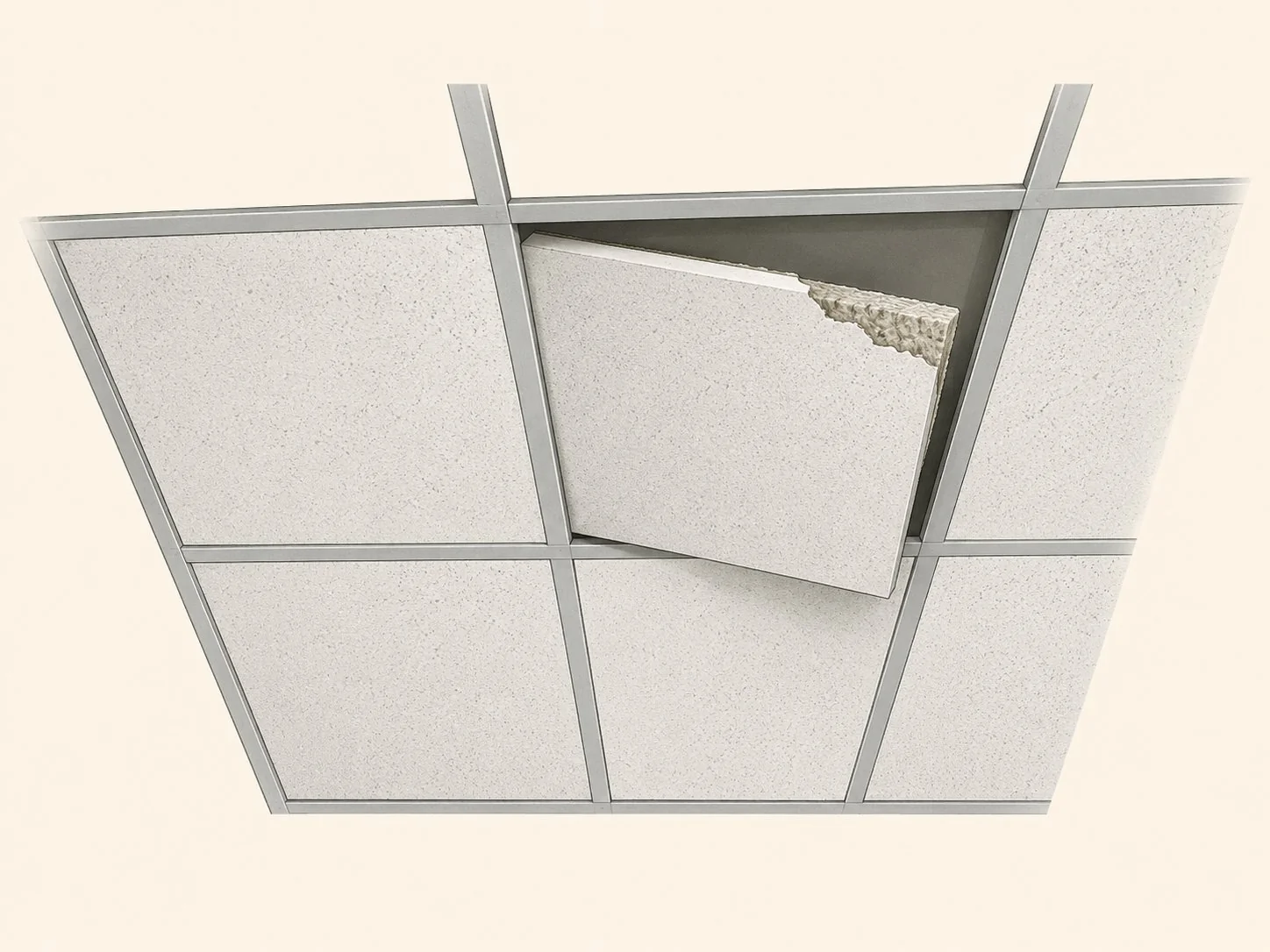
Asbestos insulating board ceiling tiles are common in UK commercial buildings of the 1960s to 1980s. They're a subset of the AIB category covered above but worth treating separately because they're so frequently encountered.
- Year range: 1960s to mid-1980s
- Typical locations: Suspended ceiling grids in offices, schools, hospitals, shops, public buildings
- Visual signal: Square tiles (usually 600mm), grey or off-white, slightly fibrous surface, sometimes with a textured pattern. The edge of a damaged tile shows the fibrous matrix
- Friability: Moderate
- Risk classification: Non-licensed or licensed depending on scope and condition
Distinguishing AIB tiles from modern mineral fibre tiles by eye is difficult. Modern tiles are generally lighter, softer, and have a more uniform colour. Only laboratory analysis confirms the answer.
Ceilings: Artex and textured coatings
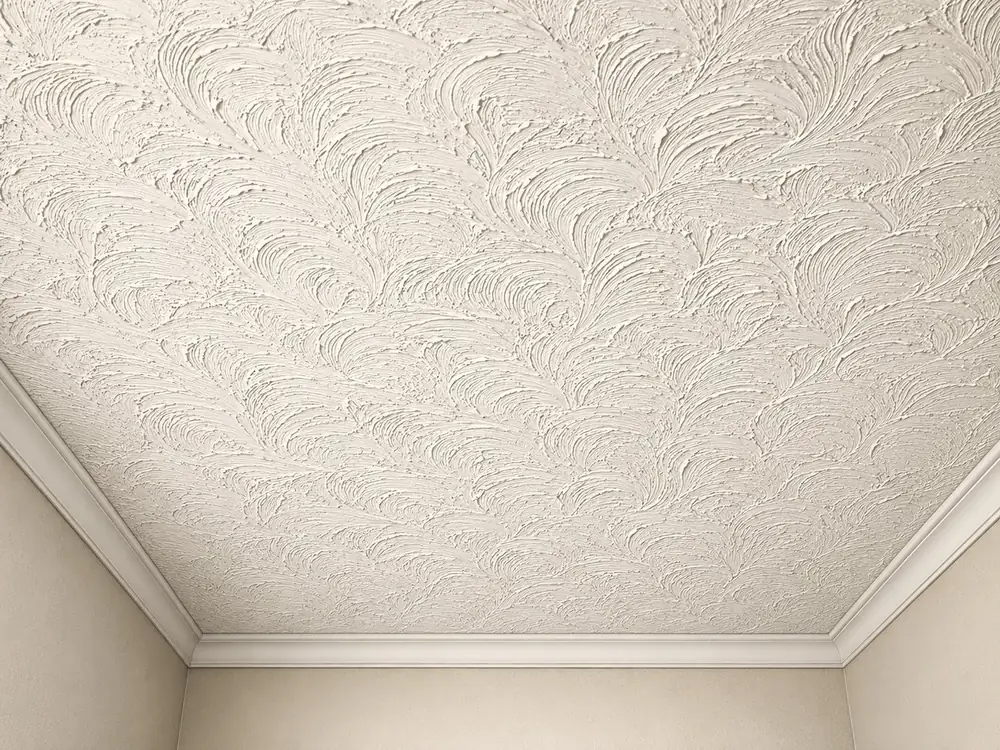
Decorative textured coatings on walls and ceilings — the swirled, stippled, or peaked finishes popular from the 1960s into the 1980s — frequently contained chrysotile, typically at a few per cent by weight. Artex is the most familiar brand name, used so widely that "Artex" is often treated as a generic description of the finish.
- Year range: 1960s to mid-1980s for asbestos-containing formulations; later product was reformulated without asbestos
- Typical locations: Ceilings in residential properties (most common), walls in some commercial settings, decorative cornices and ceiling roses
- Visual signal: Distinctive textured surface — swirled and peaked, stippled (orange-peel look), heavily stomped with a brush. Variable colours depending on subsequent decoration
- Friability: Low in intact condition; higher when sanded or scraped
- Risk classification: Non-licensed for routine repair; notifiable non-licensed work for larger-scale removal
Asbestos in textured coatings is bound into the plaster matrix and doesn't release fibres at meaningful levels in normal use. The risk arises when someone tries to sand the surface flat, steam it off, or scrape it before redecorating. That's when fibre release happens.
If your home was built or refurbished before about 1985 and has textured ceilings, treat the coating as presumed asbestos until tested. The presumption costs you nothing if you're not planning to disturb it.
Walls and partitions
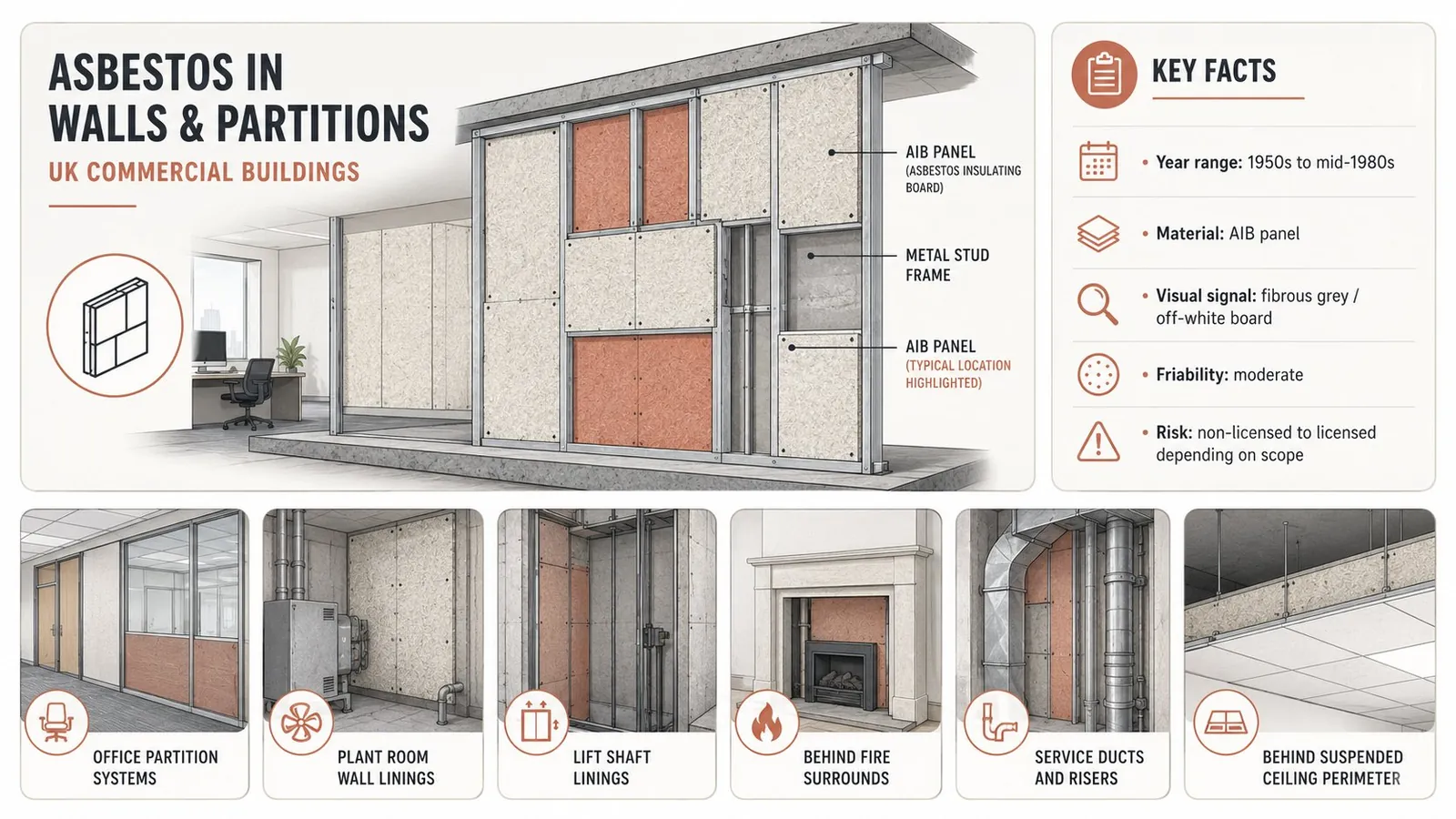
Wall and partition systems in UK commercial buildings of the asbestos era frequently incorporated AIB as a fire-resistant or lightweight panel material.
- Year range: 1950s to mid-1980s
- Typical locations: Office partition systems; plant room wall linings; lift shaft linings; behind permanent fixtures like fire surrounds; service ducts and risers; behind suspended ceiling perimeter
- Visual signal: As for AIB elsewhere — fibrous grey or off-white board
- Friability: Moderate
- Risk classification: As for AIB elsewhere — non-licensed to licensed depending on scope
The frequent error in this category is assuming that internal partition walls in a 1970s office are modern plasterboard. They may be AIB. Drilling for cable runs, wall fixings, or services without checking the panel composition is a routine cause of accidental exposure.
Heat-resistant elements: gaskets, rope seals, fire doors
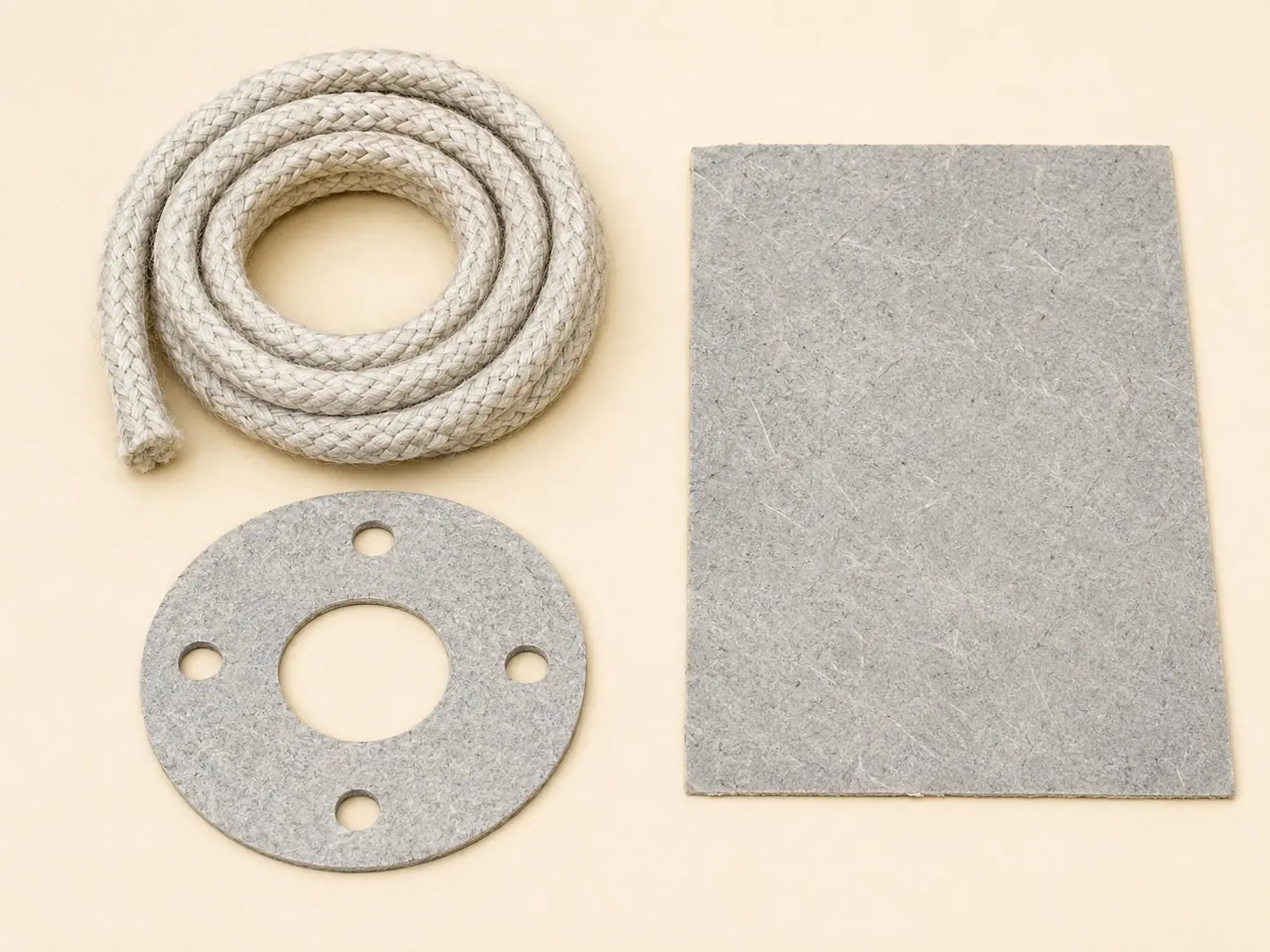
Asbestos was woven into rope and braid for use as door seals on stoves, ovens, kilns, and boilers, as gaskets between flanged pipe joints, and as the core of fire-rated doors. The applications are scattered and easy to miss in a survey.
- Year range: 1900s to mid-1980s; some uses continuing into the early 1990s
- Typical locations: Rope seals on the doors of stoves, ovens, and high-temperature equipment; gaskets between flanged pipe joints; lining of fire-rated doors (often AIB cores); around boiler doors and viewing ports; in some woodburning appliances
- Visual signal: Rope is white, off-white, or grey braid; gaskets are flat fibrous discs or rings; fire doors look like ordinary doors externally but have AIB cores
- Friability: Mid-friability
- Risk classification: Non-licensed for most activities; licensed for some specific cases
Electrical: fuse-box flash guards and cable wrap
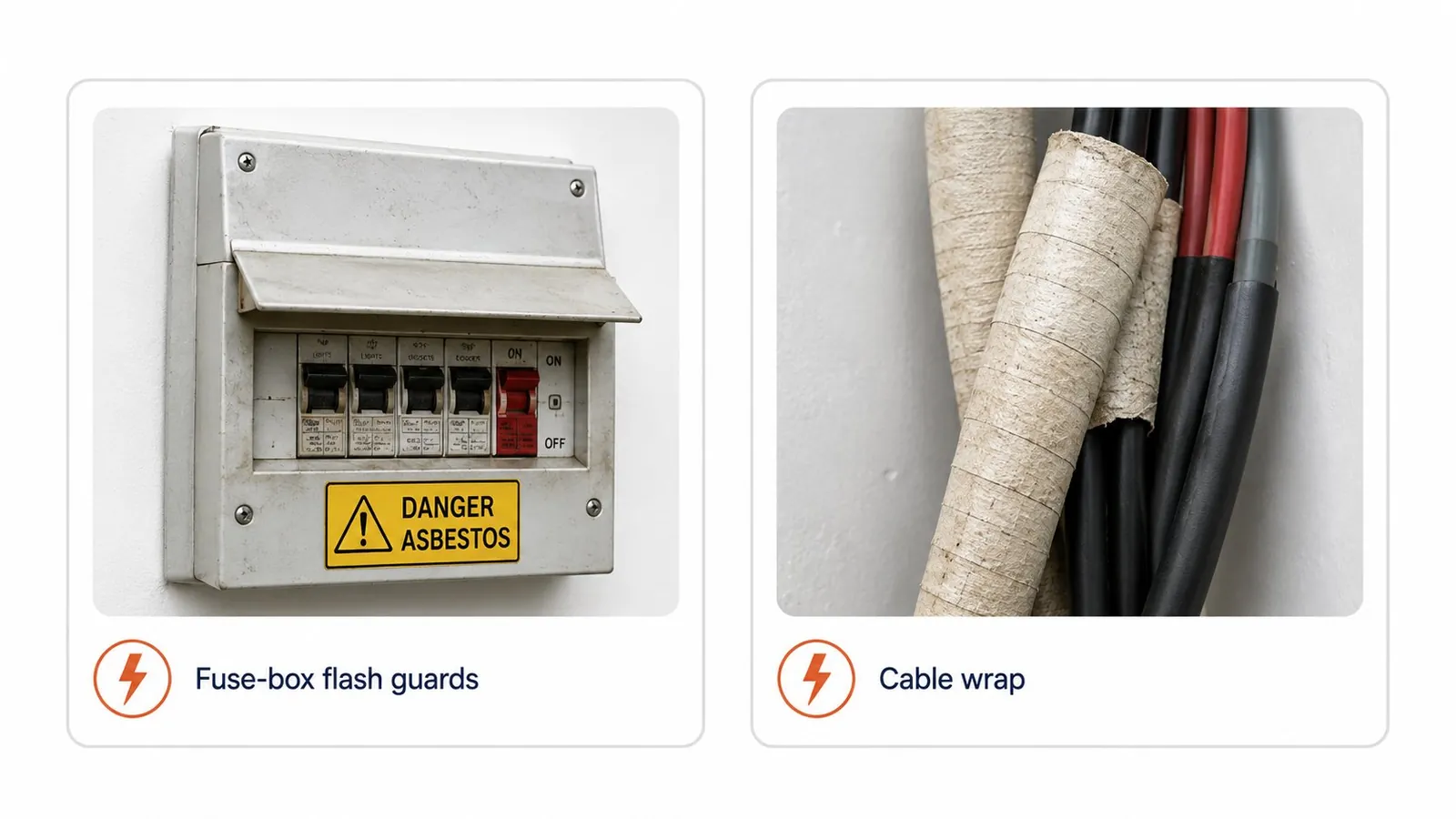
Asbestos was used for electrical insulation in several forms, mostly to provide fire resistance behind or around electrical equipment.
- Year range: 1900s to 1980s
- Typical locations: Asbestos flash guards behind fuse boxes; asbestos paper backing in fuse boxes; insulating boards behind switchgear; cable wrap on older electrical installations; lining of electrical risers
- Visual signal: Grey or off-white sheets, panels, or paper-like materials located behind or around electrical equipment
- Friability: Variable
- Risk classification: Non-licensed for most work; licensed for larger AIB removal
The pattern that catches electricians is drilling into walls behind fuse boxes to run new circuits. The panel directly behind the consumer unit in a pre-1985 property is often AIB. Drilling generates fibre release at exactly the location where the worker is breathing.
Boiler components
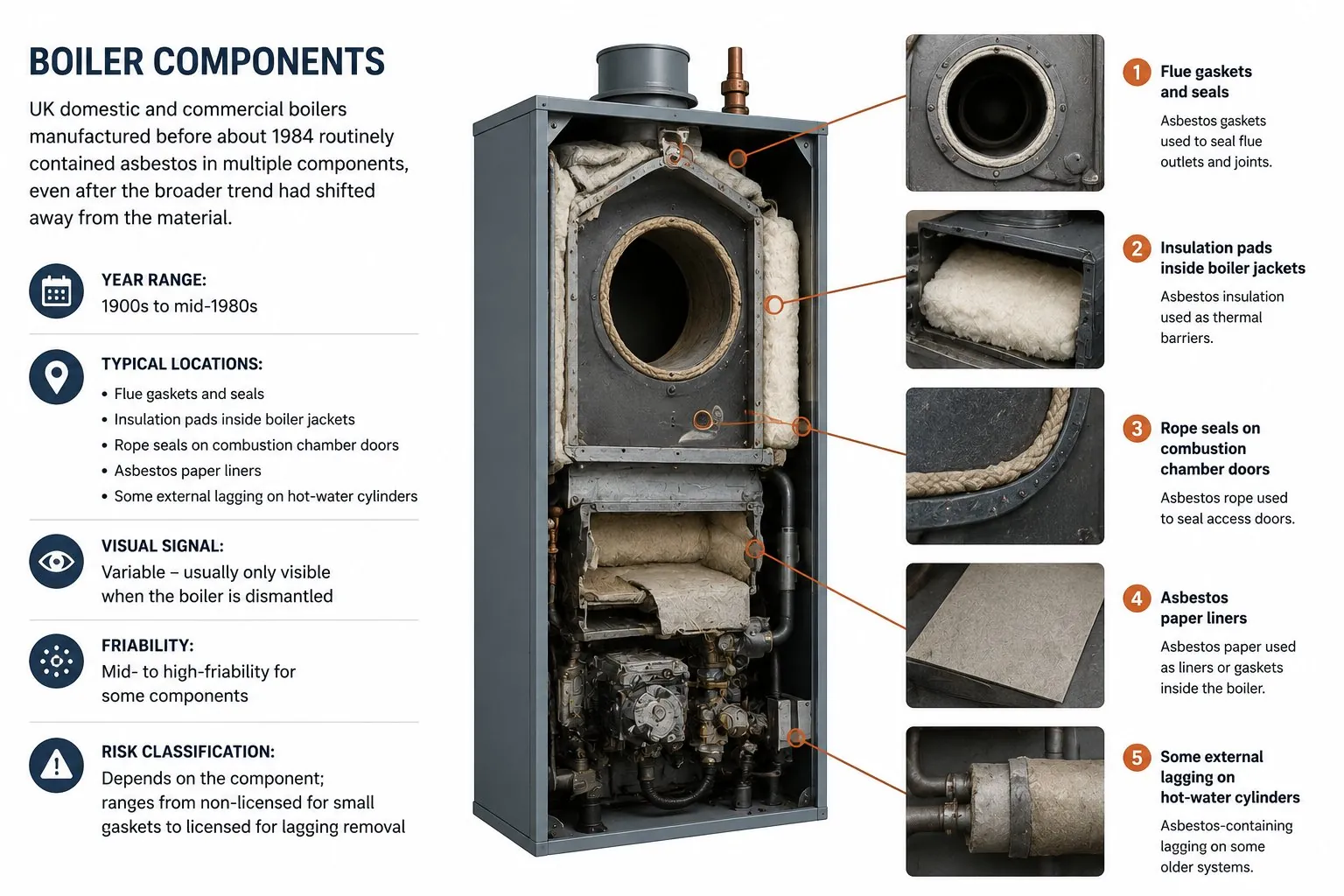
UK domestic and commercial boilers manufactured before about 1984 routinely contained asbestos in multiple components, even after the broader trend had shifted away from the material.
- Year range: 1900s to mid-1980s
- Typical locations: Flue gaskets and seals; insulation pads inside boiler jackets; rope seals on combustion chamber doors; asbestos paper liners; some external lagging on hot-water cylinders
- Visual signal: Variable — usually only visible when the boiler is dismantled
- Friability: Mid- to high-friability for some components
- Risk classification: Depends on the component; ranges from non-licensed for small gaskets to licensed for lagging removal
Older boilers themselves are increasingly being replaced through normal end-of-life upgrade cycles, and the asbestos components are usually managed as part of the replacement work by competent installers. The risk emerges when DIY work or unqualified contractors disturb the components without controls.
Where to look first in a typical home
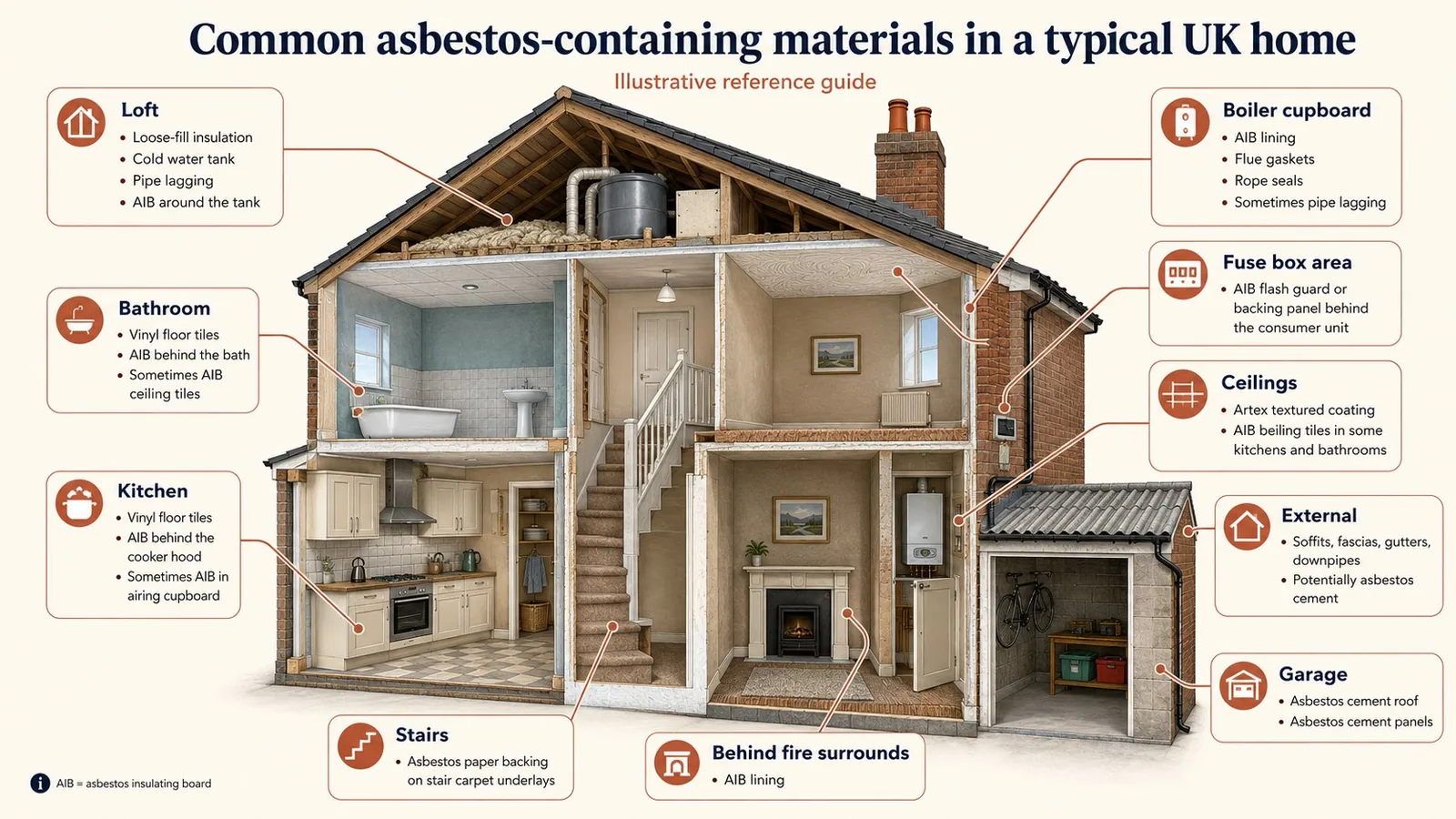
Reducing all of the above to the practical question of where to start looking in a typical UK pre-2000 home:
- Loft: loose-fill insulation, cold water tank, pipe lagging, AIB around the tank
- Boiler cupboard: AIB lining, flue gaskets, rope seals, sometimes pipe lagging
- Ceilings: Artex textured coating, AIB ceiling tiles in some kitchens and bathrooms
- Fuse box area: AIB flash guard or backing panel behind the consumer unit
- Bathroom: vinyl floor tiles, AIB behind the bath, sometimes AIB ceiling tiles
- Kitchen: vinyl floor tiles, AIB behind the cooker hood, sometimes AIB in airing cupboard
- Garage: asbestos cement roof, asbestos cement panels
- External: soffits, fascias, gutters, downpipes — all potentially asbestos cement
- Stairs: asbestos paper backing on stair carpet underlays
- Behind fire surrounds: AIB lining
If your property dates from the asbestos era and you want a definitive answer about what's in it, the right approach is a management survey by a competent surveyor. Where work is planned that might disturb materials, a refurbishment and demolition survey is required instead. The two survey types are covered in our guide to asbestos surveys.
Frequently asked questions
Which is the most common asbestos type in UK homes?
Chrysotile (white asbestos). The estimate often given is that around 90 per cent of asbestos in UK building materials is chrysotile, with the remainder split between amosite (especially in AIB and lagging) and smaller quantities of crocidolite.
Is Artex always asbestos?
No — only Artex applied before about 1985 is likely to contain chrysotile. Artex and similar textured coatings were reformulated without asbestos in the late 1980s. The product name doesn't itself indicate asbestos content; the era of application does.
Do all garage roofs from the 1970s contain asbestos?
Most of them do. Corrugated asbestos cement was the dominant material for garage, shed, and outbuilding roofs from the 1950s through to the 1980s in UK domestic and small commercial construction. A grey, weathered, corrugated roof on a pre-1990 garage should be presumed asbestos cement until tested.
Can asbestos be in plasterboard?
Standard gypsum plasterboard typically doesn't contain asbestos. The risk is in specialist boards — fire-rated boards, particularly AIB, which is often visually similar to plasterboard but compositionally different. If a panel feels fibrous to the touch and the building dates from the asbestos era, treat it as suspect.
Could a new build have asbestos?
A new build constructed after November 1999 should not contain new asbestos materials. The very rare exceptions are buildings that have reused salvaged materials of unknown provenance. New construction itself is asbestos-free.
Is asbestos common in the airing cupboard?
Yes, in pre-1985 properties. Hot water cylinders sometimes had asbestos lagging, the panel lining the airing cupboard may be AIB, and pipe lagging may run through the space. Airing cupboards in pre-1985 UK homes are one of the higher-probability locations to find ACMs.
How do I check my boiler for asbestos?
You don't — at least, not by opening it up. Asbestos in older boilers is typically inside the appliance (gaskets, insulation pads) rather than visible externally. The standard approach is to assume pre-1984 boilers may contain asbestos components and to have them removed by a competent installer following non-licensed-work procedures.
Are window sills ever asbestos?
Some interior window sills in 1960s and 70s commercial buildings were made of AIB or asbestos cement. Internal window sills in domestic properties are less commonly asbestos but not impossible — particularly composite or moulded sills from the asbestos era.
This page is the reference; the actions you take after identifying a suspected material are covered separately. For what to do if you've been exposed to or disturbed asbestos, see our practical guide. For the legal framework that governs the management of these materials in UK premises, see the Control of Asbestos Regulations 2012 and our guide to the duty to manage asbestos under Regulation 4.
For workers and supervisors whose work in pre-2000 buildings means encountering these materials is foreseeable, our CPD-certified Asbestos Awareness Course covers the training required under Regulation 10 of the Control of Asbestos Regulations 2012.
Make sure your team is trained to recognise asbestos-containing materials.
Explore the Asbestos Awareness Course →Related guides
- Types of asbestos surveys: management, refurbishment, and demolition explained
- The duty to manage asbestos: registers, plans, and what Regulation 4 requires
- What is asbestos? A UK guide to the mineral and its uses

Mark writes about workplace health & safety, asbestos awareness and accredited online training for Asbestos Awareness Course, part of Online CPD Academy.