
%201.svg)


There are six recognised types of asbestos, divided into two mineralogical groups. Three of them — chrysotile, amosite, and crocidolite — were used commercially on a large scale and account for almost all the asbestos you'll encounter in UK buildings. The other three — tremolite, actinolite, and anthophyllite — were used in small specialist applications and more often appear as natural contaminants of other minerals like talc and vermiculite.
All six are classified as Group 1 carcinogens by the International Agency for Research on Cancer. There is no version of asbestos that is safe; the differences between the types affect how readily they release fibres and how those fibres behave in the body, but they don't change the underlying classification.
This guide walks through each type — fibre shape, typical uses in the UK, when it was banned — and explains why the colour names you've probably heard are an unreliable way to identify what you're actually looking at.
The two mineral groups
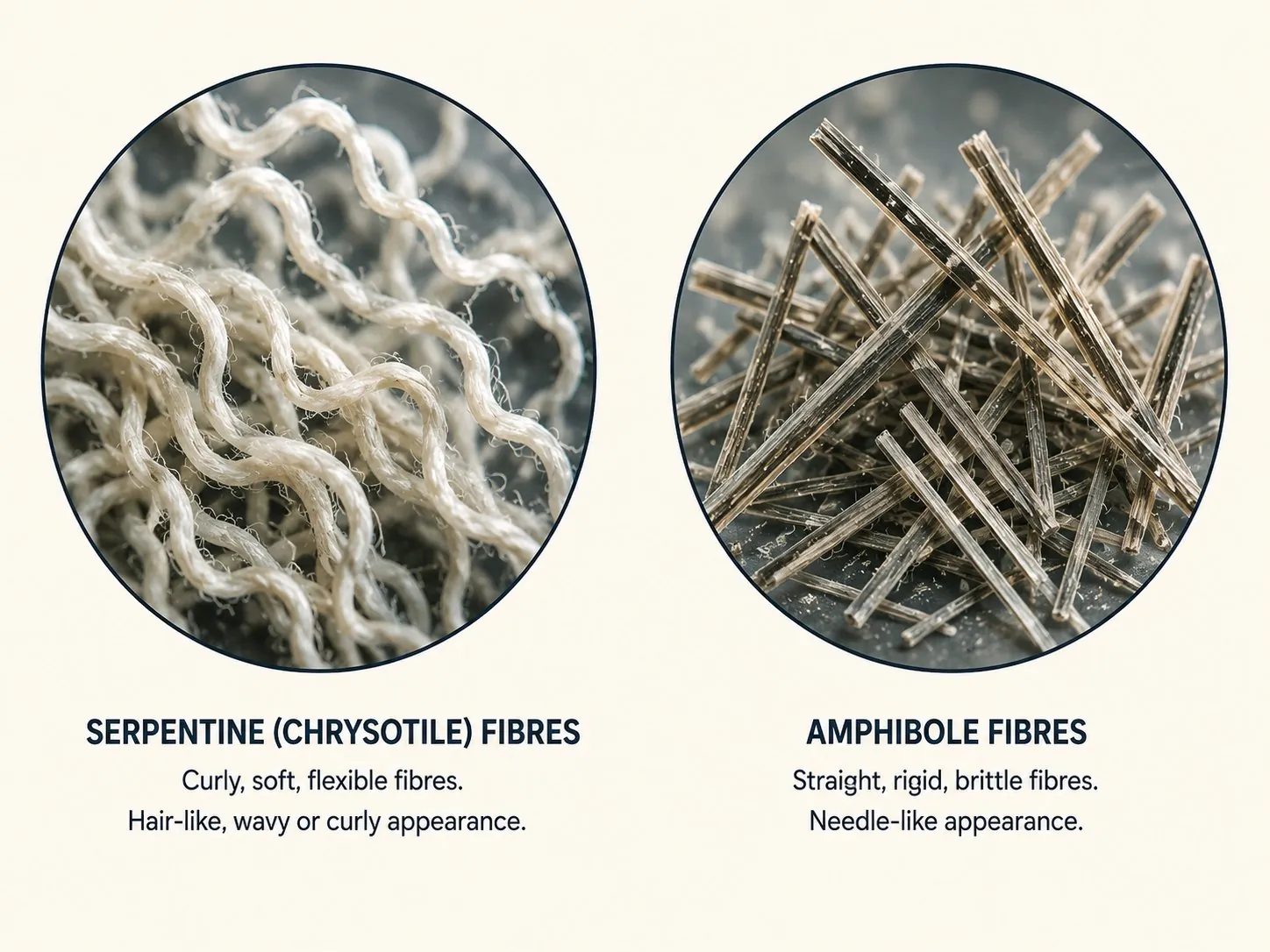
The first thing to understand is that asbestos isn't a single substance. It's a generic commercial term for a group of naturally occurring silicate minerals that share two characteristics: they're fibrous in form, and the fibres are durable enough to survive heating, chemical attack, and mechanical stress.
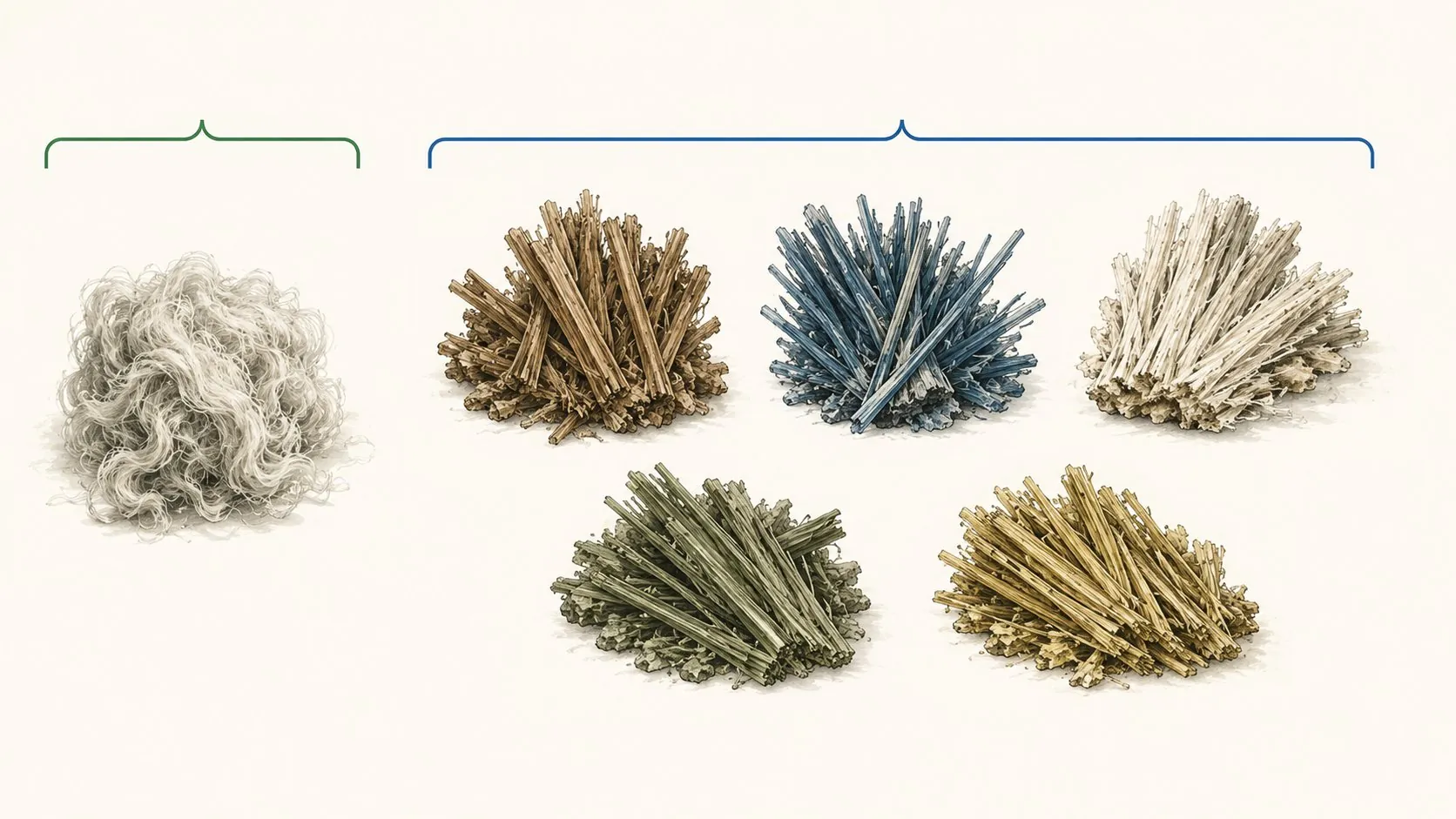
The six types split into two mineral groups based on their crystal structure:
- Serpentine asbestos — only chrysotile. Curly, soft fibres that can be spun and woven.
- Amphibole asbestos — amosite, crocidolite, tremolite, actinolite, and anthophyllite. Straight, stiff, needle-like fibres that don't bend.
The fibre shape matters because it influences how the fibres behave once inhaled. Amphibole fibres, being straight and rigid, are more bio-persistent — they're harder for the lung's clearance mechanisms to remove. Chrysotile fibres, being curly, are more readily expelled. This is the basis for the historical argument that chrysotile was less dangerous than the amphiboles, and while there's a kernel of biological truth in it, all six types remain Group 1 carcinogens. The difference is one of degree, not category.
Chrysotile (white asbestos)
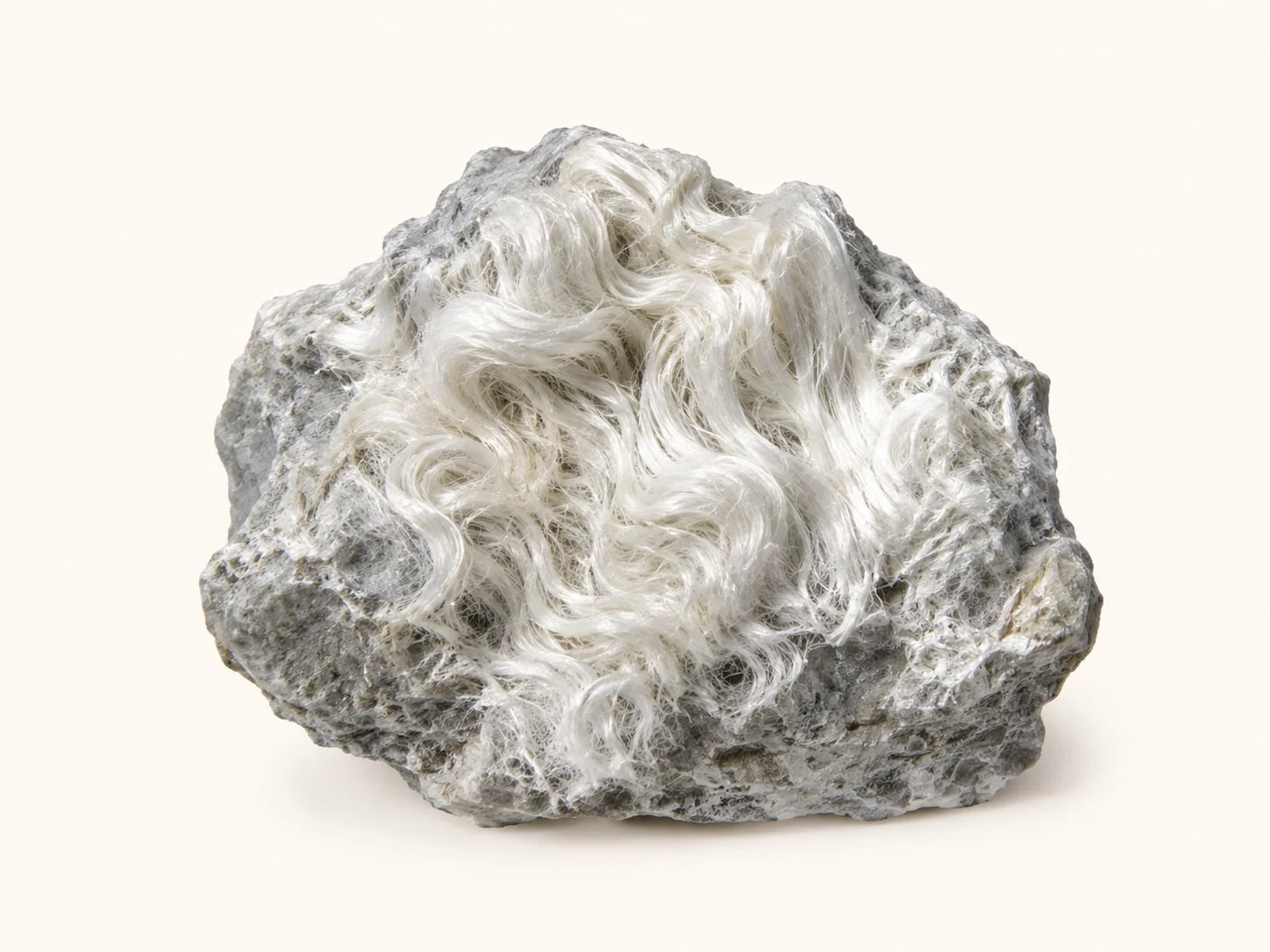
Chrysotile is the most widely used asbestos type globally and the most commonly found in UK buildings. The estimate is often given that around 90 per cent of asbestos in UK building materials is chrysotile, with the remainder split between amosite and (less commonly) crocidolite.
- Mineral group: Serpentine
- Mineralogical name: Chrysotile (Mg₃Si₂O₅(OH)₄)
- Fibre shape: Curly, soft, flexible — can be spun like cotton
- Colour in raw form: Pale grey-white to grey-green
- Banned in the UK: 24 November 1999 (the final ban)
Chrysotile's softness and flexibility made it the most versatile of the asbestos minerals. It could be spun, woven, mixed into cement, bonded into vinyl, and applied as a sprayed coating. The UK's heaviest historical uses included:
- Asbestos cement (roof sheets, gutters, downpipes, water tanks, flues)
- Vinyl and thermoplastic floor tiles
- Textured coatings on walls and ceilings (Artex being the most familiar brand)
- Rope seals and gaskets in stoves, boilers, and ovens
- Pipe lagging (often alongside amosite)
- Brake linings, clutch plates, and other automotive friction materials
- Insulation in domestic boilers and electrical equipment
Because chrysotile remained legal until 1999, you'll find it in UK building products manufactured well into the late 1990s. Many of the textured ceiling coatings and floor tiles installed in the 1980s are chrysotile-containing.
Amosite (brown asbestos)
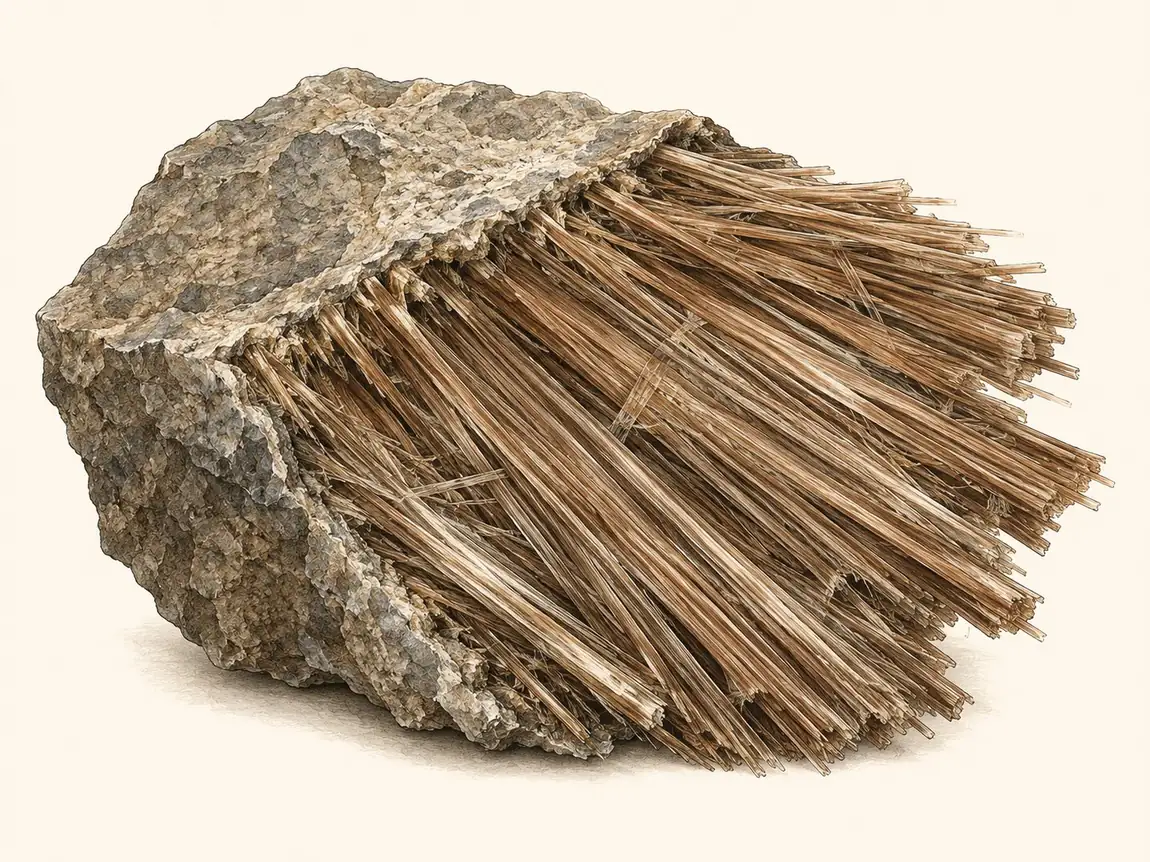
Amosite was the second most heavily used asbestos in UK construction, particularly in mid-to-late twentieth century commercial buildings.
- Mineral group: Amphibole
- Mineralogical name: Grunerite ((Fe,Mg)₇Si₈O₂₂(OH)₂)
- Fibre shape: Straight, harsh, brittle, needle-like
- Colour in raw form: Grey-brown to dull brown, sometimes greenish
- Banned in the UK: 1985 (in force from 1 January 1986)
The name "amosite" is itself an acronym — it comes from the Asbestos Mines of South Africa, the company that mined most of the world's amosite from the early twentieth century. The mineralogical name is grunerite, but you'll rarely see that used outside scientific contexts.
Amosite's combination of straight, brittle fibres and excellent heat resistance made it the asbestos of choice for:
- Asbestos insulating board (AIB) — ceiling tiles, wall panels, partition boards, fire-door linings
- Pipe lagging (often blended with chrysotile)
- Sprayed coatings on structural steel, particularly for fire protection
- Thermal insulation around boilers and calorifiers
Of all the asbestos types you'll find in a UK building, amosite is the one most associated with AIB — and AIB is one of the most encountered hazardous materials in commercial property refurbishments. Amosite is also strongly associated with mesothelioma; the disease burden among workers who installed and stripped out AIB through the 1960s and 70s is part of the reason brown asbestos was banned a decade and a half before chrysotile.
Crocidolite (blue asbestos)
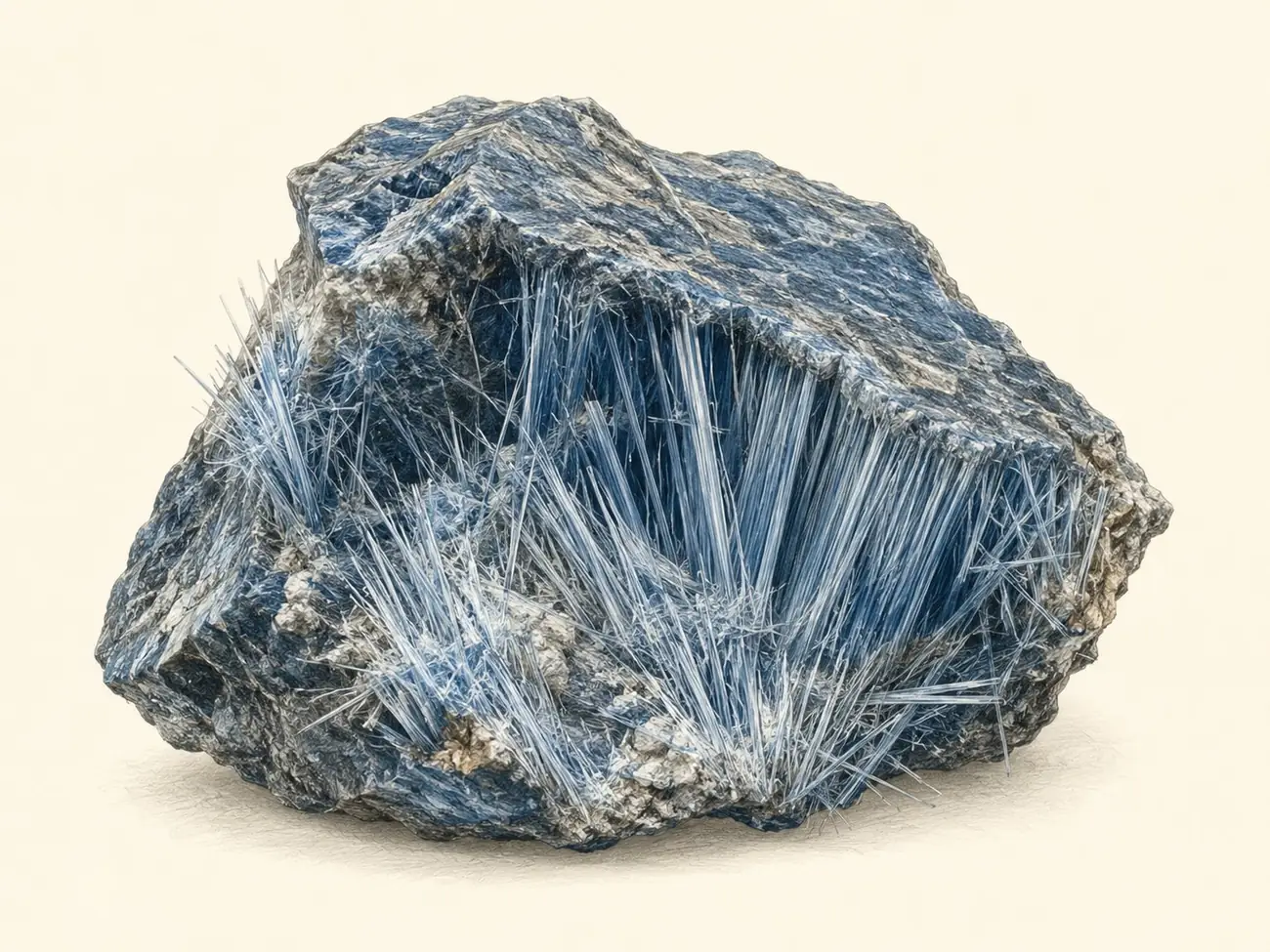
Crocidolite was used less widely than chrysotile or amosite in UK construction, but it has the highest carcinogenic potency per unit exposure and the most direct link to mesothelioma.
- Mineral group: Amphibole
- Mineralogical name: Riebeckite, fibrous form (Na₂(Fe,Mg)₅Si₈O₂₂(OH)₂)
- Fibre shape: Very thin, straight, sharp needles
- Colour in raw form: Distinct grey-blue
- Banned in the UK: 1985 (in force from 1 January 1986), with voluntary industry withdrawal from 1970
The 1960 paper by Christopher Wagner linking crocidolite exposure in South African miners to mesothelioma was the moment the modern understanding of asbestos disease began. By the late 1960s, UK industry had voluntarily stopped importing crocidolite, well ahead of the formal ban in 1985.
Crocidolite appeared in:
- Sprayed coatings on structural steel in commercial buildings, primarily 1950s and 60s
- Specialist pipe lagging, particularly in marine and industrial settings
- Cement products in some 1950s manufacturing
- Loose-fill insulation in a small number of buildings
- Asbestos-woven textiles and high-temperature gaskets
- Marine and shipbuilding insulation, where crocidolite use was extensive
Because crocidolite's commercial use ended earlier than the other two main types, you're less likely to find it in UK domestic property than chrysotile or amosite. But where it does occur — particularly in commercial and industrial buildings of the 1950s and 60s — it commands the most stringent precautions.
Tremolite, actinolite, and anthophyllite
These three amphibole minerals were used commercially in only limited quantities — and where they do appear, it's often as contaminants of other materials rather than as deliberately added asbestos.
Tremolite (Ca₂Mg₅Si₈O₂₂(OH)₂) is a white to greenish amphibole that wasn't commercially mined as asbestos but is the most common contaminant of chrysotile deposits. It also occurs in some talc and vermiculite ore bodies, which is why vermiculite-based loft insulations from certain North American mines (notably Libby, Montana) carried a tremolite contamination risk. Some products imported into the UK in the 1970s and 80s carried trace tremolite as a result.
Actinolite ((Ca,Fe,Mg)₇Si₈O₂₂(OH)₂) is a darker green-to-brown amphibole, used in even smaller quantities than tremolite. Like tremolite, it more often appears as a contaminant than a deliberate ingredient.
Anthophyllite ((Mg,Fe)₇Si₈O₂₂(OH)₂) is a yellow-brown amphibole that saw some specialist use in insulation and construction materials in the mid-twentieth century, though much less than the three main commercial types.
All three are covered by the same regulatory framework as the commercial asbestos types. If they're identified in a sample during analysis, they're treated as asbestos for the purposes of management, disposal, and licensing.
All six at a glance
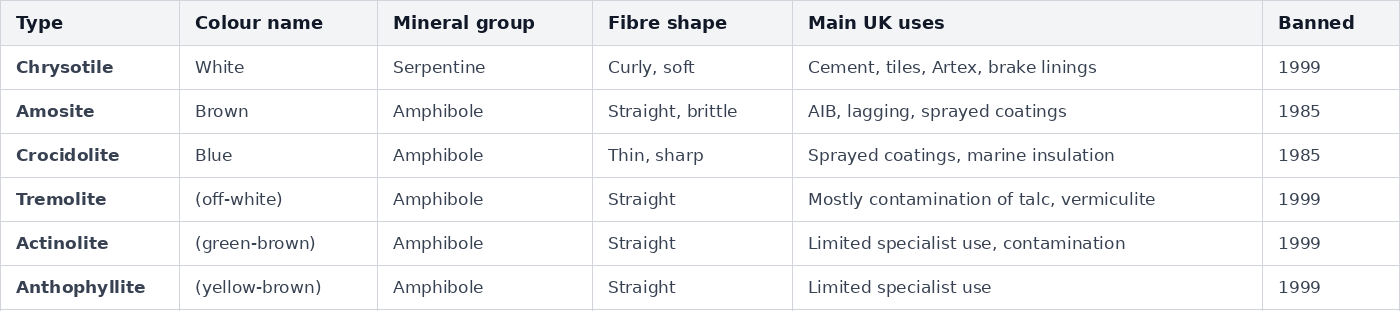
The six types at a glance, with the colour name, mineral group, fibre shape, main UK uses, and ban date for each:
- Chrysotile (white asbestos) — serpentine mineral, curly soft fibres. Used in cement, tiles, Artex, and brake linings. Banned 1999.
- Amosite (brown asbestos) — amphibole mineral, straight brittle fibres. Used in AIB, lagging, and sprayed coatings. Banned 1985.
- Crocidolite (blue asbestos) — amphibole mineral, thin sharp fibres. Used in sprayed coatings and marine insulation. Banned 1985.
- Tremolite (off-white) — amphibole mineral, straight fibres. Mostly appears as contamination of talc and vermiculite. Banned 1999.
- Actinolite (green-brown) — amphibole mineral, straight fibres. Limited specialist use, often a contaminant. Banned 1999.
- Anthophyllite (yellow-brown) — amphibole mineral, straight fibres. Limited specialist use. Banned 1999.
The 1985 ban specifically covered crocidolite and amosite. The other four were swept up by the 1999 amendment when it banned all remaining asbestos forms.
Which type is most dangerous?
This is the question every page on the topic answers slightly differently, and the honest answer requires nuance.
The IARC classifies all six asbestos types as Group 1 carcinogens — known to cause cancer in humans. No type is safe at any exposure level. The "no safe threshold" principle applies to all of them.
Within that, there are meaningful differences in fibre behaviour:
- Crocidolite fibres are the thinnest and sharpest, and they're the most strongly linked to mesothelioma in epidemiological studies. On a fibre-for-fibre basis, crocidolite is generally considered the most carcinogenic.
- Amosite sits second, with a strong mesothelioma association from AIB installation and stripping work.
- Chrysotile is the least bio-persistent of the three commercial types because its curly fibres are more readily cleared from the lungs, but it's the most widely encountered because of its dominant commercial use.
The practical implication is that "which is worst" matters less than "how much, for how long, and in what condition". A friable, damaged amosite ceiling tile being broken up with a hammer is a very different hazard from intact chrysotile-bonded cement on a stable garage roof. Both are asbestos; both are regulated; but the work activity and material condition drive the actual risk profile.
Why colour identification is unreliable
The colour names — white, brown, blue — refer to the appearance of the raw mineral fibre in mined form. Once asbestos is bound into a building product, the original colour is no longer visible. A chrysotile-containing cement sheet is grey, the colour of cement. A textured ceiling coating with chrysotile in it is whatever colour the householder painted it. A floor tile with amosite is the colour the manufacturer designed.
This is the most common misconception in DIY asbestos identification: that you can spot which type you're dealing with by what colour the material is. You can't. The only reliable way to identify the type is laboratory analysis, typically polarised light microscopy on a small physical sample at a UKAS-accredited lab.
Even within raw asbestos, colour is variable. Chrysotile ranges from white to grey-green depending on the deposit. Crocidolite can look more grey than blue in some lighting. Amosite varies from grey-brown to almost greenish. The colour names are a useful shorthand for someone who already knows the mineralogy; they're not a field identification tool.
Frequently asked questions
Are all six types of asbestos equally dangerous?
No, but all are classified as Group 1 carcinogens. The amphibole types — particularly crocidolite — are considered more potent per unit exposure than chrysotile because their straight, rigid fibres are more bio-persistent in the lungs. The legal and regulatory treatment is the same regardless.
Was blue asbestos banned before white?
Yes. Crocidolite and amosite were banned in 1985. Chrysotile remained legal until 24 November 1999.
Why was chrysotile considered safer?
Because its curly fibre structure makes it less bio-persistent — easier for the lung's natural clearance mechanisms to remove. That distinction influenced the regulatory approach for years, but contemporary epidemiology shows clearly that chrysotile causes mesothelioma, lung cancer, and asbestosis. It's safer in a relative sense, not in an absolute one.
What's the difference between amosite and crocidolite?
Both are amphibole asbestos with straight, needle-like fibres, but they're different minerals. Amosite is grunerite (iron-magnesium silicate, grey-brown). Crocidolite is fibrous riebeckite (sodium-iron silicate, blue-grey). Crocidolite fibres are typically thinner and sharper, and crocidolite has the strongest epidemiological link to mesothelioma.
Are tremolite and actinolite ever found in UK homes?
Occasionally, usually as contaminants rather than primary ingredients. Vermiculite loft insulation from contaminated North American mines is the most common pathway. Some older talc-based products may also carry trace tremolite.
Can you identify the type of asbestos by colour alone?
No. The colour names refer to the raw mineral, which you'll almost never see in a building. Once asbestos is bound into cement, board, vinyl, or paint, the original colour is gone. Laboratory analysis is the only reliable identification method.
For a deeper look at what these materials actually look like in UK buildings, see our visual reference for recognising asbestos. For the legal framework that now governs all six types and the buildings they're in, see the Control of Asbestos Regulations 2012. For the historical context of how and when each type was prohibited, our UK asbestos ban timeline walks through the legislation. And for tradespeople and supervisors who could foreseeably disturb any of these asbestos types in their work, our Asbestos Awareness Course covers the training required under Regulation 10.
The HSE's general guidance on asbestos provides the official regulatory reference for all six types.