
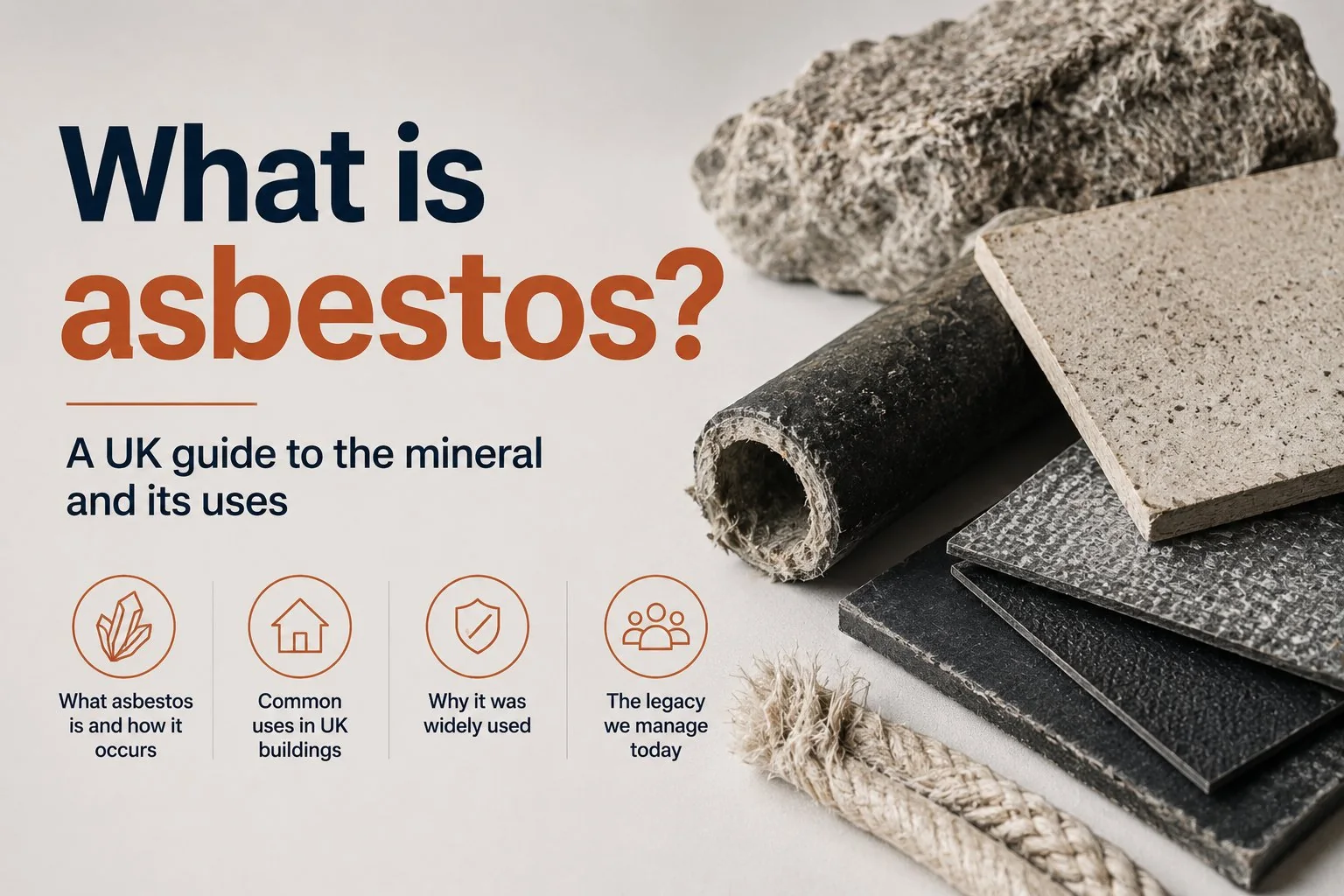
Asbestos is the generic commercial name for a group of six naturally occurring fibrous silicate minerals. The name covers two different mineral families — one curly, one straight-fibred — but they share three qualities that made them industrially valuable for most of the twentieth century: they resist heat, they resist chemical attack, and their fibres are mechanically strong.
The same qualities that made asbestos useful in buildings make it dangerous in human lungs. The fibres are durable, microscopic, and easily inhaled when materials containing them are damaged or worked on. The diseases that follow inhalation can take decades to appear, which is why a substance that was banned in the UK in 1999 still kills around 5,000 people a year here.
This page covers what asbestos actually is — at the level of the rock it comes from and the products it ended up in — without going into the disease detail covered elsewhere on this site.
The two mineral groups
Asbestos isn’t one substance. It’s a category that covers six different silicate minerals from two distinct mineral families.
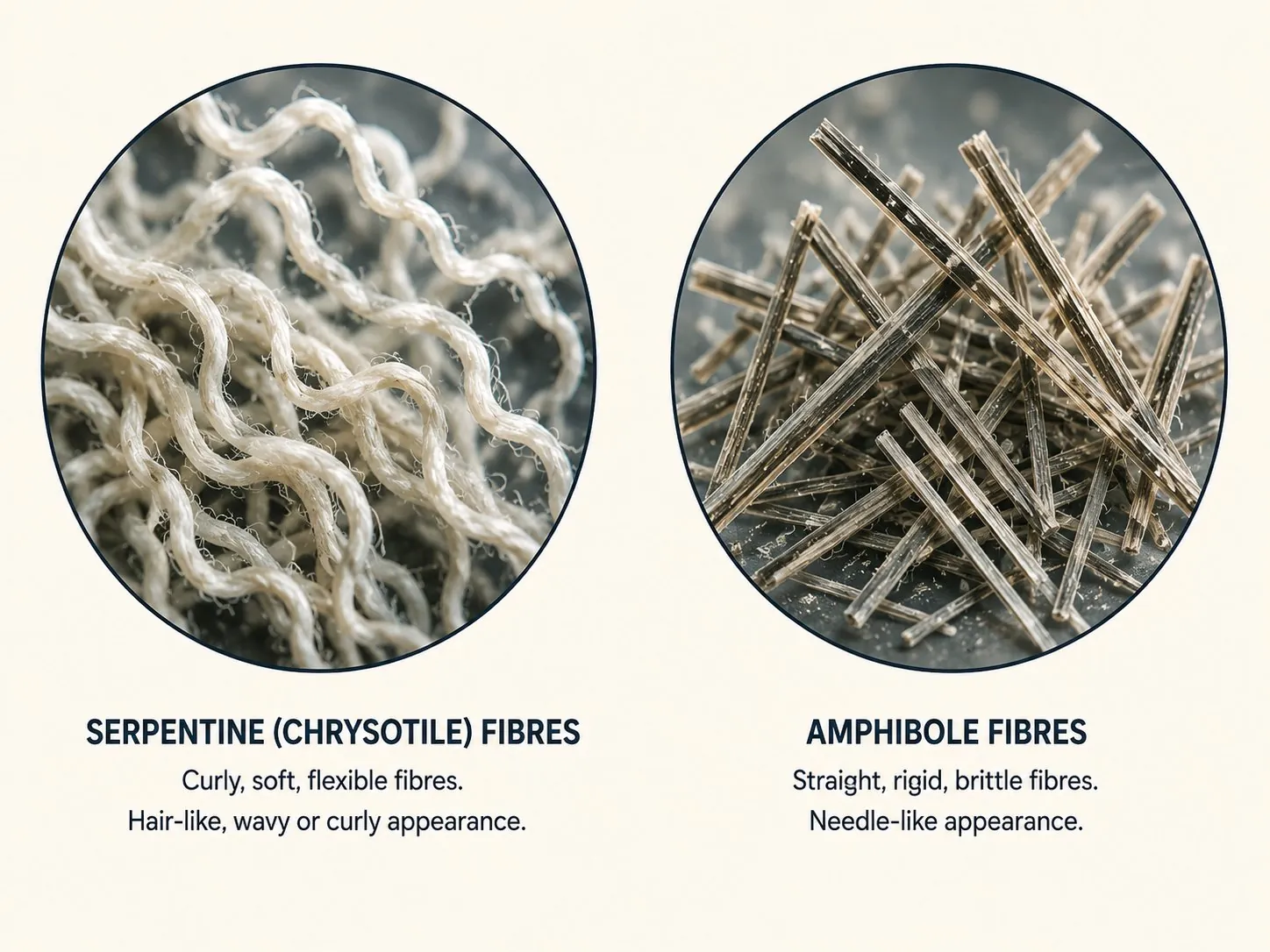
Serpentine asbestos contains one type — chrysotile. It’s the most widely used asbestos globally and accounts for most of the asbestos in UK buildings. The fibres are curly, soft, and flexible, which is why chrysotile could be spun and woven like cotton fibre.
Amphibole asbestos contains the other five types — amosite, crocidolite, tremolite, actinolite, and anthophyllite. The fibres are straight, rigid, and needle-like rather than curly. Amosite and crocidolite were used commercially on a substantial scale. The other three were used in only small quantities, and more often appear as natural contaminants of other minerals like talc and vermiculite than as deliberate ingredients.
The fibre shape matters because it affects how the fibres behave once they’re inhaled. Straight amphibole fibres are more bio-persistent — the lung’s clearance mechanisms find them harder to remove than the curly chrysotile fibres. This is the biological basis for the regulatory distinction that led to crocidolite and amosite being banned in 1985, fourteen years before chrysotile.
Our guide to the types of asbestos covers the six minerals in detail.
Where asbestos comes from
Asbestos minerals are mined from rock formations where the right geological conditions have produced fibrous, rather than crystalline, mineral growth. The fibres typically form in seams within a host rock and are extracted by crushing the rock and separating the fibre from the surrounding matrix.
Historically, the main producing countries were:
- Canada — once one of the world’s largest chrysotile producers, particularly from mines in Quebec; ceased production in 2011 and implemented a full asbestos ban in 2018
- Russia and the former Soviet Union — the largest current producer, with chrysotile mining continuing today
- South Africa — historically a major producer of amosite (the name itself comes from “Asbestos Mines of South Africa”) and crocidolite; production ceased in 2002
- Australia — a significant historical producer, particularly of crocidolite from the Wittenoom mine; banned and closed
- China, India, Kazakhstan, Brazil — current chrysotile production continues
Asbestos has never been mined commercially in the UK. The country was an importer, not a producer — and at the peak in the 1960s and 70s the UK was importing somewhere in the region of 170,000 tonnes a year for use in construction, shipbuilding, and manufacturing.
Why asbestos was used industrially
Setting aside the disease history for a moment, asbestos was an exceptionally useful material. The properties that drove industrial adoption from the late nineteenth century through to the late twentieth were:
Heat resistance. Asbestos fibres don’t burn, don’t melt at ordinary fire temperatures, and conduct heat poorly. This made them ideal for fireproofing structural steel, insulating boilers and pipes, lining fire doors, and sealing high-temperature joints.
Chemical resistance. Asbestos resists attack from most acids and alkalis, which was useful in industrial environments and in products like asbestos-cement piping carrying aggressive water or chemicals.
Mechanical strength. The fibres are strong in tension, which is why they were used as a reinforcing fibre in cement (asbestos cement) and in vinyl floor tiles. A few per cent of chrysotile dramatically improves the dimensional stability and impact resistance of either material.
Versatility of form. Asbestos could be spun, woven, mixed with cement, applied as a sprayed coating, made into rigid boards, or used as a loose insulation fill. Few alternative materials offered the same range of physical forms.
Cost. Asbestos was cheap to mine, cheap to process, and cheap to incorporate into products. The economics of substitution were never favourable until regulation forced the issue.
These properties drove a peak of industrial use that placed asbestos into more than 3,000 different products globally, ranging from building materials to consumer goods. Most of the asbestos still in UK buildings today reflects construction-sector applications from this peak period.
What asbestos was used in
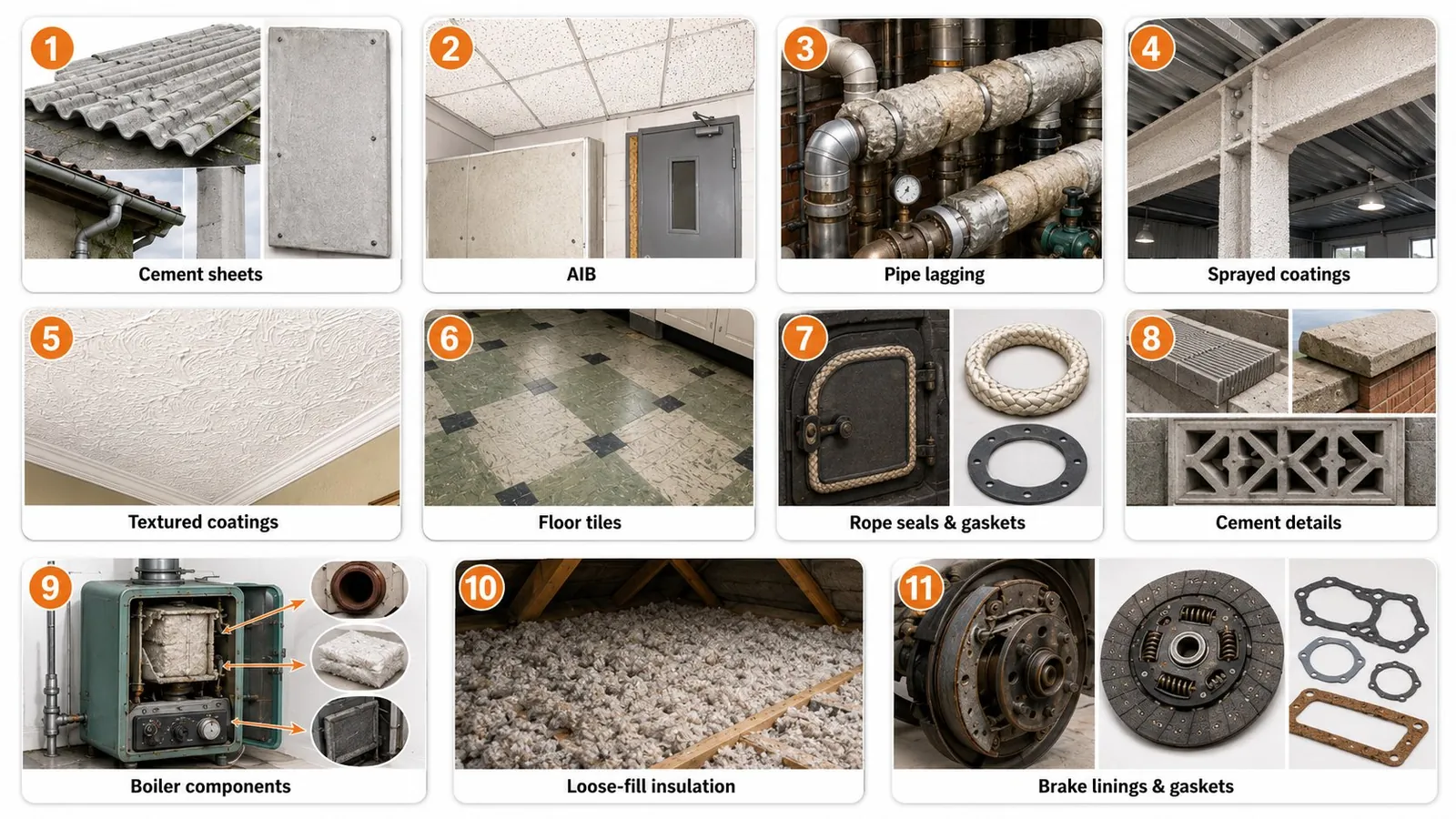
The applications most relevant to a UK reader are the construction-sector uses that still appear in pre-2000 buildings:
- Cement products — corrugated and flat sheets used for roofs, walls, soffits, gutters, downpipes, water tanks, and flue pipes
- Insulating board (AIB) — ceiling tiles, wall panels, fire-door cores, soffit panels, behind fire surrounds
- Pipe lagging — thermal insulation on heating pipes, calorifiers, and boilers in commercial and public buildings
- Sprayed coatings — applied to structural steel for fire protection in commercial buildings
- Textured decorative coatings — Artex and similar finishes on ceilings and walls
- Floor tiles — vinyl and thermoplastic tiles, with chrysotile bound into the matrix
- Rope seals and gaskets — around doors of stoves, boilers, and high-temperature equipment
- Cement-based products — including stair nosings, copings, and decorative panels
- Domestic boiler components — flue gaskets, insulation pads, jacket linings, particularly pre-1984
- Loose-fill insulation — in lofts and cavity walls of some mid-century buildings
- Brake linings, clutch plates, and gaskets — in cars and industrial machinery
Outside construction, asbestos appeared in textiles (heat-resistant clothing and blankets), electrical components (insulating boards and fuse-box flash guards), and consumer goods of various kinds. Some of these uses persisted later than others — UK asbestos cement was being manufactured into the 1990s, while textile uses largely ended in the 1970s.
Our reference guide to asbestos-containing materials in UK buildings covers each category in more detail, including typical year ranges, locations, and risk classifications.
How asbestos becomes dangerous
Intact, undisturbed asbestos in good condition is not actively releasing fibres. A chrysotile-cement roof sheet on a garage, a textured ceiling that hasn’t been touched in twenty years, a vinyl floor tile sealed under carpet — all of these contain asbestos, all are regulated, and none are an active hazard while they remain undisturbed.
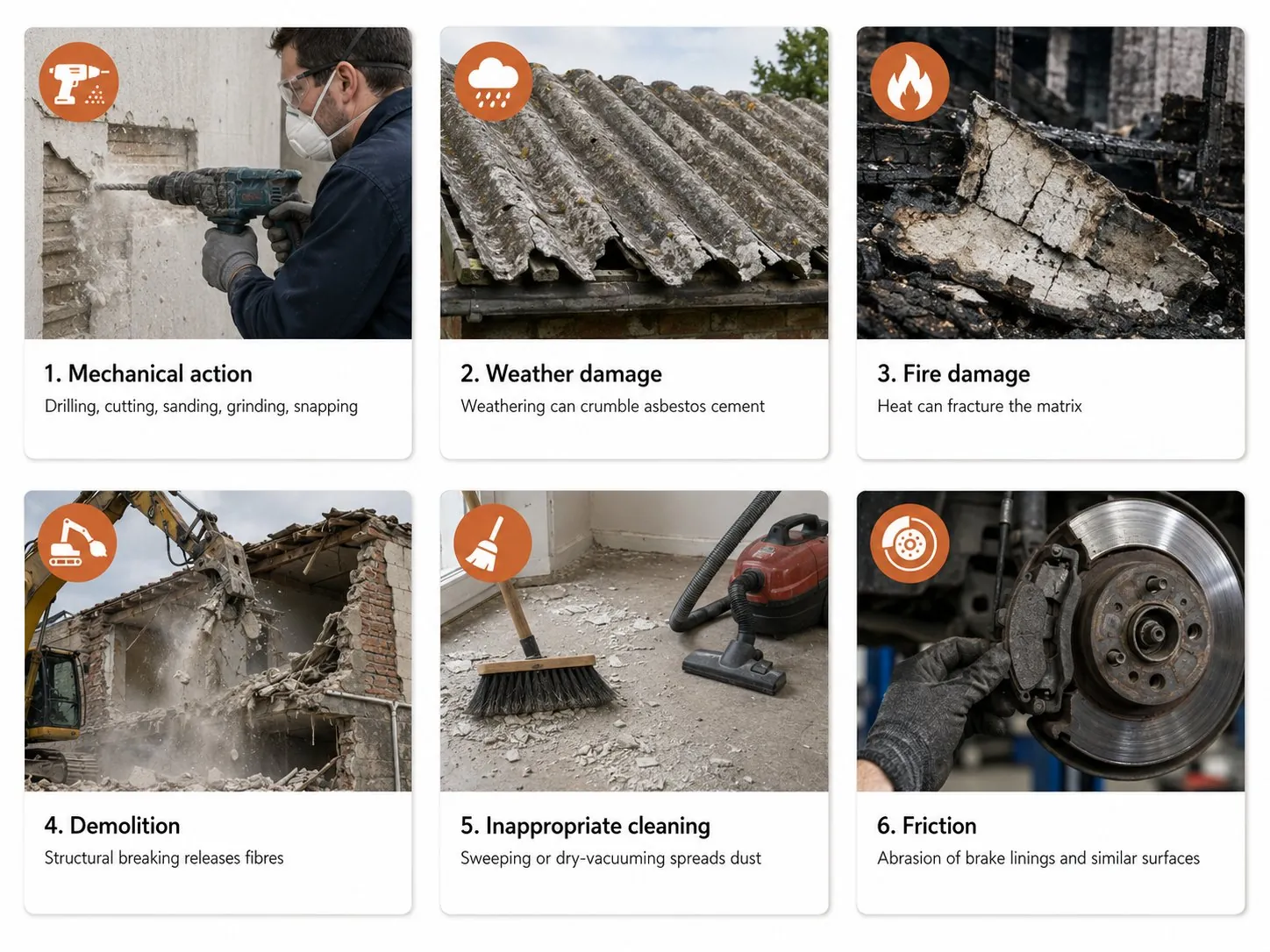
The danger comes when materials are damaged or worked on. Specifically:
- Mechanical action — drilling, cutting, sanding, grinding, snapping
- Weather damage — sustained weathering can crumble asbestos cement
- Fire damage — heat fractures the matrix and releases bound fibres
- Demolition — structural breaking inevitably releases fibres
- Inappropriate cleaning — sweeping or dry-vacuuming asbestos dust disperses it back into the air
- Friction — abrasion of brake linings and similar wear surfaces
Each of these activities can release fibres at concentrations far higher than ambient air, and inhaling those fibres is the route to disease. This is why the regulations focus heavily on identification before work, control measures during work, and proper containment of disturbed material.
The fibres themselves are small enough to bypass the upper airway’s defences. Once inhaled, they can lodge in the deep tissue of the lungs and the pleural lining, where they remain for decades. The body’s clearance mechanisms remove some — particularly chrysotile, with its curly fibre shape — but the fibres that remain can cause the chronic inflammation and cellular damage that eventually leads to mesothelioma, lung cancer, asbestosis, or pleural disease.
UK regulatory status today
Asbestos has been fully banned in the UK since 24 November 1999. It’s illegal to import, supply, or use asbestos or new products containing it. The two-stage ban — blue and brown asbestos in 1985, white asbestos in 1999 — is set out in our history of the UK asbestos ban.
The ban didn’t require existing asbestos materials to be removed. The default approach under UK law is to manage asbestos in place where it’s stable. This is set out in the Control of Asbestos Regulations 2012, which place duties on:
- Building owners and duty holders to manage asbestos in non-domestic premises (Regulation 4)
- Employers to identify asbestos before any work that might disturb it (Regulation 5)
- Employers to provide adequate training to workers who might be exposed (Regulation 10)
A small number of countries still mine and use asbestos commercially, including Russia, China, India, and Kazakhstan. The UK ban prevents new asbestos products entering the UK market, but trace contamination of imported consumer goods is occasionally detected and is one of the reasons regulatory surveillance continues.
The Health and Safety Executive provides the official UK regulatory guidance on asbestos, including the survey guide HSG264, the licensed contractors’ guide HSG247, and the Approved Code of Practice L143 that supports the regulations.
Frequently asked questions
Is asbestos man-made?
No. Asbestos is a group of naturally occurring silicate minerals that are mined from rock formations. The fibres form geologically; they aren’t synthesised.
Is asbestos magnetic?
No, in any practical sense. Asbestos minerals contain iron in some forms (amosite is iron-magnesium silicate), but they’re not magnetic in a way that’s useful for identification or separation.
Is asbestos radioactive?
No. The hazards of asbestos are chemical and mechanical — the durability and shape of the fibres in lung tissue — not radioactive.
Where does asbestos come from?
From mines in rock formations where the right geological conditions have produced fibrous mineral growth. Historically, the main producers were Canada, Russia, South Africa, and Australia. Current production is concentrated in Russia, China, Kazakhstan, India, and Brazil.
Is asbestos still mined today?
Yes. Around twenty countries still mine chrysotile commercially. The UK is not one of them and has banned the substance since 1999, including the import of new asbestos-containing products.
What’s the difference between asbestos and fibreglass?
Both are fibrous materials used for insulation, but they’re chemically and physically different. Fibreglass is man-made glass fibre; asbestos is a natural silicate mineral. Fibreglass fibres are generally larger and have different breakdown behaviour in the lung. The two materials are not interchangeable in regulatory terms — fibreglass is not asbestos and is not subject to asbestos regulations.
Why was asbestos used if it was known to be dangerous?
The dangers were known in stages, not all at once. The link to asbestosis was understood by the 1930s; the link to mesothelioma not until the 1960s; the long latency of all the diseases meant that the disease burden lagged the exposure by decades. Combined with strong commercial incentives and effective industry lobbying, the substance remained in legal use long after its hazards had been documented.
For the legal framework that now governs asbestos in the UK, see our guide to the Control of Asbestos Regulations 2012. For the history of how and when each asbestos type was banned, see when asbestos was banned in the UK. For the materials you’re most likely to encounter, see what asbestos looks like and the deeper reference guide to asbestos-containing materials.
For workers and supervisors whose work in pre-2000 UK buildings means accidental exposure to asbestos is a foreseeable risk, our CPD-accredited Asbestos Awareness Course covers the legally-required training syllabus under Regulation 10.
Related guides
- Types of asbestos: the six minerals explained
- Asbestos-containing materials in UK buildings: a reference guide
- When was asbestos banned in the UK?
Make sure your team is trained to recognise and work safely around asbestos.
Explore the Asbestos Awareness Course →
Mark writes about workplace health & safety, asbestos awareness and accredited online training for Asbestos Awareness Course, part of Online CPD Academy.