
The UK has no single public register of asbestos in its town halls, libraries, leisure centres and police stations — so the numbers you see quoted come mostly from Freedom of Information (FOI) projects run by law firms, unions and local-democracy reporters, alongside the Health and Safety Executive's (HSE) national mortality statistics and evidence to Parliament's own committees. This page pulls those civic-estate figures together in one place: how many council and public buildings contain asbestos, how slowly it is being removed, and — importantly — which figures are official statistics and which are one-off research. A note up front on scope: the headline FOI datasets below are one-off law-firm and union research projects, not regulator statistics, and we flag them as such throughout.
Key facts and figures
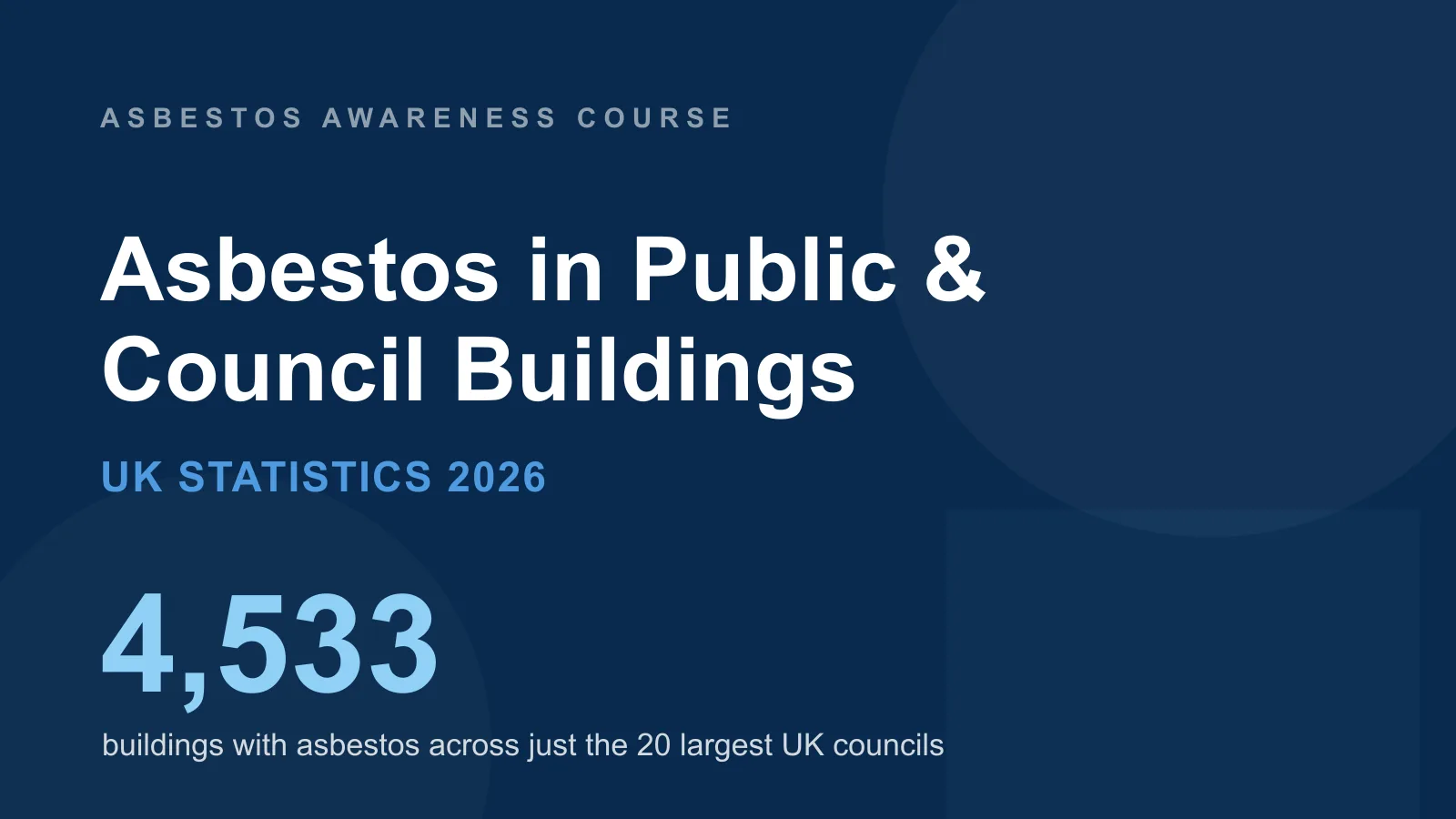
- 4,533 asbestos-containing public buildings were found across just the 20 largest UK councils — an average of around 225 each (FOI data 2017/18–2021/22, published Feb 2023).
- Only 291 of those buildings had asbestos removed in five years, while 3,263 had a survey over the same period (Irwin Mitchell FOI, Feb 2023).
- 258 buildings across the same 20 councils had asbestos removed in the 12 months to April 2023, at a confirmed cost of around £1,111,000 (Irwin Mitchell, Apr 2024).
- 31,030 buildings owned or run by English councils contain asbestos, per an FOI project covering 253 responding authorities (Stephensons, Mar 2022).
- 83% of Scotland's police stations — 177 of 214 — contain asbestos; only 37 are asbestos-free (Scottish Conservatives FOI, Aug 2025).
- 1 in 5 spaces in the Palace of Westminster (620 of 3,109) contains asbestos (Public Accounts Committee evidence, Mar 2026).
- 307 Cardiff Council buildings were reported to contain asbestos in the newest civic-estate FOI (LDRS via Nation.Cymru, Jul 2026).
- 40 years was the removal deadline for all non-domestic buildings recommended by MPs, prioritising public buildings (Work and Pensions Committee, Apr 2022).
Figures are the latest available as of July 2026, and this page is updated as new data lands — HSE publishes its mesothelioma statistics each July and its full asbestos-related disease suite each November, and the Local Democracy Reporting Service is running a live per-council FOI campaign that produces fresh civic-estate figures through the year.
How many public and council buildings contain asbestos?
4,533 public buildings across just the 20 largest UK councils contain asbestos — an average of roughly 225 per authority — according to FOI research by law firm Irwin Mitchell, published in February 2023 and covering the five financial years 2017/18 to 2021/22. Extrapolated across all 387 local authorities in England, Scotland and Wales, the firm estimated that around 87,000 public buildings could still contain asbestos. These are civic and operational buildings — offices, town halls, libraries, leisure centres, depots — not the millions of homes and schools counted separately.
A wider FOI project by Stephensons Solicitors, reported in March 2022, put the figure at 31,030 buildings owned or run by English councils. Of the 333 councils asked, 253 responded, and every single one of them had at least one asbestos-containing building — town halls, swimming pools, libraries and public toilets among them. Both numbers are one-off law-firm research based on FOI returns, so they depend on what each council chose to disclose and how it defined a "building"; they are best read as a floor, not a precise census.
The reason the civic estate is so heavily affected is the same as for homes and schools: most public buildings were built or refurbished before the UK's asbestos ban, and asbestos was a standard construction material until the late 1990s. For a fuller explanation of when and where it was used, see our guides to asbestos-containing materials in UK buildings and when asbestos was banned in the UK.
| FOI dataset | Buildings with asbestos | Coverage | Published |
|---|---|---|---|
| Irwin Mitchell (20 largest councils) | 4,533 | 20 councils, 2017/18–2021/22 | Feb 2023 |
| Irwin Mitchell (national extrapolation) | ~87,000 (estimate) | All 387 GB local authorities | Feb 2023 |
| Stephensons Solicitors | 31,030 | 253 responding English councils | Mar 2022 |
| TUC / Labour Research Dept (excl. schools & housing) | At least 2,690 | Sample of 31 English councils | May 2022 |
| LDRS — Cardiff Council | 307 | Single council | Jul 2026 |
How fast is asbestos being removed from public buildings?
Only 291 of the 4,533 identified buildings had asbestos removed across the five years 2017/18–2021/22 — while 3,263 had an asbestos survey over the same period, according to the Irwin Mitchell FOI. In other words, councils were surveying far more buildings than they were clearing, which is consistent with the legal "manage in place" model but leaves the material sitting in the estate. At that pace, the firm calculated, only around 2,300 of the 4,500 identified buildings would be asbestos-free within 40 years — the removal rate would need to roughly double even to hit that long horizon.
The follow-up FOI a year later showed a sharp acceleration. In the 12 months to April 2023, 258 buildings across the same 20 councils had asbestos removed, at a total confirmed cost of around £1,111,000 — nearly as many in one year as in the previous five combined. Kent County Council led with 56 removals and Wiltshire followed with 54, while Croydon was the only responding council to report none. One caveat worth stating plainly: the Kent and Wiltshire totals were school-heavy (around two-thirds of Kent's were education buildings), so the removal counts blur the civic estate with the school estate — the detailed school picture belongs to our asbestos in schools statistics page.
| Measure (20 largest UK councils) | Figure | Period |
|---|---|---|
| Buildings with asbestos | 4,533 | 2017/18–2021/22 |
| Buildings surveyed | 3,263 | 2017/18–2021/22 |
| Buildings with asbestos removed | 291 | 2017/18–2021/22 |
| Buildings with asbestos removed | 258 | 12 months to Apr 2023 |
| Confirmed removal cost | ~£1,111,000 | 12 months to Apr 2023 |
| Council leading removals (Kent) | 56 | 12 months to Apr 2023 |
Which councils reported the most asbestos buildings?
BCP Council reported 1,001 asbestos-containing public buildings — the highest of the 20 councils — yet recorded just three removals in five years. Buckinghamshire was next among those disclosing large numbers, at 712. These are the councils that both hold the largest operational estates and disclosed the fullest returns, so a high number partly reflects diligent record-keeping rather than uniquely poor management. The counterpoint from union research is telling: in the TUC / Labour Research Department study of 31 English councils (published May 2022), only one authority — Chorley — reported having cleared asbestos from all its premises.
That TUC study is the cleanest civic-estate-only figure available, because it deliberately excluded schools and housing: it found at least 2,690 local-authority premises containing asbestos across a sample of just 31 councils — roughly a tenth of all UK councils. Scale that to the whole country and the civic estate alone plausibly runs to tens of thousands of buildings, before any homes or schools are counted.
How much asbestos is in the UK's police and emergency estate?
177 of Scotland's 214 police stations — 83% of the estate — contain asbestos, and only 37 are asbestos-free, according to FOI figures obtained by the Scottish Conservatives and reported in August 2025. Every policing region had affected buildings; the worst were Aberdeenshire and Moray (25 stations), Greater Glasgow (23) and Tayside (21). The same disclosure noted that four stations also contained reinforced autoclaved aerated concrete (RAAC), the crumbling 1950s–1990s roofing material that closed schools in 2023. Police Scotland's estate is being addressed through a ten-year Estates Masterplan endorsed by the Scottish Police Authority in late 2024, so these figures should improve over the programme.
This is a good example of why the civic-estate picture is patchy: the Scottish policing data exists only because opposition politicians filed an FOI request. There is no equivalent published breakdown for police, fire or ambulance estates across England and Wales, so the 83% figure should be read as a Scotland-specific snapshot rather than a UK average.
How much asbestos is in the Parliamentary estate?
620 of the Palace of Westminster's 3,109 spaces — one in five — contain asbestos, mostly in the basement, according to evidence given to Parliament's Public Accounts Committee (PAC) in March 2026. The Palace is the most closely documented public building in the country precisely because its Restoration and Renewal (R&R) programme has to catalogue every hazard: the same evidence chain has referenced an estimated 90,000 m² of asbestos coatings across the building. The PAC warned of a "real and rising risk" that the Palace could suffer a catastrophic event before restoration is complete, with Parliament reportedly spending up to £2 million a week patching up the building.
The problem extends well beyond the Palace itself. Earlier R&R evidence, reported in 2023, estimated that around 2,500 sites across the wider parliamentary estate contain asbestos, with several asbestos incidents recorded since 2016; fully stripping the Palace was estimated to require around 300 workers over two-and-a-half years with the building unoccupied. As a live, recurring programme with National Audit Office and PAC oversight, the Parliamentary estate is one of the few parts of the public estate whose asbestos data is refreshed on a predictable cycle.
What does the latest council FOI show?
Cardiff Council reported 307 buildings containing asbestos in the newest civic-estate FOI, obtained by the Local Democracy Reporting Service and published in July 2026. The breakdown is a useful illustration of how the material is spread across a single council's estate: 120 education buildings, 62 leisure and cultural buildings (leisure centres, libraries, museums), 31 civic and administrative buildings (offices, town halls, depots, fire and police buildings), 22 health or institutional buildings and 72 categorised as "other". The council said asbestos-containing materials only pose a risk when disturbed and that it employs four certified asbestos officers to manage them.
The Cardiff figure matters less for its exact total than for what it represents: an ongoing, rolling FOI campaign that keeps producing fresh, council-by-council numbers. Because these arrive one authority at a time rather than as a national release, the civic-estate picture is best understood as a living mosaic — which is why this page is topped up as newer council disclosures appear, without ever promising a single national update.
Who is responsible, and why is asbestos left in place?
Under Regulation 4 of the Control of Asbestos Regulations 2012 (CAR 2012), the "dutyholder" for each public building must manage the asbestos in it — usually the council, NHS body or government department that owns or maintains the premises. That duty means finding the asbestos (or presuming its presence), assessing its condition, keeping a written management plan and register, and telling anyone liable to disturb it where it is. Crucially, the law does not require removal. Asbestos that is in good condition, sealed and undisturbed is generally lower risk left in place than disturbed by removal, so the default legal position is to manage it, not rip it out. Our guides to the duty to manage asbestos and the Control of Asbestos Regulations 2012 set out exactly what a dutyholder must do.
That "manage in place" principle is why 31,000-plus council buildings can lawfully still contain asbestos decades after the ban — and why campaigners argue the model is failing an ageing estate. In April 2022, the Commons Work and Pensions Committee recommended the Government set a 40-year deadline for removing asbestos from all non-domestic buildings, prioritising the highest-risk public buildings first, and noted that HSE estimates at least 300,000 non-domestic premises in Great Britain still contain asbestos. The Government did not adopt the deadline in its response, so removal remains condition-led rather than time-limited.
What is the human cost across the whole estate?
2,146 people died from mesothelioma in Great Britain in 2024, according to HSE figures — down from 2,218 in 2023 but still one of the highest national tolls in the world, reflecting exposures that largely pre-date the 1980s. Mesothelioma is a cancer caused almost exclusively by asbestos, and more than 70% of these deaths now occur in people aged over 75. A further 503 deaths in 2024 mentioned asbestosis on the death certificate. In total, HSE estimates that around 5,000 people a year die from asbestos-related diseases in Great Britain, making asbestos the single biggest cause of work-related deaths in the UK.
Those deaths cannot be pinned to public buildings specifically — occupational mortality data records a person's job, not the building where their exposure happened — so no one can say how many trace back to a library, leisure centre or town hall. But the workers most exposed to public-building asbestos today are the maintenance staff, caretakers and contractors who drill, chase cables and lift ceiling tiles in pre-2000 premises. For the national death and exposure headlines, see our UK asbestos statistics page; for the disease detail, see asbestosis statistics.
Frequently asked questions
How many council buildings in the UK contain asbestos?
There is no single official figure. The best available estimates come from FOI research: an Irwin Mitchell project found 4,533 asbestos-containing public buildings across just the 20 largest UK councils (2017/18–2021/22), and extrapolated around 87,000 across all 387 UK local authorities. A separate Stephensons FOI put the total at 31,030 buildings run by English councils. All of these are one-off law-firm research based on what councils chose to disclose, not regulator statistics, so they are best read as minimum estimates.
Why is asbestos still allowed to remain in public buildings?
Because UK law does not require removal. Under Regulation 4 of the Control of Asbestos Regulations 2012, dutyholders must manage asbestos in good condition in place — finding it, assessing it, keeping a written plan and warning anyone who might disturb it — because sealed, undisturbed asbestos is generally lower risk than the disturbance caused by removal. Removal is triggered only when material is damaged, deteriorating or in the way of refurbishment. MPs recommended a 40-year removal deadline in 2022, but the Government did not adopt it.
Who is responsible for managing asbestos in council and public buildings?
The "dutyholder" — normally the council, NHS body, police authority or government department that owns or maintains the building. Under CAR 2012 they must keep an asbestos register and management plan, assess the condition of any asbestos, and make sure staff and contractors know where it is before work starts. Site staff and contractors who could disturb asbestos must have asbestos awareness training under Regulation 10.
How long would it take to remove asbestos from the UK's public estate?
At the removal rate recorded in the Irwin Mitchell FOI, only around 2,300 of the 4,500 buildings identified across 20 councils would be asbestos-free within 40 years — meaning the pace would need to roughly double even to clear those buildings in four decades, let alone the estimated tens of thousands across the whole country. Faster removal is possible but expensive: the same 20 councils spent around £1.1 million clearing 258 buildings in a single year.
Are the public-building asbestos figures official statistics?
Mostly not. The headline prevalence and removal numbers come from one-off FOI projects run by law firms (Irwin Mitchell, Stephensons), a union research body (TUC / Labour Research Department) and local-democracy reporters, plus evidence to Parliamentary committees. The only official national statistics here are HSE's mortality figures (mesothelioma and asbestos-related disease deaths). We label each source on the page so you can tell research estimates from regulator data.
Manage or work on public buildings? Make sure your team can recognise asbestos before they disturb it.
Explore the Asbestos Awareness Course →Related guides
- Asbestos Statistics UK: Deaths, Exposure & Key Facts
- Asbestos in UK Homes & Buildings: Statistics and Facts
- Asbestos in Schools Statistics UK: How Many Schools Are Affected?
- Asbestosis Statistics UK: Deaths, Trends & Compensation
- The duty to manage asbestos: registers, plans and Regulation 4
- The Control of Asbestos Regulations 2012 explained
Sources & references
- Irwin Mitchell — More than 4,500 public buildings across 20 of the largest UK local authorities still contain asbestos (FOI, February 2023)
- Irwin Mitchell — More than 250 public buildings across the 20 largest UK councils had asbestos removed in the past year (FOI follow-up, April 2024)
- Stephensons Solicitors — Tens of thousands of council buildings contain asbestos (FOI, March 2022)
- TUC / Labour Research Department — Asbestos in local authority premises (report, May 2022)
- Nation.Cymru / Local Democracy Reporting Service — Asbestos found in more than 300 Cardiff Council buildings (July 2026)
- House of Commons Work and Pensions Committee — The HSE's approach to asbestos management (April 2022)
- STV News — Scotland's police stations and asbestos: Scottish Conservatives FOI (August 2025)
- Public Accounts Committee — "Real and rising risk" to the Palace of Westminster (March 2026)
- National Audit Office — Restoration and Renewal of the Palace of Westminster: 2026 update
- Health and Safety Executive — Mesothelioma statistics for Great Britain
- Health and Safety Executive — Asbestos-related disease statistics, Great Britain (November 2025)

Mark writes about workplace health & safety, asbestos awareness and accredited online training for Asbestos Awareness Course, part of Online CPD Academy.