
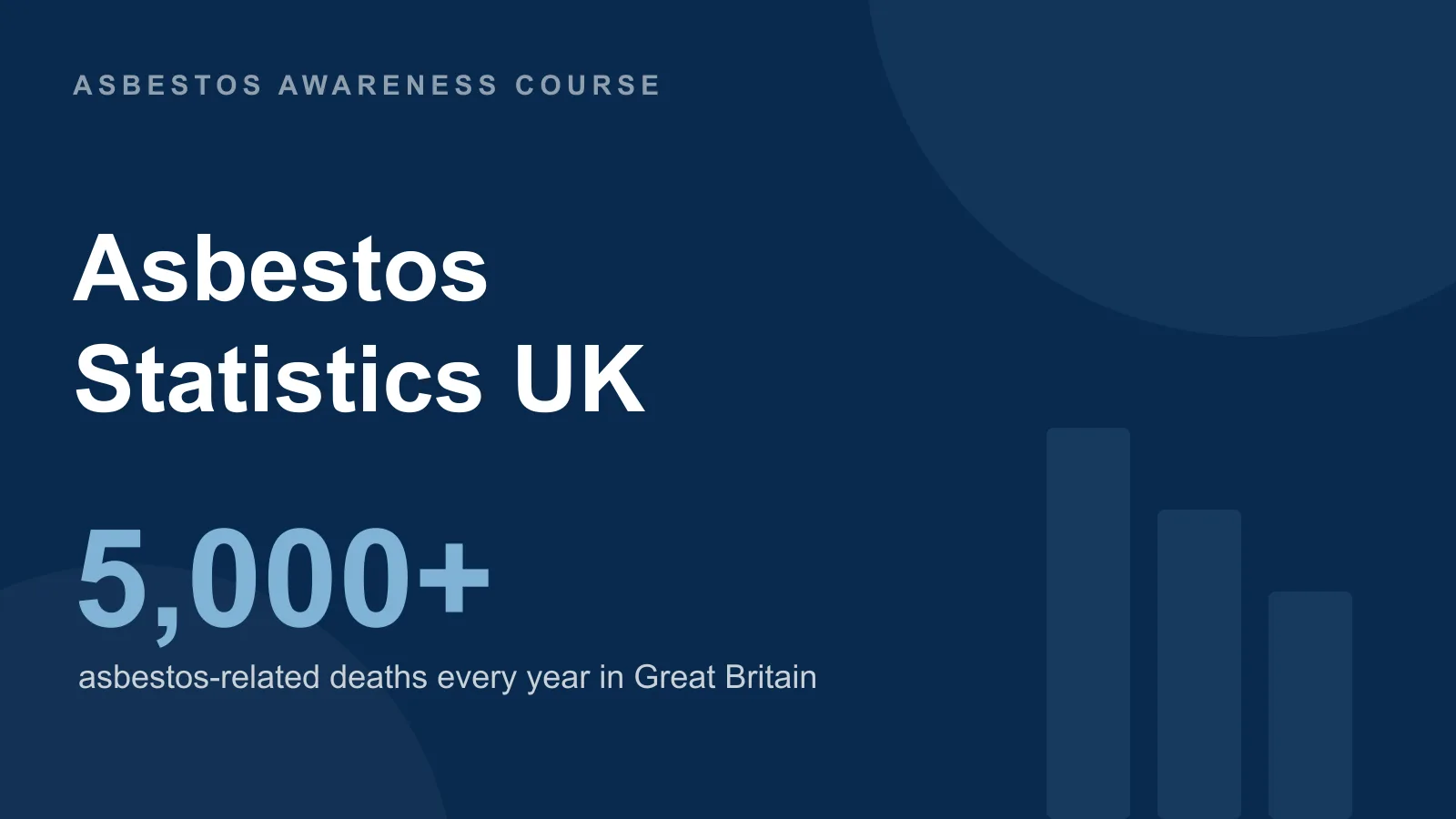
Around 5,000 people still die every year in Great Britain from diseases caused by past asbestos exposure — more than a quarter of a century after the substance was banned. This page gathers the key UK asbestos statistics in one place: annual deaths, mesothelioma trends, workforce exposure, the ban timeline and compensation data. Every figure is drawn from official sources — principally the Health and Safety Executive's annual statistics releases, alongside Cancer Research UK registry data and Department for Education survey findings — and each is given with its data period.
Key facts and figures
- 5,000+ deaths in Great Britain every year are linked to past asbestos exposure — the HSE's current headline figure.
- 2,146 people died from mesothelioma in Great Britain in 2024, down from 2,218 in 2023.
- ~2,500 asbestos-related lung cancer deaths occur each year — HSE estimates roughly one for every mesothelioma death.
- 503 death certificates mentioned asbestosis in 2024, excluding those that also mentioned mesothelioma.
- 1.3 million tradespeople are at risk of asbestos exposure, potentially disturbing it more than 100 times a year.
- 20 tradespeople a week die from past asbestos exposure, according to HSE campaign figures.
- 24 November 1999 — the date the UK's full asbestos ban came into force; blue and brown asbestos were banned in 1985.
- 15–60 years — the latency period between asbestos exposure and the first symptoms of disease.
These are the latest figures available as of July 2026. The HSE publishes updated asbestos-related disease and mesothelioma statistics every November, and this page is updated when new data is released.
How many people die from asbestos in the UK each year?
Around 5,000 deaths each year in Great Britain are attributed to past asbestos exposure, according to the HSE's current asbestos-related disease statistics. The total combines three conditions: mesothelioma, asbestos-related lung cancer and asbestosis.
The best recorded of the three is mesothelioma, a cancer of the lining of the lungs that is almost always caused by asbestos, with 2,146 deaths in 2024. The HSE estimates there are roughly as many asbestos-related lung cancer deaths as mesothelioma deaths — around 2,500 a year — although these are harder to count directly, because asbestos-related lung cancer is clinically indistinguishable from lung cancer with other causes, particularly smoking. Asbestosis, a chronic scarring of the lung tissue, was mentioned on 503 death certificates in 2024 (excluding deaths that also mentioned mesothelioma); asbestosis was recorded as the underlying cause in around 40% of those cases.
For context, 126 workers were killed in workplace accidents in Great Britain in 2025/26. Asbestos-related disease claims roughly forty times as many lives each year as all workplace accidents combined.
| Measure | Latest figure | Data period | Trend |
|---|---|---|---|
| All asbestos-related deaths (GB) | ~5,000 a year | Current HSE estimate | Expected to decline gradually |
| Mesothelioma deaths (GB) | 2,146 | 2024 | Falling — 2,218 in 2023; 2011–2020 average ~2,508 |
| Asbestos-related lung cancer deaths (GB) | ~2,500 a year | Current HSE estimate | Assumed to track mesothelioma deaths |
| Asbestosis deaths, excluding mesothelioma co-mentions (GB) | 503 | 2024 | Broadly stable |
| New mesothelioma cases (UK) | ~2,590 a year | 2019 & 2021–2022 average | Incidence down ~21% over the last decade |
| New IIDB cases of asbestos-related pleural thickening (GB) | 395 | 2024 | Stable — 390 in 2023, 375 in 2022 |
A note on geography: the HSE's death figures cover Great Britain (England, Scotland and Wales), while Cancer Research UK's incidence figures cover the whole UK. The two are not directly interchangeable, which is why each figure on this page carries its source and data period.
How many people die from mesothelioma in the UK?
2,146 people died from mesothelioma in Great Britain in 2024 — a second consecutive annual fall, down from 2,218 in 2023, and well below the 2011–2020 average of around 2,508 deaths per year.
On the incidence side, Cancer Research UK reports around 2,590 new mesothelioma cases a year in the UK (average for 2019 and 2021–2022) — roughly 2,100 in men and 490 in women. Some 63% of cases are diagnosed in people aged 75 and over, and incidence rates have fallen by around 21% over the last decade. The strong male skew reflects the disease's occupational origins: the men being diagnosed today largely worked in construction, shipbuilding, insulation and heavy industry in the decades before exposure controls tightened.
Because mesothelioma is almost always fatal and almost always caused by asbestos, it acts as the barometer for the wider epidemic. The HSE's projections indicate that annual deaths will continue to decline gradually as the generations with the heaviest occupational exposure age. For what the disease is, its symptoms and how exposure causes harm, see our guide to asbestos exposure and symptoms.
How many tradespeople are exposed to asbestos?
1.3 million tradespeople are estimated to be at risk of asbestos exposure in the UK, potentially disturbing asbestos-containing materials more than 100 times a year on average — HSE research figures promoted through its Asbestos & You campaign and cited by bodies including the TUC. The same campaign figures indicate that around 20 tradespeople a week die as a result of past asbestos exposure.
The at-risk group is far wider than licensed removal operatives. Joiners and carpenters, electricians, plumbers and heating engineers, painters and decorators, roofers, and maintenance and facilities staff all routinely work on buildings constructed before 2000 — where asbestos may be present in ceiling tiles, partition boards, floor tiles, pipe lagging, cement products and dozens of other materials.
That exposure profile is why Regulation 10 of the Control of Asbestos Regulations 2012 requires employers to provide asbestos awareness training for any worker whose job could foreseeably disturb asbestos. Our guide to who needs asbestos awareness training explains where the duty applies, and the Asbestos Awareness Course covers the required syllabus online in 1–2 hours.
When was asbestos banned in the UK?
Asbestos was fully banned in the UK on 24 November 1999. The prohibition came in two stages: blue asbestos (crocidolite) and brown asbestos (amosite) were banned in 1985, while white asbestos (chrysotile) remained in legal use until the 1999 regulations completed the ban.
The ban prohibited new import, supply and use — it did not require existing asbestos to be removed. Any building constructed or refurbished before 2000 may therefore still contain asbestos. That date is the dividing line used throughout UK regulation, and it is the reason surveys, registers and management plans are required for older non-domestic premises. For the full legislative history, year by year, see our guide to when asbestos was banned in the UK.
Why are asbestos deaths still so high 25 years after the ban?
Asbestos-related diseases take between 15 and 60 years to develop after exposure. Today's deaths — around 5,000 a year — largely reflect industrial exposures from the 1950s to the 1980s, when asbestos was imported into Britain in enormous quantities for construction, shipbuilding and manufacturing.
The latency period explains the shape of the epidemic. Mesothelioma deaths kept rising for decades after the health risks were established, averaging around 2,508 a year across 2011–2020, and have only recently begun to fall — down to 2,146 in 2024. The people dying now were typically exposed long before the 1985 and 1999 prohibitions took effect.
Falling death numbers do not mean the hazard has gone. Enormous quantities of asbestos remain in place in buildings across the country, and anyone who drills, cuts or breaks into pre-2000 building fabric without checking first can still be exposed today. That is why the training and management duties under the Control of Asbestos Regulations 2012 remain in force, and why the HSE continues to run awareness campaigns aimed at the trades.
How much asbestos is left in UK buildings and schools?
Any building constructed or refurbished before 2000 may contain asbestos, and published estimates of the scale of the legacy range from around 300,000 non-domestic buildings to well over a million — we unpack the competing estimates, and where asbestos hides in domestic properties, on our companion page of asbestos in UK homes and buildings statistics.
In education, the Department for Education's Asbestos Management Assurance Process found that 80.9% of participating state schools in England reported asbestos somewhere on their estate (2019 report) — the full school-by-school picture, including staff deaths and system-built school buildings, is on our page of asbestos in schools statistics.
For duty holders, the practical requirements that follow — surveys, registers and management plans — are covered in our guide to the duty to manage asbestos.
How many people claim compensation for asbestos-related disease?
395 new cases of asbestos-related diffuse pleural thickening were assessed for Industrial Injuries Disablement Benefit (IIDB) in 2024, compared with 390 in 2023, 375 in 2022 and 460 in 2021. IIDB is the government's no-fault benefit scheme for prescribed industrial diseases, and its assessment counts are published alongside the HSE's annual asbestos statistics — a second, claims-based view of the disease burden that broadly mirrors the death-certificate data.
The IIDB figures capture only one route to compensation. Civil claims against former employers and their insurers run separately through the courts, and are not included in the counts above.
Frequently asked questions
How many people die from asbestos in the UK per year?
Around 5,000 a year in Great Britain, on the HSE's current headline estimate. That combines 2,146 mesothelioma deaths (in 2024), an estimated 2,500 asbestos-related lung cancer deaths a year, and several hundred asbestosis deaths.
Are asbestos deaths going up or down?
Down. Mesothelioma deaths fell to 2,218 in 2023 and again to 2,146 in 2024, against a 2011–2020 average of around 2,508 a year, and HSE projections indicate a continued gradual decline.
When was asbestos banned in the UK?
In two stages: blue and brown asbestos in 1985, and white asbestos in 1999, with the full ban in force from 24 November 1999. Buildings built or refurbished before 2000 may still contain it.
How many tradespeople are exposed to asbestos?
The HSE estimates 1.3 million tradespeople are at risk of exposure, potentially disturbing asbestos more than 100 times a year, and around 20 tradespeople a week die from past exposure.
What is the biggest asbestos-related cause of death?
Mesothelioma and asbestos-related lung cancer are of similar size: mesothelioma is the best recorded (2,146 deaths in 2024), and the HSE assumes roughly one asbestos-related lung cancer death for each mesothelioma death. Asbestosis is smaller, with 503 death certificates mentioning it in 2024.
Where do UK asbestos statistics come from?
Principally the HSE's annual asbestos-related disease and mesothelioma statistics, published each November from death-certificate and IIDB data. Cancer Research UK publishes incidence figures from the UK's cancer registries, and the Department for Education has published survey data on asbestos in schools.
Related guides
- Asbestos in UK Homes & Buildings: Statistics and Facts
- Asbestos in Schools Statistics UK: How Many Schools Are Affected?
- When was asbestos banned in the UK? The complete timeline
- Asbestos exposure: risks, symptoms, and the timeline of harm
- Who needs asbestos awareness training in the UK?
- The duty to manage asbestos: registers, plans, and what Regulation 4 requires
Sources & references
- Health and Safety Executive — Asbestos-related disease statistics in Great Britain, 2025
- Health and Safety Executive — Mesothelioma statistics for Great Britain, 2025
- Health and Safety Executive — Health and safety statistics: key figures for Great Britain
- Health and Safety Executive — Asbestos: frequently asked questions (Asbestos & You campaign)
- Cancer Research UK — Mesothelioma statistics
- Department for Education — Asbestos Management Assurance Process (AMAP) report
- Trades Union Congress — The asbestos crisis: why Britain needs an eradication law
Work on pre-2000 buildings? Get the asbestos awareness training the regulations require.
Explore the Asbestos Awareness Course →
Mark writes about workplace health & safety, asbestos awareness and accredited online training for Asbestos Awareness Course, part of Online CPD Academy.