
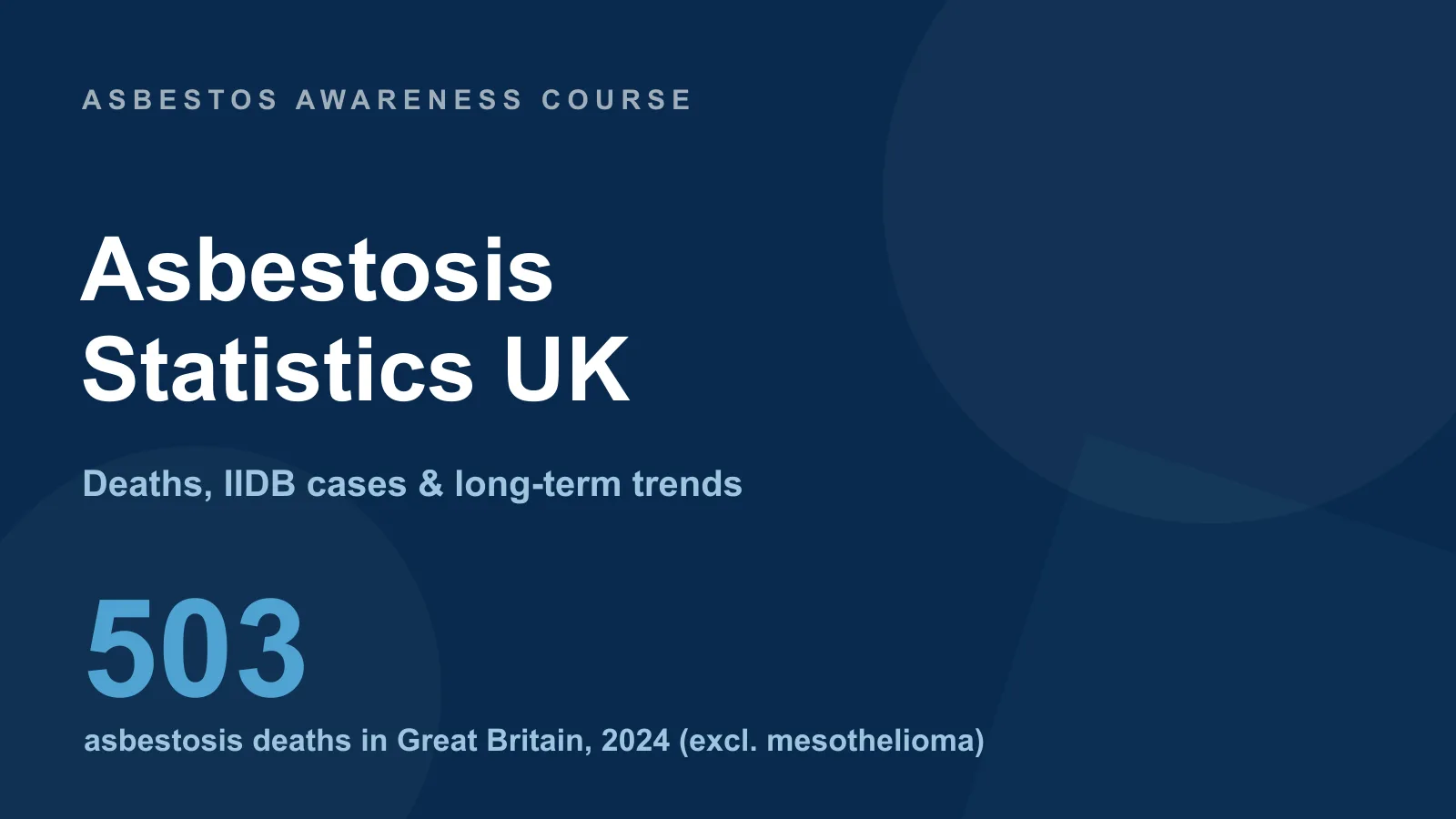
Mesothelioma takes the headlines, but it is not the only fatal legacy of Britain's asbestos century. Asbestosis — the slow, progressive scarring of the lungs caused by inhaling asbestos fibres — kills hundreds of people in Great Britain every year, and the annual death count has roughly quintupled since the late 1970s. This page pulls together the official figures from the Health and Safety Executive's (HSE) Asbestos-related disease statistics, Great Britain report and its supporting data tables, together with the Department for Work and Pensions' (DWP) Industrial Injuries Disablement Benefit (IIDB) data, to set out how many people die from asbestosis each year, how many disease claims are assessed, and how the trend and the geography have shifted.
Asbestosis sits within a group of prescribed non-malignant asbestos diseases, alongside diffuse pleural thickening and pleural plaques. Those conditions are covered here too, because they are counted in the same official tables and are frequently confused with one another. For context: asbestos is estimated to cause around 5,000 asbestos-related disease deaths a year in Great Britain, including 2,146 mesothelioma deaths in 2024. The rest of this page keeps its focus firmly on the non-mesothelioma slice of that toll.
Key asbestosis facts and figures
- 503 deaths in Great Britain in 2024 mentioned asbestosis on the death certificate but not mesothelioma (2024, provisional).
- 523 death certificates mentioned asbestosis in total in 2024; 20 of those also mentioned mesothelioma.
- Near-fivefold rise: deaths mentioning asbestosis (excluding mesothelioma) climbed from 109 in 1978 to 503 in 2024.
- 137 to 503: male asbestosis deaths rose from 137 in 1981 to 503 in 2024.
- 695 new cases of asbestosis were assessed for Industrial Injuries Disablement Benefit in 2024, up from 615 in 2023.
- 395 new cases of diffuse pleural thickening were assessed for IIDB in 2024 (2024).
- 16.3 per million: the male asbestosis death rate in 2022–24, up from 5.8 per million in 1981–83.
- 28.9 per million: the highest regional male asbestosis death rate in 2022–24, in Scotland.
Figures are the latest available as of July 2026, and this page is updated when new data is released — HSE publishes its full asbestos-related disease report and supporting tables each year in early July (the 2026 edition landed on 1 July 2026), while DWP refreshes its IIDB caseload on Stat-Xplore each quarter.
How many people die from asbestosis in the UK each year?
503 people in Great Britain died in 2024 with asbestosis recorded on the death certificate but no mention of mesothelioma, according to HSE's Asbestos-related disease statistics, Great Britain 2026 and its underlying Table ASIS01 (2024 figures are provisional). Counting every certificate that mentioned asbestosis, the total for 2024 was 523 — of which 20 also mentioned mesothelioma and are conventionally counted under the mesothelioma total to avoid double-counting.
Two things about that 503 are worth pinning down. First, "mentioned on the death certificate" is a broader measure than "caused by": asbestosis was recorded as the underlying cause of death in 185 cases in 2024, down from 213 in 2023, with the remainder being cases where asbestosis contributed alongside another primary cause. Second, the burden falls overwhelmingly on men who worked in the heavy asbestos trades — shipbuilding, insulation, construction and demolition — decades ago. Only around 2 to 3 per cent of recent asbestosis deaths (excluding mesothelioma) are among women, averaging roughly 30 female deaths a year over the long run.
Because asbestosis, like all asbestos diseases, has a latency measured in decades, today's deaths reflect exposures largely from the 1960s through the 1980s. For the wider picture of how many people were and are exposed, and the national headline totals, see our UK asbestos statistics page.
Is asbestosis the same as mesothelioma?
No — asbestosis is not a cancer, and it is counted separately from mesothelioma in the official statistics. Asbestosis is fibrosis, a permanent scarring of the lung tissue caused by heavy, prolonged inhalation of asbestos fibres; mesothelioma is an aggressive cancer of the lining of the lungs or abdomen that can follow much lower exposures. The two are easy to conflate because both are caused by asbestos and both can appear on the same death certificate, which is exactly why HSE reports asbestosis deaths in two ways: the 523 certificates mentioning asbestosis in 2024, and the narrower 503 that mention asbestosis but not mesothelioma.
The distinction matters for anyone reading the numbers. The mesothelioma toll (2,146 deaths in 2024) is the figure most often quoted for "asbestos deaths", but it is a different disease with a different dose-response relationship. Asbestosis generally requires substantial cumulative exposure, which is why it clusters so tightly in former industrial workforces. Our guide to asbestos exposure, risks and symptoms sets out how the four main asbestos diseases differ clinically.
How has the asbestosis death trend changed since the 1970s?
Deaths mentioning asbestosis (excluding mesothelioma) have risen almost fivefold, from 109 in 1978 to 503 in 2024. The rise tracks the delayed arrival of disease in men exposed during the peak decades of UK asbestos use. Male asbestosis deaths specifically climbed from 137 in 1981 to 503 in 2024, and the male death rate rose from 5.8 per million per year in 1981–83 to 16.3 per million in 2022–24 — a near-tripling of the age-standardised rate on top of the growth in raw numbers.
The trend is not uniform across age groups, and this is where the first signs of a turning point appear. Asbestosis death rates below age 65 have fallen since the 1980s, and rates at ages 75–84 have started to fall in recent years — a pattern consistent with lower asbestos exposures in more recent birth cohorts, as controls tightened and the material was progressively banned. The overall count is still rising because the very elderly, most heavily exposed cohorts are still dying; the fall in younger-age rates is what will eventually pull the total down.
| Year | Deaths mentioning asbestosis (excl. mesothelioma) | Trend |
|---|---|---|
| 1978 | 109 | Baseline (late 1970s ~100/yr) |
| 1981 | 137 (male) | Rising |
| 2023 | Underlying cause 213 | Near recent peak |
| 2024 | 503 (523 incl. mesothelioma) | Provisional |
Source: HSE Table ASIS01 and Asbestos-related disease statistics, Great Britain 2026. The "underlying cause" figure is a narrower count than "deaths mentioning asbestosis" and is not directly comparable across the rows above.
How many asbestosis IIDB claims are assessed each year?
695 new cases of asbestosis were assessed for Industrial Injuries Disablement Benefit in 2024, according to HSE Table IIDB06, up from 615 in 2023, 600 in 2022 and 675 in 2021. IIDB is the state benefit paid to people whose disease was caused by their employment, and the assessment count is a useful parallel indicator to the death figures — it captures people who are living with the disease, not only those who have died from it.
The long-run IIDB series mirrors the death trend. Asbestosis assessments rose from 132 in 1978 to a peak of 905 in 2019 before easing back and settling in the 600–700 range in the early 2020s. The recent numbers bounce year to year partly because of administrative timing in how claims are processed, so the direction of travel matters more than any single year's figure. Note that IIDB assessment counts and death counts measure different things and are not additive.
| Year | New asbestosis IIDB assessments |
|---|---|
| 1978 | 132 |
| 2019 (peak) | 905 |
| 2021 | 675 |
| 2022 | 600 |
| 2023 | 615 |
| 2024 | 695 |
Source: HSE Table IIDB06 and Asbestos-related disease statistics, Great Britain 2026 (DWP data).
Can you claim IIDB for diffuse pleural thickening?
Yes — diffuse pleural thickening is a prescribed disease (D9) for IIDB, and 395 new cases were assessed in 2024, up slightly from 390 in 2023 and 375 in 2022, though below the 460 assessed in 2021 (HSE Table IIDB01). Diffuse pleural thickening is a widespread thickening of the lung lining that can restrict breathing, and unlike simple pleural plaques it can be functionally disabling — which is why it qualifies for benefit where plaques alone generally do not.
Over the decade before 2020, diffuse pleural thickening IIDB cases averaged about 460 a year, of which only around 1 per cent were female — an even sharper male skew than asbestosis, reflecting how concentrated heavy occupational exposure was among men. Pleural plaques, the third non-malignant condition in this group, are areas of localised scarring that usually cause no symptoms; they are a marker of past exposure rather than a disabling disease, and in England and Wales they do not by themselves support a civil compensation claim. Our guide to what to do if you have been exposed to asbestos explains the medical and benefit routes in more detail.
What do chest physicians report about asbestosis?
Chest physicians in the THOR surveillance scheme reported an estimated 114 new cases of non-malignant pleural disease in 2024, down from 156 in 2023 and well below the 366 reported in 2019 before the pandemic disrupted routine referrals — a substantial share of these are pleural plaques. This voluntary reporting scheme, run by specialist chest doctors, is a different lens on the same diseases: it catches people at diagnosis rather than at death or benefit assessment, so it tends to signal changes earlier, but its estimates are more sensitive to reporting gaps.
For pneumoconiosis specifically — a category that in this scheme is mostly asbestosis — chest physicians reported an estimated 132 cases in 2022, of which 82 were asbestosis. Over the longer run the scheme recorded the incidence of pneumoconiosis rising by an average of about 3.6 per cent a year across 1999–2019, accelerating to roughly 5.7 per cent a year over 2010–2019 before the pandemic broke the series. The pandemic dip in these numbers reflects disrupted clinics and reporting, not a genuine fall in disease.
Where are asbestosis death rates highest?
Scotland has the highest male asbestosis death rate in Great Britain, at 28.9 per million per year in 2022–24, according to HSE Table ASIS03. That is well above the East of England (20.2 per million) and the North West (16.8 per million), and reflects the concentration of shipbuilding, marine engineering and heavy industry that defined Scotland's Clyde-side workforce for much of the twentieth century.
The geography is also shifting in a telling way. The North East of England — once among the very highest-rate regions — has fallen from a peak of 50.7 per million in 2010–12 to 16.2 per million in 2022–24, as the most heavily exposed generation of shipyard and industrial workers passes through. That decline in a former hotspot, alongside falling rates below age 65, is one of the clearer signals that the asbestosis epidemic is past its peak in the youngest cohorts even as the national total continues to edge up.
| Region | Male asbestosis death rate (per million/yr), 2022–24 | Note |
|---|---|---|
| Scotland | 28.9 | Highest in GB |
| East of England | 20.2 | — |
| North West | 16.8 | — |
| North East | 16.2 | Down from 50.7 in 2010–12 |
Source: HSE Table ASIS03, age-standardised male asbestosis death rates by region (excluding mesothelioma).
Frequently asked questions
How many people die from asbestosis in the UK each year?
In 2024, 503 people in Great Britain died with asbestosis mentioned on the death certificate but not mesothelioma; counting every certificate that mentioned asbestosis, the total was 523. These are provisional HSE figures from the 2026 Asbestos-related disease statistics report and Table ASIS01. The figure has risen almost fivefold from about 109 a year in the late 1970s.
Is asbestosis the same as mesothelioma?
No. Asbestosis is a non-cancerous scarring (fibrosis) of the lungs caused by heavy asbestos exposure, whereas mesothelioma is a cancer of the lung or abdominal lining that can follow much lower exposures. HSE counts them separately: in 2024 there were 503 asbestosis deaths excluding mesothelioma, against 2,146 mesothelioma deaths.
How many asbestosis IIDB claims are assessed each year?
Around 695 new asbestosis cases were assessed for Industrial Injuries Disablement Benefit in 2024 (HSE Table IIDB06), compared with 615 in 2023 and a peak of 905 in 2019. IIDB assessments count people living with the disease and are a separate measure from the death statistics.
Can you claim Industrial Injuries Disablement Benefit for diffuse pleural thickening?
Yes. Diffuse pleural thickening is a prescribed disease (D9) for IIDB, and 395 new cases were assessed in 2024. Because it can restrict breathing, it qualifies for benefit — unlike simple pleural plaques, which are usually symptomless and do not by themselves support a civil claim in England and Wales.
Is asbestosis still increasing in the UK?
The overall annual count is still rising, driven by deaths among the most heavily exposed elderly cohorts, but death rates below age 65 have been falling since the 1980s and some older-age rates are now easing too. That pattern, together with sharp falls in former hotspots such as the North East, suggests the epidemic has peaked in younger generations and will eventually decline.
For workers and duty holders whose jobs bring them into pre-2000 buildings — where the asbestos-containing materials that caused this legacy still sit — our CPD-certified Asbestos Awareness Course covers the training required under Regulation 10 of the Control of Asbestos Regulations 2012.
Understanding the disease toll is one thing — preventing the next generation of it is another. Make sure your team can recognise asbestos before they disturb it.
Explore the Asbestos Awareness Course →Related guides
- Asbestos Statistics UK: Deaths, Exposure & Key Facts
- Asbestos and Lung Cancer Statistics UK
- Asbestos Compensation Statistics UK
- Asbestos exposure: risks, symptoms, and the timeline of harm
- What to do if you've been exposed to asbestos
Sources & references
- Health and Safety Executive — Asbestos-related disease statistics, Great Britain 2026 (primary report)
- HSE Table ASIS01 — Deaths mentioning asbestosis, 1978–2024
- HSE Table ASIS03 — Age-standardised male asbestosis death rates by region (excluding mesothelioma)
- HSE Table IIDB01 — New IIDB prescribed-disease cases (D1 pneumoconiosis / D9 diffuse pleural thickening)
- HSE Table IIDB06 — New IIDB asbestosis / pneumoconiosis cases
- HSE Table THORR01 — Chest-physician (THOR/SWORD) reported pneumoconiosis and non-malignant pleural disease
- DWP — Industrial Injuries Disablement Benefit quarterly statistics (Stat-Xplore)
- HSE — Mesothelioma statistics for Great Britain (context figure only)

Mark writes about workplace health & safety, asbestos awareness and accredited online training for Asbestos Awareness Course, part of Online CPD Academy.