
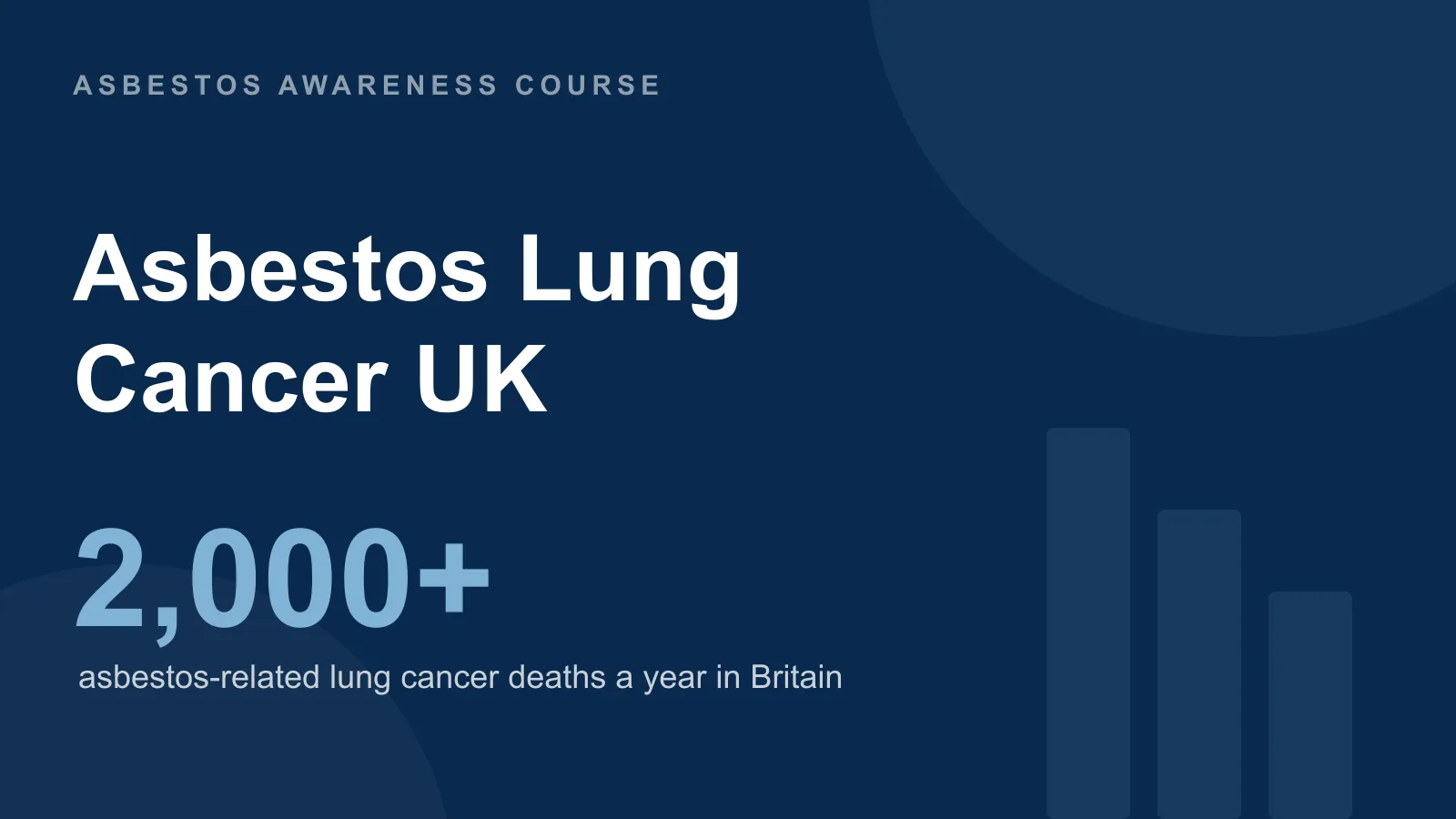
Mesothelioma is the disease that everyone associates with asbestos, but it is only half the cancer story. The Health and Safety Executive (HSE) estimates that asbestos-related lung cancer kills a similar number of people in Great Britain every year — on the order of 2,000 deaths — yet almost none of those cases are ever formally recognised as asbestos-related. This page draws on HSE's Asbestos-related disease statistics, Great Britain 2026 report and its supporting data tables, the Department for Work and Pensions' (DWP) Industrial Injuries Disablement Benefit (IIDB) figures, and Cancer Research UK's all-cause lung cancer data to explain how that hidden estimate is built, why so few people ever claim for it, and how asbestos and smoking multiply the risk.
One point up front, because it governs everything below. Asbestos-related lung cancer is clinically indistinguishable from any other lung cancer — there is no scan, biopsy or blood test that stamps a tumour as asbestos-caused. That single fact is why the toll is estimated by epidemiology rather than counted case by case, and why the gap between the estimate and the claims is so vast. For the combined headline — asbestos causes around 5,000 asbestos-related disease deaths a year in Great Britain, including 2,146 mesothelioma deaths in 2024 — see our UK asbestos statistics overview. This page keeps its focus on the lung-cancer slice. Nothing here is medical, diagnostic or legal advice; the compensation sections signpost official schemes only.
Key asbestos lung cancer facts and figures
- ~2,000 deaths a year: HSE estimates a "similar" number of asbestos-related lung cancer deaths to mesothelioma in Great Britain — broadly 2,000 to 2,150 a year (HSE 2026 estimate).
- 2,146 mesothelioma deaths in Great Britain in 2024 — the comparator that anchors the lung-cancer estimate (2024, provisional).
- Just 85 new IIDB cases of asbestos-related lung cancer (prescribed diseases D8 + D8A) were assessed in 2024 — against a ~2,000 epidemiological estimate (2024).
- ~260 a year: the average number of new D8/D8A IIDB cases over 2010–2019, before a post-pandemic collapse to double figures.
- ~74 cases of asbestos-associated lung cancer were reported by chest physicians through the THOR scheme in 2019, close to the 73-a-year prior-decade average.
- 32,800 lung cancer deaths a year in the UK from all causes — about 90 a day — so asbestos accounts for a small but substantial slice (2021–2024, Cancer Research UK).
- 72% smoking, 13% workplace: the share of UK lung cancer cases attributed to smoking and to workplace exposures respectively, the latter including asbestos (Cancer Research UK).
- ~2% female: women make up only about 2% of IIDB asbestos-lung-cancer cases and under 1% of THOR cases — a legacy of male-dominated heavy industry.
Figures are the latest available as of July 2026, and this page is updated when new data is released — HSE publishes its full asbestos-related disease report and supporting tables each year in early July (the 2026 edition landed on 1 July 2026), DWP refreshes the IIDB caseload on Stat-Xplore each quarter, and Cancer Research UK refreshes its all-cause lung cancer comparator on a rolling three-year registry basis.
How many people die from asbestos-related lung cancer in the UK each year?
HSE estimates that asbestos causes a similar number of lung cancer deaths to mesothelioma each year in Great Britain — broadly on the order of 2,000 to 2,150. The 2026 report puts it plainly: alongside 2,146 mesothelioma deaths in 2024, there is "a similar estimated number of lung cancer deaths linked to past asbestos exposures". HSE's own working assumption for years has been that a ratio of roughly one asbestos-related lung cancer for every mesothelioma implies "currently over 2,000 asbestos-related lung cancer deaths each year in Britain".
The word to hold on to is estimated. There is no register of asbestos lung cancers because, clinically, they cannot be told apart from lung cancers caused by tobacco or anything else. So HSE does not count them; it infers them, using the observed mesothelioma toll as a yardstick and an epidemiological ratio to scale from one to the other. That is a fundamentally different kind of number from the 2,146 mesothelioma deaths, which are actual death-certificate counts. The lung-cancer figure is robust as an order of magnitude but should never be quoted to a false precision — HSE itself frames it as "around" or "over" 2,000, not a single hard total.
For context on scale, the comparator moves year to year: mesothelioma deaths were 2,146 in 2024, down from 2,255 in 2023 and from an average of 2,508 a year over 2011–2020. Because the lung-cancer estimate is pegged to mesothelioma, the two are expected to decline together over the coming decades as the most heavily exposed generations pass through.
Is asbestos-related lung cancer more common than mesothelioma?
On HSE's headline estimate they are roughly equal — around 2,000 deaths each a year — but the underlying ratio is genuinely uncertain, and the honest answer is "it depends how you measure it". The estimate rests on the lung-cancer-to-mesothelioma ratio in asbestos-exposed populations, and that ratio is one of the more debated numbers in occupational epidemiology.
HSE cites evidence that, among British asbestos workers, there were about 1.3 asbestos-related lung cancers for every mesothelioma — which would make lung cancer the larger burden. But that ratio falls to below 1.0 once you adjust for the workers' heavy smoking, because a large share of their lung cancers would have occurred from tobacco alone. A more recent population-based study using amphibole lung-burden measurements estimated a ratio of just 0.55 asbestos-related lung cancers per mesothelioma for British men born in the 1940s — which would make lung cancer the smaller burden. HSE's working "around 2,000" reflects a pragmatic middle position of roughly one-to-one.
| Ratio estimate (lung cancers per mesothelioma) | Basis | Implication |
|---|---|---|
| 1.3 | British asbestos workers, unadjusted | Lung cancer > mesothelioma |
| Below 1.0 | Same workers, adjusted for smoking | Lung cancer < mesothelioma |
| ~1.0 | HSE working assumption | Roughly equal (~2,000 each) |
| 0.55 | Men born 1940s, amphibole lung-burden study | Lung cancer < mesothelioma |
Source: HSE Asbestos-related disease statistics, Great Britain 2026, lung cancer section. The point of the table is not to pick a winner but to show why the "~2,000" estimate carries a genuine range of uncertainty around it.
Why do so few people claim compensation for asbestos-related lung cancer?
Because almost no one can prove their lung cancer was the asbestos one. Set the ~2,000-a-year epidemiological estimate against the benefit data and the gap is startling: only 85 new cases of asbestos-related lung cancer (prescribed diseases D8 and D8A) were assessed for Industrial Injuries Disablement Benefit in 2024. Even in more normal years the figure averaged only about 260 a year over 2010–2019 — roughly one formal case for every eight the epidemiology implies.
The mechanism behind the gap is the same clinical invisibility that forces HSE to estimate in the first place. To succeed with an IIDB claim under D8 or D8A, a person generally needs documented evidence of qualifying asbestos exposure and a linked disease marker — for D8A, that means asbestosis or bilateral diffuse pleural thickening alongside the lung cancer. Most people who develop asbestos-related lung cancer never had that supporting diagnosis recorded, were also smokers (which muddies attribution), or simply died without the exposure history ever being connected to the tumour. The result is that the state scheme captures only the small, well-documented tail of a much larger hidden population.
The post-pandemic numbers show how thin that tail has become. New D8/D8A IIDB cases fell to 180 in 2021, then 125 in 2022, 125 in 2023 and just 85 in 2024 — well below the pre-pandemic average, reflecting both disrupted diagnosis and referral during COVID-19 and the underlying downward drift.
| Year | New IIDB asbestos-related lung cancer cases (D8 + D8A) | Trend |
|---|---|---|
| 2010–2019 average | ~260 a year | Pre-pandemic baseline |
| 2021 | 180 | Post-pandemic fall |
| 2022 | 125 | Falling |
| 2023 | 125 | Falling |
| 2024 | 85 | Lowest in the series |
Source: HSE Table IIDB01 and Asbestos-related disease statistics, Great Britain 2026 (DWP data). This is signposting, not legal advice — anyone who believes their lung cancer may be occupational should discuss IIDB and the wider compensation routes with their clinician and a specialist adviser. Our asbestos compensation statistics page sets out the schemes and the money involved in more depth.
How much does asbestos raise your lung cancer risk if you also smoke?
Asbestos and tobacco do not simply add together — they multiply, and an asbestos-exposed smoker's lung cancer risk is estimated at roughly 50 to 90 times that of a non-smoker with no asbestos exposure. HSE describes the two as acting "together to increase the risk", and the occupational-medicine literature has long characterised the interaction as broadly multiplicative rather than additive.
A worked illustration makes the point. If asbestos exposure alone multiplies baseline lung cancer risk by roughly five, and smoking alone multiplies it by roughly ten, then an additive model would predict a combined risk of about fifteen times baseline — but a multiplicative model predicts about fifty times. The real-world figure sits in that 50-to-90 range depending on the intensity of both exposures. This is why asbestos-exposed workers who smoke carry one of the highest occupational lung cancer risks of any group, and why HSE and cancer charities stress that stopping smoking is the single most effective way for an exposed person to cut their risk — the smoking component of the combined risk is the part that can still be changed decades after the asbestos exposure itself.
The synergy also explains why attribution is so fraught. Because a large majority of the exposed workforce were smokers, and because 72% of all UK lung cancer is attributed to smoking, it is often impossible to say of any individual tumour whether asbestos, tobacco or the interaction of the two "caused" it — which loops directly back to why claims are so rare.
How does asbestos compare with the total UK lung cancer picture?
Lung cancer kills around 32,800 people a year in the UK from all causes — about 90 every day — so the ~2,000 asbestos-related deaths are a small but real fraction of the total. Cancer Research UK records roughly 50,200 new lung cancer cases a year, making it one of the most common cancers in the country, and attributes 72% of cases to smoking and 13% to workplace exposures (a category that includes asbestos alongside diesel exhaust, silica and other agents).
Reading those two datasets together is instructive. HSE's ~2,000 asbestos-related lung cancer deaths would be roughly 6% of all UK lung cancer deaths — comfortably inside Cancer Research UK's 13% "workplace exposures" slice, which is what you would expect given asbestos is the single largest occupational lung carcinogen. It is the invisibility, not the rarity, that defines this disease: 2,000 deaths a year is far from trivial, but because each one is folded into the general lung cancer statistics, the asbestos signature is lost unless someone goes looking for the exposure history.
Which other cancers does asbestos cause?
Beyond lung cancer and mesothelioma, HSE attributes small numbers of larynx and stomach cancers to past asbestos exposure. These are much smaller burdens, but they are part of the recognised toll and worth stating precisely. Larynx cancer attributable to asbestos runs at about 8 new cases and 3 deaths a year (2018–2022 incidence, 2020–2024 mortality). Stomach cancer attributable to asbestos is larger, at about 39 new cases and 22 deaths a year on the same basis.
For scale, non-malignant asbestos disease also continues in parallel: 503 deaths in Great Britain in 2024 mentioned asbestosis on the death certificate (excluding those that also mentioned mesothelioma). Asbestosis is a separate, non-cancerous scarring of the lung and is covered in full on our dedicated asbestosis statistics page — it is included here only so the cancer figures are not mistaken for the whole picture.
| Asbestos-attributed cancer | New cases a year | Deaths a year |
|---|---|---|
| Lung cancer | Estimated (~2,000 deaths) | ~2,000 (HSE estimate) |
| Mesothelioma | — | 2,146 (2024) |
| Stomach | ~39 | ~22 |
| Larynx | ~8 | ~3 |
Source: HSE Asbestos-related disease statistics, Great Britain 2026, lung cancer and other asbestos-related cancers sections. Larynx and stomach figures are 2018–2022 incidence and 2020–2024 mortality averages.
What do chest physicians report about asbestos and lung cancer?
Chest physicians in the THOR surveillance scheme identified about 74 lung cancer cases in 2019, close to the 73-a-year average over the prior decade — most of them asbestos-associated. THOR (The Health and Occupation Research network) is a voluntary reporting scheme through which specialist chest doctors flag occupational lung disease at the point of diagnosis. It is a useful early-warning lens, but HSE is explicit that schemes like this "substantially underestimate the true scale" of asbestos-related lung cancer — a THOR count in the dozens sits against an epidemiological estimate in the thousands.
The gender pattern in the surveillance data is stark and consistent with the wider figures: women account for only about 2% of IIDB asbestos-lung-cancer cases and under 1% of THOR cases. That reflects the male-dominated construction, shipbuilding, insulation and heavy-industry workforces where the heaviest historical exposures occurred, rather than any biological difference in susceptibility. As with every asbestos disease, today's cases trace back to exposures decades ago, which is why the burden remains concentrated among older men.
Frequently asked questions
How many people die from asbestos-related lung cancer in the UK each year?
HSE estimates a "similar" number to mesothelioma — broadly on the order of 2,000 to 2,150 asbestos-related lung cancer deaths a year in Great Britain, alongside the 2,146 mesothelioma deaths recorded in 2024. Crucially this is an epidemiological estimate, not a counted total: asbestos lung cancers cannot be told apart clinically from other lung cancers, so HSE infers the number from the mesothelioma toll rather than counting death certificates.
Is asbestos-related lung cancer more common than mesothelioma?
On HSE's headline figures they are roughly equal, at around 2,000 deaths each a year. The underlying ratio is uncertain: unadjusted data on British asbestos workers suggests about 1.3 lung cancers per mesothelioma (lung cancer larger), but that falls below 1.0 after adjusting for smoking, and a recent lung-burden study put it as low as 0.55 for men born in the 1940s (lung cancer smaller). HSE uses a pragmatic roughly one-to-one ratio.
Can you claim IIDB compensation for asbestos-related lung cancer, and why do so few people?
Yes — asbestos-related lung cancer is a prescribed disease for Industrial Injuries Disablement Benefit (D8 and D8A), but only 85 new cases were assessed in 2024, far below the ~2,000 epidemiological estimate. The gap exists because a successful claim generally needs documented asbestos exposure plus a supporting disease marker (such as asbestosis or bilateral pleural thickening for D8A), and most people who develop the disease never had that recorded, were also smokers, or were never connected to their exposure history. This is signposting only, not legal advice.
How much does asbestos raise your lung cancer risk if you also smoke?
The two risks multiply rather than add. An asbestos-exposed smoker's lung cancer risk is estimated at roughly 50 to 90 times that of a non-smoker with no asbestos exposure, whereas simply adding the separate risks would predict far less. HSE notes the two "act together to increase the risk". Because the smoking component can still be reduced, stopping smoking is the most effective way for an asbestos-exposed person to lower their risk, even years after the exposure.
For workers and duty holders whose jobs bring them into pre-2000 buildings — where the asbestos-containing materials behind this legacy still sit — our CPD-certified Asbestos Awareness Course covers the training required under Regulation 10 of the Control of Asbestos Regulations 2012.
The estimated toll is a warning, not a fixed fate — most asbestos-related lung cancer traces back to disturbed material that could have been left alone. Make sure your team can recognise asbestos before they cut into it.
Explore the Asbestos Awareness Course →Related guides
- Asbestos Statistics UK: Deaths, Exposure & Key Facts
- Asbestosis Statistics UK: Deaths, IIDB Cases & Trends
- Asbestos Compensation Statistics UK
- Asbestos exposure: risks, symptoms, and the timeline of harm
- What to do if you've been exposed to asbestos
Sources & references
- Health and Safety Executive — Asbestos-related disease statistics, Great Britain 2026 (lung cancer & other cancers sections)
- HSE Table IIDB01 — New IIDB cases of asbestos-related lung cancer (prescribed diseases D8 / D8A)
- HSE Table THORR01 — Chest-physician (THOR) reported occupational lung disease including lung cancer
- HSE — Mesothelioma statistics for Great Britain (comparator for the lung-cancer estimate)
- DWP — Industrial Injuries Disablement Benefit quarterly statistics (Stat-Xplore, prescribed diseases D8/D8A)
- Cancer Research UK — Lung cancer statistics (all-cause UK incidence, mortality, smoking & workplace fractions)
- House of Commons Library — Asbestos-related diseases: payments from the DWP (briefing SN06012)
- HSE — The burden of occupational cancer in Great Britain (RR931), asbestos attributable-fraction method

Mark writes about workplace health & safety, asbestos awareness and accredited online training for Asbestos Awareness Course, part of Online CPD Academy.